sexta-feira, 8 de junho de 2012

The Algebra Initiative Colloquium

Papers presented at a conference on reform in algebra, December 9-12, 1993

Carole Lacampagne | 1995 | PDF

Vol. 1

This volume contains the plenary or reactor papers presented at a conference on reform in algebra held in Leesburg, Virginia, December 9-12, 1993. Papers included are: (1) "Introduction" (C. B. Lacampagne); (2) "Summary" (C. B. Lacampagne); (3) "Recommendations" (C. B. Lacampagne); (4) "The Development of Algebra and Algebra Education" (V. J. Katz); (5) "Long-Term Algebra Reform: Democratizing Access to Big Ideas" (J. J. Kaput); (6) "Algebra in the K-12 Curriculum" (G. Burrill); (7) "What Is the Appropriate K-12 Algebra Experience for Various Students?" (J. Fey); (8) "Algebra at the College Level" (M. Artin); (9) "Algebra Initiative" (V. Pless); (10) "Algebra and the Technical Workforce" (H. Pollak); (11) "Reshaping Algebra to Serve the Evolving Needs of the Technical Workforce" (S. Garfunkel); (12) "A Cognitive Perspective in the Mathematical Preparation of Teachers: The Case of Algebra" (A. G. Thompson & P. W. Thompson); (13) "Preparing Teachers to Teach Algebra for All: Preliminary Musings and Questions" (M. Enneking); and (14) "Algebra for All: Dumbing Down or Summing Up?" (L. A. Steen). Appendices include the conference agenda; Conceptual Framework for the Algebra Initiative of the National Institute on Student Achievement, Curriculum, and Assessment; and a participant list.
Vol. 2

This volume presents recommendations from four working groups at a conference on reform in algebra held in Leesburg, Virginia, December 9-12, 1993. Working Group 1: Creating an Appropriate Algebra Experience for All Grades K-12 Students produced the following papers: (1) "Report" (A. H. Schoenfeld); (2) "Five Questions About Algebra Reform (and a thought experiment)" (D. Chazan); (3) "Algebra and the Democratic Imperative" (R. B. Davis); (4) "Realism(s) for Learning Algebra" (R. Hall); (5) "Algebra, The New Civil Right" (B. Moses); (6) "Issues Surrounding Algebra" (E. Phillips); (7) "Is Thinking About 'Algebra' a Misdirection?" (A. H. Schoenfeld); and (8) "Thoughts Preceding the Algebra Colloquium" (Z. Usiskin). Working Group 2: Educating Teachers, Including K-8 Teachers, to Provide These Algebra Experiences produced: (1) "Report" (A. Buccino); (2) "Educating Teachers to Provide Appropriate Algebra Experiences: Practicing Elementary and Secondary Teachers--Part of the Problem or Part of the Solution?" (C. Gifford-Banwart); (3) "Educating Teachers for Algebra" (A. Buccino); (4) "Experience, Abstraction, and 'Algebra for All': Some Thoughts on Situations, Algebra, and Feminist Research" (S. K. Damarin); (5) "Educating Teachers, Including K-8 Teachers, to Provide Appropriate Algebra Experiences" (N. D. Fisher); (6) "On the Learning and Teaching of Linear Algebra" (G. Harel); and (7) "Algebra: The Next Public Stand for the Vision of Mathematics for All Students" (H. S. Kepner, Jr.). Working Group 3: Reshaping Algebra to Serve the Evolving Needs of the Technical Workforce produced: (1) "Report" (S. Forman); (2) "Algebra, Jobs, and Motivation" (P. Davis); (3) "To Strengthen Technical Education Systematically" (J. G. Greeno); (4) "Thoughts About Reshaping Algebra to Serve the Evolving Needs of a Technical Workforce" (R. Lesh); (5) "Algebra for the Technical Workforce of the 21st Century" (P. D. McCray); (6) "Some Thoughts on Algebra for the Evolving Work Force" (T. A. Romberg & M. Spence); and (7) "Algebra: A Vision for the Future" (S. S. Wood). Working Group 4: Renewing Algebra at the College Level to Serve the Future Mathematician, Scientist, and Engineer produced: (1) "Report" (J. Gallian); (2) "Some Thoughts on Teaching Undergraduate Algebra" (W. D. Blair); (3) "Toward One Meaning for Algebra" (A. Cuoco); (4) "Some Thoughts on Abstract Algebra" (S. Montgomery); and (5) "Suggestions for the Teaching of Algebra" (W. Y. Velez). Appendices include the conference agenda; Conceptual Framework for the Algebra Initiative of the National Institute on Student Achievement, Curriculum, and Assessment; and a participant list.

Combinatorics

N.I A. Vilenkin

Academic Press Inc | 1971 | 311 páginas | DJVU

Nenhum link disponível

Professor Naum Ya. Vilenkin is not only a distinguished mathematician but also a gifted popularizer of significant mathematics. His "Stories about Sets" (Academic Press, 1968) ranged from a discussion of infinities to a discussion of the dimension of a manifold. His present book on combinatorics is a leisurely tour which takes the reader from very simple combinatorial problems to recurrence relations and generating functions and requires no more than a high school background in mathematics. The book includes a collection of hundreds (439) of problems with solutions.

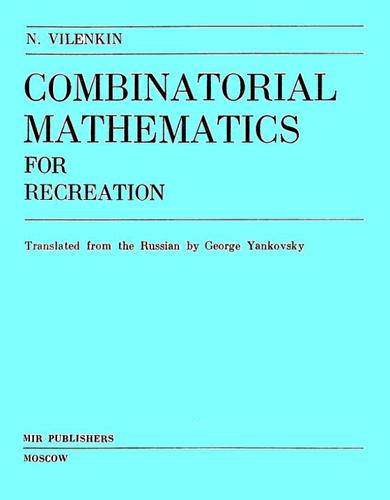
Combinatorial Mathematics for Recreation

N. Vilenkin

MIR Publishers | 1972 | 207 páginas | Djvu | 3,76 Mb

One Two Three Infinity: Facts and Speculations of Science


George Gamow

Dover Publications | 1988 | 340 páginas | PDF | 8,05 Mb


Nenhum link disponível

djvu - link

Over 120 delightful pen-and-ink illustrations by the author add another dimension of good-natured charm to these wide-ranging explorations. A mind-expanding volume for the layman and the science-minded. "This is a layman's book as readable as a historical novel, but every chapter bears the solid imprint of authoritative research."  — San Francisco Chronicle.

Mathematical Fun, Games and Puzzles


Jack Frohlichstein

Dover Publications | 1962 | 306 páginas | PDF | 3,26 Mb

djvu - 1,8 Mb
link
link1
link2

Following the content of the standard school curriculum, this book presents in 418 problems and diversions the basic ideas of arithmetic. Averages, fractions, decimals, percent, powers and roots, etc. Shortcuts, checking methods, also introduced in this enjoyable format. 120 illustrations.

Think of a Number

M. E. Lines

Taylor & Francis | 1990 | 172 páginas | PDF | 14 Mb

uploaded.net
link
link1
scribd.com

djvu - 1 Mb
link
link1

How many colors are needed to color a map? Must hailstones numbers always fall to the ground? Can statistics prove anything? What is a perfect square, and who has found the ultimate one? How do numbers affect national security? What kinds of problems confront the traveling salesman? Does anyone know how best to pack balls together? What is life like in 4 (or 3 1/2) dimensions? How does a clock count, and why should we care? What number secrets do sunflowers and pine cones conceal? What is a monster doing in mathematics?

These and many other fascinating questions about familiar numbers like 1, 2, and 3 are explored in Malcolm Line's second adventure into the world of numbers. Written in a lively and readable style, Think of a Number relates the story of some of the most famous problems that have confronted the world's experts over the centuries, from the earliest interests of the ancient Greeks to the very cutting-edge of modern research involving today's most powerful computers. The book explores the relationship between numbers and nature in its broadest sense and discovers the beauty of fractals and chaos. Requiring little or no prior knowledge of mathematics, this resource will be fascinating reading for anyone with an interest in numbers and their role in the natural world.

Contents
1 Introduction 1
2 The Fibonacci family and friends 6
3 Rising and falling with the hailstone numbers 20
4 Lies, damned lies, and statistics 29
5 The pluperfect square; an ultimate patio decor 40
6 The trouble with Euclid's fifth 49
7 Clock numbers; an invention of the master 60
8 Cryptography; the science of secret writing 71
9 Numbers and national security 81
10 Are four colours enough? 91
11 Rulers, ominoes, and Professor Golomb 101
12 What on earth is an NP problem? 109
13 How many balls can you shake into a can? 119
14 In-between dimensions 130
15 The road to chaos 139
16 Super-mathematics and the monster 148
Bibliography 159

A smoother pebble: Mathematical explorations

Donald C. Benson

Oxfоrd Univеrsity Prеss | 266 páginas | 2003 | PDF | 9,74 Mb

link


This book takes a novel look at the topics of school mathematics--arithmetic, geometry, algebra, and calculus. In this stroll on the mathematical seashore we hope to find, quoting Newton, "...a smoother pebble or a prettier shell than ordinary..." This book assembles a collection of mathematical pebbles that are important as well as beautiful.

Introduction
I. BRIDGING THE GAP
1. The Ancient Fractions
2. Greek Gifts
3. The Music of the Ratios
II. THE SHAPE OF THINGS
4. Tubeland
5. The Calculating Eye
III. THE GREAT ART
6. Algebra Rules
7. The Root of the Problem
8. Symmetry Without Fear
9. The Magic Mirror
IV. A SMOOTHER PEBBLE
10. On the Shoulders of Giants
11. Six-Minute Calculus
12. Roller-Coaster Science
Glossary
References
Index