domingo, 22 de abril de 2012

Elementary and Middle School Mathematics: Teaching Developmentally

John A. Van de Walle

7.ª edição

Allyn & Bacon | 2009 | 576 páginas | PDF | 16 Mb

libgen.info

This leading K-8 math methods text has the most coverage of the NCTM Standards, the strongest coverage of middle school mathematics, and the highest student approval of any text currently available.

Elementary and Middle School Mathematics:  Teaching Developmentally provides an unparalleled depth of ideas and discussion to help students develop a real understanding of the mathematics they will teach. This text reflects the NCTM Principles and Standards and the benefits of constructivist—or student-centered—mathematics instruction. It is structured for maximum flexibility, offering 23 brief, compartmentalized chapters that may be mixed and matched to fit any course or teaching approach.  Practical and concise, it offers readers a strong theoretical perspective of how children learn mathematics and then shows them the best way to teach it. 

The text is organized into two sections.  The first section introduces trends in mathematics education and the process of doing mathematics.  It then develops the core ideas of learning, teaching, planning, and assessment.  Additional perspectives on mathematics for special children and the role of technology are also discussed.  Chapters 3 and 4 are the most critical as they describe the constructivist view of learning and how it is applied as well as what it means to teach through problem solving. 

Section II serves as the application of the core ideas in Section I.  Chapters on every major area of content in the K-8 mathematics curriculum are included.  Numerous problem-based activities to engage students are interwoven with a discussion of the mathematical content and how children develop their understanding of that content.   The appendices at the end of the book provide additional information on the Principles and Standards of the NCTM, the Professional Standards, and Guides for Blackline Masters and suggestions for use of construction materials. 

Both a comprehensive textbook and a reference as students begin their teaching careers; Van de Walle’s book will help teachers and students alike to find the excitement that happens when mathematics makes sense.

Table of Contents
  1. Teaching Mathematics in the Era of the NCTM Standards
  2. Exploring What it Means to Do Mathematics and Developing Understanding in Mathematics
  3. Teaching Through Problem Solving
  4. Planning in the Problem-Based Classroom
  5. Building Assessment Into Instruction
  6. Teaching Mathematics Equitably to All children
  7. Technology and School Mathematics
  8. Developing Early Number Concepts and Number Sense
  9. Developing Meanings for the Operations
  10. Helping Children Master the Basic Facts
  11. Whole-Number Place-Value Development
  12. Strategies for Whole-Number Computation
  13. Computational Estimation with Whole Numbers
  14. Algebraic Thinking: Generalizations, Patterns, and Functions
  15. Developing Fraction Concepts
  16. Computation with Fractions
  17. Decimal and Percentage Concepts and Decimal Computation
  18. Proportional Reasoning
  19. Developing Measurement Concepts
  20. Geometric Thinking and Geometric Concepts
  21. Concepts of Data Analysis
  22. Exploring Concepts of Probability
  23. Developing Concepts of Exponents, Integers, and Real Numbers

sexta-feira, 20 de abril de 2012

Mathematical Problem Solving

Alan Schoenfeld

Academic Press | 409 páginas | 1985 |  PDF | 3 Mb (no OCR)

link
link1

djvu | 3,49 Mb (OCR)
link
depositfiles.com

Schoenfeld outlines four categories needed to characterize someones problem solving skills. They are resources, heuristics, control and beliefs. Discussion and examples are given in detail about these categories. It has been very thorough and useful to me.

terça-feira, 17 de abril de 2012

Smart Shopping Math


Lucia McKay

Saddleback Educational Publishing, Inc. | 2005 | 104 páginas | PDF | 2,5 MB

link
link1

Welcome to Smart Shopping! This is Book 5 of the Practical Math in Context series.
The goal of this book and the other books in this series is to build your confidence and practical math skills. You will use these math skills in everyday situations throughout your life. You solve problems and make mathematical decisions every day. You compare products and make choices about what to buy. You work to earn money. You decide what to spend and how much to save.
Practical Math in Context gives you strategies to solve everyday math problems in a variety of ways. It strengthens your skills and gives you practice with many different math topics. Each of the six books presents topics you are likely to encounter in everyday life. Each book includes problems that involve estimation, equations, mental math, calculators, and critical thinking. Each book includes additional topic-specific skills such as graphing, averages, statistics, ratios, and measurement.
Each unit begins with a preview lesson, which models and explains the types of problems you will encounter in the unit. Then there are five lessons, at least one of which is usually a game. Each unit ends with a review of the unit concepts. There are illustrations and graphic art throughout.

Smart Shopping Teacher Notes
Mary Ann Frishman

Saddleback Educational Publishing, Inc. | 2005 | 8 páginas |  pdf | 1,2 Mb

link
link1


Home & School Math


Lucia McKay

(Practical Math in Context)

Saddleback Educational Publishing, Inc. | 2011 | 114 páginas |  PDF  | 1,37 Mb

uploading.com

2005 | 104 páginas |  Pdf | 1,7 Mb

depositfiles.com


Practical Math in Context gives you strategies to solve everyday math problems in a variety of ways. It strengthens your skills and gives you practice with many different math topics. Each of the six books presents topics you are likely to encounter in everyday life. Each book includes problems that involve estimation, equations, mental math, calculators, and critical thinking. Each book includes additional topic-specific skills such as graphing, averages, statistics, ratios, and measurement.

Home & School Math Teacher Notes
Mary Ann Frishman

Saddleback Educational Publishing, Inc. | 2005 | 7 páginas |  pdf | 1 Mb

link
link1


Focus in High School Mathematics: Reasoning and Sense Making

Gary Martin

National Council of Teachers of Mathematics | 2009 | 129 páginas | PDF | 3,39 Mb

link
uploading.com
depositfiles.com

PDF - 4 Mb

edwebsfiles.ed.uiuc.edu (link direto)
education.illinois.edu (link direto)

Addressing the direction of high school mathematics in the 21st century, this resource builds on the ideas of NCTM s Principles and Standards for School Mathematics and focuses on how high school mathematics can better prepare students for future success.

Reasoning and sense making are at the heart of the high school curriculum. Discover the components of mathematical reasoning and sense making in grades 9-12, including:

- Reasoning habits that instruction should develop across the curriculum

- Key elements for reasoning in five content strands 

- Examples that illustrate the roles of teachers and students in the classroom

Focus in High School Mathematics aims to bring together teachers, administrators, supervisors, and curriculum specialists to reshape the conversation about high school mathematics and shift the curriculum toward an emphasis on reasoning and sense making for all students.

Which Way Social Justice in Mathematics Education?


(International Perspectives on Mathematics Education)

Leone Burton

Praeger |  2003  | 344 páginas | PDF | 10,15 Mb

link

This contributed volume explores equity and social justice within the field of mathematics education. In part one, Helga Jungwirth's introductory chapter provides a strong theoretical overview that is based in actual classroom behaviors and a typology that classifies the various interpretations found within this volume. Also in part one, Laurie Hart discusses developments in equity research in the United States. Part two focuses on results of studies about social justice and their impact on learning in mathematics classrooms in various parts of the world. For example, in a chapter on Peru, social justice does not just encompass gender, but also inequalities in opportunities to learn, such as problems of resources, living and social conditions, communal demands and language needs. And, part three focuses on computers as a resource to mathematics teaching.
The contributors raise several important social justice issues which have previously remained unresearched. Although there are a number of chapters specifically dealing with gender, many of the authors use one of the following strategies: their gender-specific questions are set in a wider socio-cultural context, they challenge what have threatened to become false orthodoxies, or they raise other important issues. These other issues include the meaning of democratic citizenship for mathematics classrooms, the links between parents and children learning mathematics, and the preconceptions of some teachers of underprivileged students in Australia. Other chapters explore different forms of classroom communication, participation, and assessment. The pieces on computers state that there is still not enough research to conclude whether computers in the mathematics classrooms are supportive of, or detrimental to, the learning of all students. The one thing on which every author in this volume does agree is that social justice in mathematics education has still not been attained, but that we must strive toward it to improve educational practices and society in general.

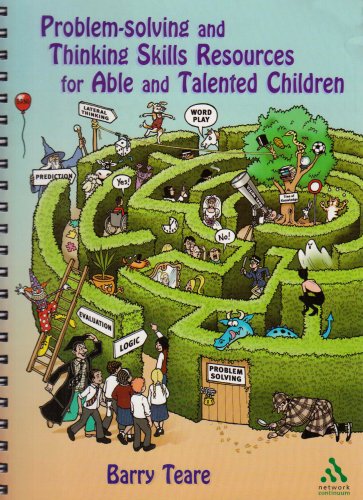
Problem-solving and Thinking Skills Resources for Able and Talented Children

Barry Teare

Network Continuum Education | 2006 | 244 páginas | 10,66 Mb


This treasure trove of resources is divided into ten themed sections, each preceded by an outline giving the key principles, links with curriculum guidelines and an explanation about the importance of the particular skill. Charts at the beginning of the book summarize curriculum links and skills involved. Each photocopiable activity is accompanied by teachers' notes, and fully explained solutions are given where appropriate