segunda-feira, 9 de abril de 2012

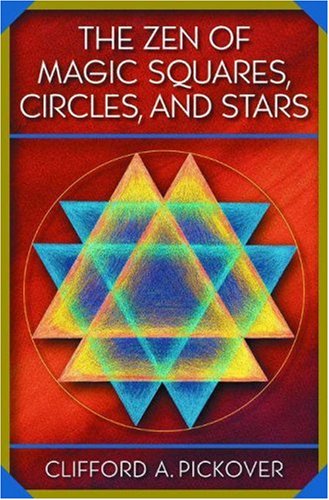
The Zen of Magic Squares, Circles, and Stars: An Exhibition of Surprising Structures across Dimensions.


Clifford A. Pickover

Princeton University Press | 2002 | 400 páginas | PDF | 4,8 Mb

link
uploading.com

Humanity's love affair with mathematics and mysticism reached a critical juncture, legend has it, on the back of a turtle in ancient China. As Clifford Pickover briefly recounts in this enthralling book, the most comprehensive in decades on magic squares, Emperor Yu was supposedly strolling along the Yellow River one day around 2200 B.C. when he spotted the creature: its shell had a series of dots within squares. To Yu's amazement, each row of squares contained fifteen dots, as did the columns and diagonals. When he added any two cells opposite along a line through the center square, like 2 and 8, he always arrived at 10. The turtle, unwitting inspirer of the ''Yu'' square, went on to a life of courtly comfort and fame.
Pickover explains why Chinese emperors, Babylonian astrologer-priests, prehistoric cave people in France, and ancient Mayans of the Yucatan were convinced that magic squares--arrays filled with numbers or letters in certain arrangements--held the secret of the universe. Since the dawn of civilization, he writes, humans have invoked such patterns to ward off evil and bring good fortune. Yet who would have guessed that in the twenty-first century, mathematicians would be studying magic squares so immense and in so many dimensions that the objects defy ordinary human contemplation and visualization?
Readers are treated to a colorful history of magic squares and similar structures, their construction, and classification along with a remarkable variety of newly discovered objects ranging from ornate inlaid magic cubes to hypercubes. Illustrated examples occur throughout, with some patterns from the author's own experiments. The tesseracts, circles, spheres, and stars that he presents perfectly convey the age-old devotion of the math-minded to this Zenlike quest. Number lovers, puzzle aficionados, and math enthusiasts will treasure this rich and lively encyclopedia of one of the few areas of mathematics where the contributions of even nonspecialists count.

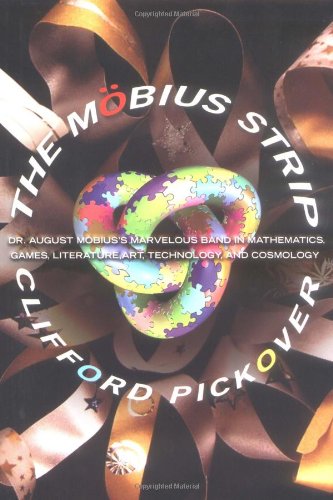
The Mobius Strip: Dr. August Mobius's Marvelous Band in Mathematics, Games, Literature, Art, Technology, and Cosmology

Clifford A. Pickover

Thunder's Mouth Press  | 2006 | 304 páginas | Djvu | 2,93 Mb


The road that leads from the Möbius strip—a common-sense-defying continuous loop with only one side and one edge, made famous by the illustrations of M.C. Escher—goes to some of the strangest spots imaginable. It takes us to a place where the purely intellectual enters our daily world: where our outraged senses, overloaded with grocery bills, the price of gas, and what to eat for lunch, are expected to absorb really bizarre ideas. And no better guide to this weird universe exists than the brilliant thinker Clifford A. Pickover, the 21st century's answer to Buckminster Fuller. Come along as Pickover traces the origins of the Möbius strip from the mid-1800s, when the visionary scientist Dr. August Möbius became the first to describe the properties of one-sided surfaces, to the present, where it is an integral part of mathematics, magic, science, art, engineering, literature, and music. It has become a metaphor for change, strangeness, looping, and rejuvenation. Touching on everything from molecules and metal sculptures to postage stamps, architectural structures, and models of our entire universe, The Möbius Strip is lavishly illustrated and gives readers a glimpse into other worlds and new ways of thinking as Pickover reaches across cultures and dimensions.

Keys to Infinity

Clifford A. Pickover

Wiley | 1995 | 352 páginas

PDF - 5,94 Mb

link

djvu - 4 Mb
link
uploading.com

"An original and exciting exploration of how utterly weird, and utterly beautiful, the infinite can be."-Ian Stewart, author of Does God Play Dice?
What can we know about numbers too large to compute or even imagine? Do the tiny bubbles in the froth of a milkshake actually form an infinite fractal pattern? What are apocalyptic numbers and recursive worlds? These and dozens of equally beguiling mathematical mysteries, problems, and paradoxes fill this mind-bending new book.
In each chapter, acclaimed author Clifford Pickover poses a delightful brain-teasing challenge that reveals the scope and splendor of the world of infinity. Try scaling the ladders to heaven, playing a game of infinite chess, or escaping from the land of Fractalia. Along the way you will encounter a myriad of intriguing topics from vampire numbers, to abduction algebra, to the infinity worms of Callisto.
Every problem and puzzle is presented in a remarkably accessible style requiring no specialized mathematical knowledge. Over one hundred illustrations enhance the text and help to explain the mathematical concepts, and stunning color images created by the author reveal the breathtaking beauty of the patterns of infinity. A variety of computer programs offer additional ways to penetrate the enigma of infinity.
For anyone who has ever wondered just how big infinity really is, or just how small, this book will provide an endless source of insight, creativity, and fun.
Advance praise for
KEYS TO INFINITY
"In this the latest of Dr. Pickover's marvelous books, he breaks all finite chains to soar into the transcendental, mind-boggling regions of mathematical infinity. Written in the author's informal, clear style, it is a treasure trove of recreational problems, many published here for the first time, with special emphasis on computer programs and riveting graphics. As you soar, fasten your seat belt."-Martin Gardner, author of The Magic Numbers of Dr. Matrix
"Inventive, quirky, fun! Pickover presents an engaging, inspiring romp in the realm of number and mathematical thought."-Ivars Peterson, author of The Mathematical Tourist
"Join Pickover on his wonderful merry-go-round of ideas, and reach for the infinite. Keys to Infinity is an engaging book. . .a must for those wishing to explore the infinite in all its manifestations."-Theoni Pappas, author of The Joy of Mathematics
"Keys to Infinity contains a near infinity of absorbing themes: from stepladders to the moon and spiral earths, to worm worlds, random chords, and self-similar curlicues. Fascinating!"-Manfred Schroeder, author of Fractals, Chaos, Power Laws
"What could be more appropriate to the subject of infinity than a book like this one, so dense with wonderful puzzles, anecdotes, images, and computer programs that you could pore over it forever? In Keys to Infinity, Pickover has once again assembled a mathematical feast."-Carl Zimmer, Senior Editor Discover
"Cliff Pickover has produced yet another book of mathematical puzzles, weird facts, computer art, and simple programs to challenge our minds and enthrall us with the beauty of the infinite mathematical world in which we live."-Dr. Julien C. Sprott, author of Strange Attractors

What Does Understanding Mathematics Mean for Teachers?: Relationship as a Metaphor for Knowing


 (Studies in Curriculum Theory Series)

Yuichi Handa

Springer | 2011 | 168 páginas | PDF | 668 kb

link

epub - 279 kb

link
uploading.com

This book opens up alternative ways of thinking and talking about ways in which a person can "know" a subject (in this case, mathematics), leading to a reconsideration of what it may mean to be a teacher of that subject.
In a number of European languages, a distinction is made in ways of knowing that in the English language is collapsed into the singular word know. In French, for example, to know in the savoir sense is to know things, facts, names, how and why things work, and so on, whereas to know in the connaître sense is to know a person, a place, or even a thing—namely, an other— in such a way that one is familiar with, or in relationship with this other. Primarily through phenomenological reflection with a touch of empirical input, this book fleshes out an image for what a person’s connaître knowing of mathematics might mean, turning to mathematics teachers and teacher educators to help clarify this image.


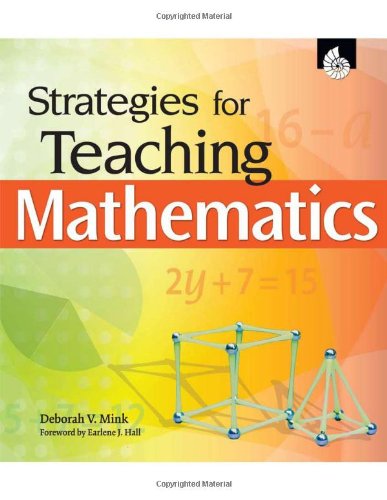
Strategies for Teaching Mathematics

Mink Deborah V.

Shell Education | 2009 | 320 páginas | PDF | 3,9 Mb

link
link1
link2
uploading.com
depositfiles.com

Build students' understanding of mathematical concepts. Choose from a wide range of easy-to-implement strategies and model lessons that enhance mathematics instruction.
Topics include:
  • using manipulatives
  • developing mathematical vocabulary
  • teaching procedures
  • developing problem solving abilities
  • using games
  • assessing mathematics thinking
Differentiation is included in every lesson as well as current research and background information. Includes Teacher Resource CD with reproducibles including rubrics and assessments.

Early Numeracy: Mathematical activities for 3 to 5 year olds

Este resumo não está disponível. Clique aqui para ver a mensagem.

Algebra: Sets, Symbols, and the Language of Thought

(The History of Mathematics)
JohnTabak

Facts on File | 2011 | 236 páginas | PDF | 3 Mb

link
link1

For thousands of years, algebra consisted solely of expanding the list of problem-solving algorithms-a list of procedures similar in concept to the quadratic formula. But much of contemporary algebra focuses on identifying and describing the logical structures upon which mathematics is built. It is now clear that identifying and exploiting these structures is just as important for mathematical and scientific progress as the development of new algorithms. Algebra, Revised Editiondescribes the history of both strands of algebraic thought. This updated resource describes some of the earliest progress in algebra as well as some of the mathematicians in Mesopotamia, Egypt, China, and Greece who contributed to this early period. It goes on to explore the many breakthroughs in algebraic techniques as well as how letters were used to represent numbers. New material has been added to the chapter on "modern" algebra, a type of mathematical research that continues to occupy the attention of many mathematicians today. “

Contents
Preface x
Acknowledgments xvi
Introduction xvii
1 The First Algebras 1
Mesopotamia: The Beginnings of Algebra 1
Mesopotamians and Second-Degree Equations 5
The Mesopotamians and Indeterminate Equations 7
Clay Tablets and Electronic Calculators 8
Egyptian Algebra 10
Chinese Algebra 12
Rhetorical Algebra 15
2 Greek Algebra 18
The Discovery of the Pythagoreans 20
The Incommensurability of √2 24
Geometric Algebra 25
Algebra Made Visible 27
Diophantus of Alexandria 31
3 Algebra from India to Northern Africa 34
Brahmagupta and the New Algebra 36
Mahavira 40
Bhaskara and the End of an Era 42
Poetry and Algebra 45
Islamic Mathematics 45
Al-Khwa¯rizmı¯ and a New Concept of Algebra 48
A Problem and a Solution 52
Omar Khayyám, Islamic Algebra at Its Best 52
Leonardo of Pisa 57
4 Algebra as a Theory of Equations 58
The New Algorithms 61
Algebra as a Tool in Science 67
François Viète, Algebra as a Symbolic Language 68
Thomas Harriot 73
Albert Girard 75
The Fundamental Theorem of Algebra 77
The Importance of Polynomials 81
5 Algebra in Geometry and Analysis 83
René Descartes 85
Descartes on Multiplication 88
Pierre de Fermat 92
Fermat’s Last Theorem 95
The New Approach 97
Polar Coordinates 98
6 The Search for New Structures 102
Niels Henrik Abel 104
Évariste Galois 106
Galois Theory and the Doubling of the Cube 109
Doubling the Cube with a Straightedge and Compass
Is Impossible 112
Algebraic Structures 114
The Importance of Group Theory 120
7 The Laws of Thought 124
Aristotle 124
George Boole and the Laws of Thought 127
Boolean Algebra 131
Aristotle and Boole 135
Refining and Extending Boolean Algebra 136
Boolean Algebra and Computers 139
8 The Theory of Matrices and Determinants 142
Early Ideas 144
Spectral Theory 148
The Theory of Matrices 157
Matrix Multiplication 163
Emmy Noether and the Theory of Rings 165
Nicolas Bourbaki and Mathematical Structure 169
The Problem Solvers 172
Conclusion 179
Afterword: An Interview with Dr. Bonita Saunders
on the Digital Library of Mathematical Functions 181
Chronology 193
Glossary 210
Further Resources 215
Index 225