domingo, 25 de março de 2012

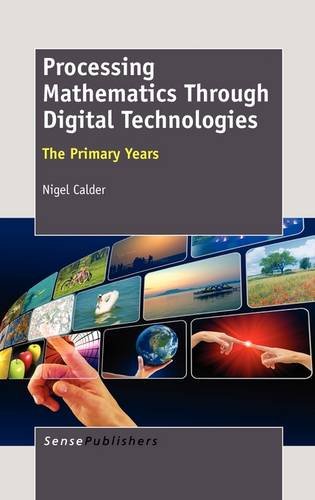
Processing Mathematics Through Digital Technologies: The Primary Years

Nigel Calder

Sense Publishers | 2011 | 150 Páginas| PDF |1,95 MB

link
filepost.com

Digital technologies permeate our lives. We use them to communicate, research, process, record, and for entertainment. They influence the way we interact in the world, the way we live. Digital technologies also offer the potential to transform the nature of the learning process in mathematics. The learning environment, the types of tasks learners can engage with, and the nature of that engagement differs from working in other environments. The Internet, for instance, presents greater scope for child-centered, inquiry-based learning. Dynamic geometry software and GoogleEarth offer interactive ways of exploring shape, position and space that is not possible with the pencil-and-paper medium. This book provides insights into how mathematical understanding emerged for primary-aged children (5-13 years) when they investigated mathematical tasks through digital media. It considers learning theories that are frequently used in mathematics education, and situates a contemporary interpretive approach within those perspectives. A key purpose was to provide some practical tasks for teachers/teacher educators to incorporate digital technologies into their mathematics programmes, tasks that have been used successfully for learning. This is a significant reference book for primary-school teacher education and a valuable resource for all schools teaching at that age.

Precalculus: Functions and Graphs

4.ª Edição

Mark Dugopolski

Addison Wesley | 2012 | 960 páginas | PDF | 27,8 Mb

  Dugopolski’s Precalculus: Functions and Graphs, Fourth Edition gives students the essential strategies they need to make the transition to calculus. The author’s emphasis on problem solving and critical thinking is enhanced by the addition of 900 exercises including new vocabulary and cumulative review problems. Students will find carefully placed learning aids and review tools to help them learn the math without getting distracted. Along the way, students see how the algebra connects to their future calculus courses, with tools like Foreshadowing Calculus and Concepts of Calculus.


Table of Contents
P. Prerequisites
P.1 Real numbers and Their Properties
P.2 Integral Exponents and Scientific Notation
P.3 Rational Exponents and Radicals
P.4 Polynomials
P.5 Factoring Polynomials
P.6 Rational Expressions
P.7 Complex Numbers
Chapter P Highlights
Chapter P Review Exercises
Chapter P Test

1. Equations, Inequalities, and Modeling
1.1 Equations in One Variable
1.2 Constructing Models to Solve Problems
1.3 Equations and Graphs in Two Variables
1.4 Linear Equations in Two Variables
1.5 Scatter Diagrams and Curve Fitting
1.6 Complex Numbers
1.7 Quadratic Equations
1.8 Linear and Absolute Value Inequalities
Chapter 1 Highlights
Chapter 1 Review Exercises
Chapter 1 Test
Concepts of Calculus: Limits

2. Functions and Graphs
2.1 Functions
2.2 Graphs of Relations and Functions
2.3 Families of Functions, Transformations, and Symmetry
2.4 Operations with Functions
2.5 Inverse Functions
2.6 Constructing Functions with Variation
Chapter 2 Highlights
Chapter 2 Review Exercises
Chapter 2 Test
Tying it all Together
Concepts of Calculus: Instantaneous Rate of Change

3. Polynomial and Rational Functions
3.1 Quadratic Functions and Inequalities
3.2 Zeroes of Polynomial Functions
3.3 The Theory of Equations
3.4 Miscellaneous Equations
3.5 Graphs of Polynomial Functions
3.6 Rational Functions and Inequalities
Chapter 3 Highlights
Chapter 3 Review Exercises
Chapter 3 Test
Tying it all Together
Concepts of Calculus: Instantaneous Rate of Change of the Power Functions

4. Exponential and Logarithmic Functions
4.1 Exponential Functions and Their Applications
4.2 Logarithmic Functions and Their Applications
4.3 Rules of Logarithms
4.4 More Equations and Applications
Chapter 4 Highlights
Chapter 4 Review Exercises
Chapter 4 Test
Tying it all Together
Concepts of Calculus: The Instantaneous Rate of Change of f(x)= ex

5. The Trigonometric Functions
5.1 Angles and Their Measurements
5.2 The Sine and Cosine Functions
5.3 The Graphs of the Sine and Cosine Functions
5.4 The Other Trigonometric Functions and Their Graphs
5.5 The Inverse Trigonometric Functions
5.6 Right Triangle Trigonometry
Chapter 5 Highlights
Chapter 5 Review Exercises
Chapter 5 Test
Tying it all Together
Concepts of Calculus: Evaluating Transcendental Functions

6. Trigonometric Identities and Conditional Equations
6.1 Basic Identities
6.2 Verifying Identities
6.3 Sum and Difference Identities
6.4 Double-Angle and Half-Angle Identities
6.5 Product and Sum Identities
6.6 Conditional Trigonometric Equations
Chapter 6 Highlights
Chapter 6 Review Exercises
Chapter 6 Test
Tying it all Together
Concepts of Calculus: Area of a Circle and π

7. Applications of Trigonometry
7.1 The Law of Sines
7.2 The Law of Cosines
7.3 Vectors
7.4 Trigonometric Form of Complex Numbers
7.5 Powers and Roots of Complex and Numbers
7.6 Polar Equations
Chapter 7 Highlights
Chapter 7 Review Exercises
Chapter 7 Test
Tying it all Together
Concepts of Calculus: Limits and Asymptotes

8. Systems of Equations and Inequalities
8.1 Systems of Linear Equations in Two Variables
8.2 Systems of Linear Equations in Three Variables
8.3 Nonlinear Systems of Equations
8.4 Partial Fractions
8.5 Inequalities and Systems of Inequalities in Two Variables
8.6 The Linear Programming Model
Chapter 8 Highlights
Chapter 8 Review Exercises
Chapter 8 Test
Tying it all Together
Concepts of Calculus: Instantaneous Rate of Change and Partial Fractions

9. Matrices and Determinants
9.1 Solving Linear Systems Using Matrices
9.2 Operations with Matrices
9.3 Multiplication of Matrices
9.4 Inverses of Matrices
9.5 Solution of Linear Systems in Two Variables Using Determinants
9.6 Solution of Linear Systems in Three Variables Using Determinants
Chapter 9 Highlights
Chapter 9 Review Exercises
Chapter 9 Test
Tying it all Together

10. The Conic Sections
10.1 The Parabola
10.2 The Ellipse and the Circle
10.3 The Hyperbola
10.4 Rotation of Axes
10.5 Polar Equations of the Conics
Chapter 10 Highlights
Chapter 10 Review Exercises
Chapter 10 Test
Tying it all Together
Concepts of Calculus: The Reflection Property of a Parabola

11. Sequences, Series, and Probability
11.1 Sequences
11.2 Series
11.3 Geometric Sequences and Series
11.4 Counting and Permutations
11.5 Combinations, Labeling, and the Binomial Theorem
11.6 Probability
11.7 Mathematical Induction
Chapter 11 Highlights
Chapter 11 Review Exercises
Chapter 11 Test
Concepts of Calculus: Limits of Sequences

A. Appendix: Basic Algebra Review
A.1 Real Numbers and Their Properties
A.2 Exponents and Radicals
A.3 Polynomials
A.4 Factorials Polynomials
A.5 Rational Expressions

B. Appendix: Solutions to Try This Exercises
Credits
Answers to Selected Exercises
Index of Applications
Index
Fear of Math: How to Get over It and Get on With Your Life

Claudia Zaslavsky

Rutgers University Press | 1994 | 264 páginas | Djvu | 4 Mb

This book about mathematics anxiety focuses on many factors in society that bring about fear and avoidance of mathematics, and the influence of these factors on various groups in the population. The book begins with several stories of people who have suffered from or overcome mathematics anxiety, followed by a chapter giving reasons for overcoming it, including many real-life examples where an understanding of mathematics is necessary. The next chapter discusses myths of innate inferiority, including spatial ability, the Scholastic Aptitude Test, timed tests, intelligence tests, and needed research. In chapter 4 gender, race, ethnicity, and class are discussed. The next two chapters discuss mathematics in schools and school math versus real math. Chapter 7 includes strategies for overcoming fear and avoidance of mathematics and how to accommodate unique learning styles. The next chapter discusses how families and parents can help their children be more successful in mathematics. The last chapter is a call for a more humane mathematics that will serve all people. A list of intervention programs, organizations and government agencies, distributors of mathematics books and materials, and a select bibliography are included.

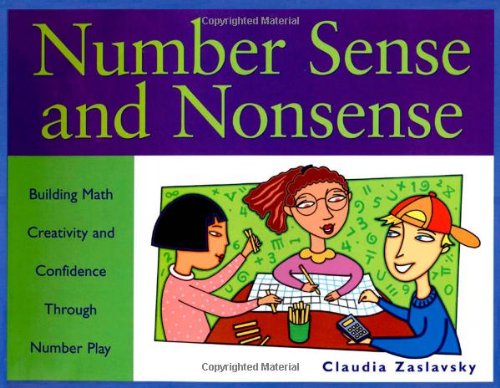
Number Sense and Nonsense: Building Math Creativity and Confidence Through Number Play

Claudia Zaslavsky

Chicago Review Press | 2001 | 160 páginas | PDF | 7,09 Mb

link
link1

These 80-plus math activities and number games help kids to think critically about math instead of just memorizing rules. The emphasis is on the underlying relationships between numbers and the process of manipulating them. Kids get together and play games with odd and even numbers, prime and composite numbers, factors, divisors, and multiples of numbers, common and decimal fractions. Children learn the history of numbers—finger counting, number symbols in various cultures, and different ways of calculating. The book is full of riddles, puzzles, number tricks, and calculator games. Kids develop skills in estimation and computation as they become familiar with the characteristics and behavior of numbers. They will gain math confidence and be ready to take chances, find their own errors, and challenge their peers.

More Math Games & Activities from Around the World

Claudia Zaslavsky

Chicago Review Press | 2003 | 176 páginas | PDF | 6,91 Mb

link
uploading.com

Math, history, art, and world cultures come together in this delightful book for kids, even for those who find traditional math lessons boring. More than 70 games, puzzles, and projects encourage kids to hone their math skills as they calculate, measure, and solve problems. The games span the globe, and many have been played for thousands of years, such as three-in-a-row games like Achi from Ghana or the forbidden game of Jirig from Mongolia. Also included are imaginative board games like Lambs and Tigers from India and the Little Goat Game from Sudan, or bead and string puzzles from China, and Möbius strip puzzles from Germany. Through compelling math play, children will gain confidence and have fun as they learn about the different ways people around the world measure, count, and use patterns and symmetry in their everyday lives.

Famous Puzzles of Great Mathematicians

Miodrag Petković

American Mathematical Society | 2009 | 325 páginas | PDF | 11 Mb


This entertaining book presents a collection of 180 famous mathematical puzzles and intriguing elementary problems that great mathematicians have posed, discussed, and/or solved. The selected problems do not require advanced mathematics, making this book accessible to a variety of readers. Mathematical recreations offer a rich playground for both amateur and professional mathematicians. Believing that creative stimuli and aesthetic considerations are closely related, great mathematicians from ancient times to the present have always taken an interest in puzzles and diversions. The goal of this book is to show that famous mathematicians have all communicated brilliant ideas, methodological approaches, and absolute genius in mathematical thoughts by using recreational mathematics as a framework. Concise biographies of many mathematicians mentioned in the text are also included. The majority of the mathematical problems presented in this book originated in number theory, graph theory, optimization, and probability. Others are based on combinatorial and chess problems, while still others are geometrical and arithmetical puzzles. This book is intended to be both entertaining as well as an introduction to various intriguing mathematical topics and ideas. Certainly, many stories and famous puzzles can be very useful to prepare classroom lectures, to inspire and amuse students, and to instill affection for mathematics.

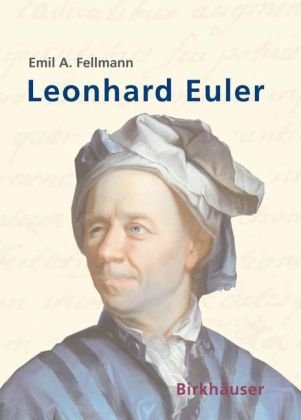
Leonhard Euler

Emil A. Fellmann

Birkhäuser Basel | 2010  | 185 páginas | PDF  | 5,32 Mb

Euler was not only by far the most productive mathematician in the history of mankind, but also one of the greatest scholars of all time. He attained, like only a few scholars, a degree of popularity and fame which may well be compared with that of Galilei, Newton, or Einstein.
Moreover he was a cosmopolitan in the truest sense of the word; he lived during his first twenty years in Basel, was active altogether for more than thirty years in Petersburg and for a quarter of a century in Berlin.
Leonhard Euler’s unusually rich life and broadly diversified activity in the immediate vicinity of important personalities which have made history, may well justify an exposition.
This book is based in part on unpublished sources and comes right out of the current research on Euler. It is entirely free of formulae as it has been written for a broad audience with interests in the history of culture and science.