quinta-feira, 8 de março de 2012

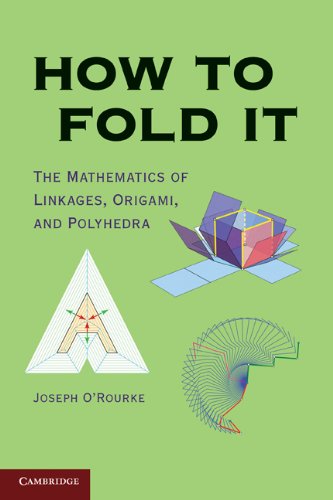
How to Fold It: The Mathematics of Linkages, Origami and Polyhedra


Joseph O'Rourke

Cambridge University Press | 2011 | 190 páginas | PDF | 16,6 Mb

link direto
link

What do proteins and pop-up cards have in common? How is opening a grocery bag different from opening a gift box? How can you cut out the letters for a whole word all at once with one straight scissors cut? How many ways are there to flatten a cube? You can answer these questions and more through the mathematics of folding and unfolding. From this book, you will discover new and old mathematical theorems by folding paper and find out how to reason toward proofs. With the help of 200 color figures, author Joseph O'Rourke explains these fascinating folding problems starting from high school algebra and geometry and introducing more advanced concepts in tangible contexts as they arise. He shows how variations on these basic problems lead directly to the frontiers of current mathematical research and offers ten accessible unsolved problems for the enterprising reader. Before tackling these, you can test your skills on fifty exercises with complete solutions. The book's Web site, http://www.howtofoldit.org, has dynamic animations of many of the foldings and downloadable templates for readers to fold or cut out.

Developmental Approach to Early Numeracy: Helping to Raise Children's Achievements and Deal with Difficulties in Learning

Carol Aubrey

Continuum | 2000 | 142 páginas | PDF | 5 Mb

link

Under-achievement in maths is a growing concern for many teachers. This book shows how a developmental approach to teaching maths can help to both identify difficulties and raise children’s achievement. Beginning with the Early Years, age – focused chapters outline some of the strategies that can be used to identify those in need of special teaching. Practical examples show how these strategies can be applied in classroom situations.
Beginning with the early years, age-focused chapters look at:
the knowledge children develop outside school
how teachers can assess and build on that knowledge
children's misunderstandings in maths, and how to remedy these.
This book also outlines some of the strategies that can be used to identify those in need of special teaching. Practical examples show you how these strategies can be applied in classroom situations. Each chapter is closely linked to the requirements of the National Numeracy Strategy, and example lesson plans and activities are included detailing ways of using recommended strategies within the numeracy hour

quarta-feira, 7 de março de 2012

Logic For Dummies

Mark Zegarelli

For Dummies | 2006 | 388 páginas | PDF

link direto
link
4shared.com

djvu - link


Logic concepts are more mainstream than you may realize. There's logic every place you look and in almost everything you do, from deciding which shirt to buy to asking your boss for a raise, and even to watching television, where themes of such shows as CSI and Numbers incorporate a variety of logistical studies. Logic For Dummies explains a vast array of logical concepts and processes in easy-to-understand language that make everything clear to you, whether you're a college student of a student of life. You'll find out about:

* Formal Logic
* Syllogisms
* Constructing proofs and refutations
* Propositional and predicate logic
* Modal and fuzzy logic
* Symbolic logic
* Deductive and inductive reasoning

Logic For Dummies tracks an introductory logic course at the college level. Concrete, real-world examples help you understand each concept you encounter, while fully worked out proofs and fun logic problems encourage you students to apply what you've learned.

terça-feira, 6 de março de 2012

Is God a Mathematician?


Mario Livio

Simon & Schuster | 2010 | 320 páginas | PDF | 3 Mb

link
ishare.iask

epub - 3 Mb
link
link1
link2

mobi - 4 Mb - link

Nobel Laureate Eugene Wigner once wondered about "the unreasonable effectiveness of mathematics" in the formulation of the laws of nature. Is God a Mathematician? investigates why mathematics is as powerful as it is. From ancient times to the present, scientists and philosophers have marveled at how such a seemingly abstract discipline could so perfectly explain the natural world. More than that -- mathematics has often made predictions, for example, about subatomic particles or cosmic phenomena that were unknown at the time, but later were proven to be true. Is mathematics ultimately invented or discovered? If, as Einstein insisted, mathematics is "a product of human thought that is independent of experience," how can it so accurately describe and even predict the world around us?
Mathematicians themselves often insist that their work has no practical effect. The British mathematician G. H. Hardy went so far as to describe his own work this way: "No discovery of mine has made, or is likely to make, directly or indirectly, for good or ill, the least difference to the amenity of the world." He was wrong. The Hardy-Weinberg law allows population geneticists to predict how genes are transmitted from one generation to the next, and Hardy's work on the theory of numbers found unexpected implications in the development of codes.
Physicist and author Mario Livio brilliantly explores mathematical ideas from Pythagoras to the present day as he shows us how intriguing questions and ingenious answers have led to ever deeper insights into our world. This fascinating book will interest anyone curious about the human mind, the scientific world, and the relationship between them.

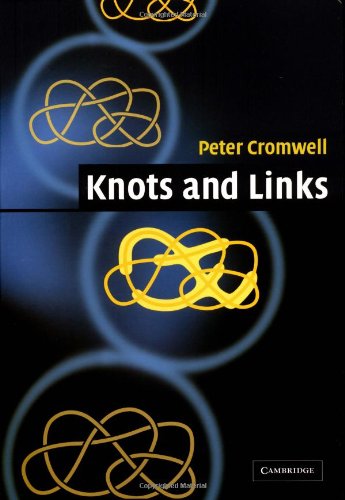
Knots and Links


Peter R. Cromwell

Cambridge | 2004 | 346 páginas | djvu | 3,8 Mb
link
link1
link2

djvu | 7,1 Mb - uploading.com

PDF - scribd.com

Knot theory is the study of embeddings of circles in space. Peter Cromwell has written a textbook on knot theory designed for use in advanced undergraduate or beginning graduate-level courses. The exposition is detailed and careful yet engaging and full of motivation. Numerous examples and exercises serve to help students through the material, while an instructor's manual is available online.

segunda-feira, 5 de março de 2012

Discrete mathematics and its applications


Kenneth Rosen

7.ª edição

McGraw-Hill Science | 2011 | 1072 páginas | PDF | 36 Mb


Discrete Mathematics and its Applications, Seventh Edition, is intended for one- or two-term introductory discrete mathematics courses taken by students from a wide variety of majors, including computer science, mathematics, and engineering. This renowned best-selling text, which has been used at over 500 institutions around the world, gives a focused introduction to the primary themes in a discrete mathematics course and demonstrates the relevance and practicality of discrete mathematics to a wide a wide variety of real-world applications…from computer science to data networking, to psychology, to chemistry, to engineering, to linguistics, to biology, to business, and to many other important fields.

domingo, 4 de março de 2012

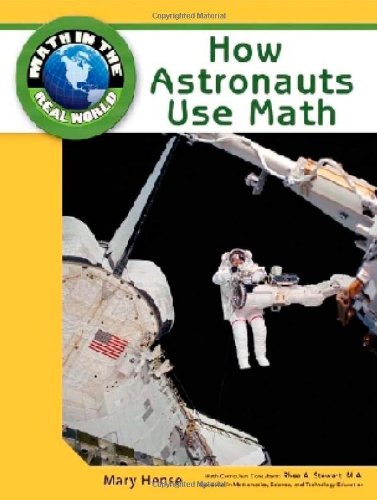
How Astronauts Use Math


Mary Hense

(Math in the Real World)

Chelsea Clubhouse | 2009 | 32 páginas | PDF | 1,9 Mb

When astronauts fly into space to conduct missions, it is made possible because of precise mathematical calculations, from how the spacecraft leaves Earth's atmosphere to how the astronauts pilot the craft. How Astronauts Use Math reveals how designers use math to calculate distance, speed, velocity, and their own safety when creating space-faring vehicles.

Concepts and skills emphasized include:
• Number Sense and Operations
• Problem Solving
• Estimation
• Measurement
• Data Analysis
• Algebraic Thinking
• Geometry and Spatial Sense.
About the Author(s)
Mary Hense always loved planes and spaceships. From her backyard in Florida, she watches rockets take off from the Kennedy Space Center more than 60 miles away.

Outros livros da mesma colecção:

How Deep Sea Divers Use Math

How Fighter Pilots Use Math