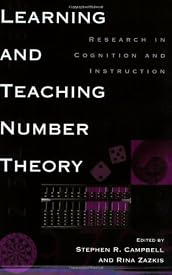
 (Mathematics, Learning, and Cognition: Monograph Series of the Journal of Mathematical Behavior)
Stephen R. Campbell, Rina Zazkis
Ablex Publishing | 2001 | 206 páginas | rar - pdf | 1,1 Mb
link (password: matav)
Number theory has been a perennial topic of inspiration and importance throughout the history of philosophy and mathematics. Despite this fact, surprisingly little attention has been given to research in learning and teaching number theory per se. This volume is an attempt to redress this matter and to serve as a launch point for further research in this area. Drawing on work from an international group of researchers in mathematics education, this volume is a collection of clinical and classroom-based studies in cognition and instruction on learning and teaching number theory. Although there are differences in emphases in theory, method, and focus area, these studies are bound through similar constructivist orientations and qualitative approaches toward research into undergraduate students' and preservice teachers' subject content and pedagogical content knowledge.
Collectively, these studies draw on a variety of cognitive, linguistic, and pedagogical frameworks that focus on various approaches to problem solving, communicating, representing, connecting, and reasoning with topics of elementary number theory, and these in turn have practical implications for the classroom. Learning styles and teaching strategies investigated involve number theoretical vocabulary, concepts, procedures, and proof strategies ranging from divisors, multiples, and divisibility rules, to various theorems involving division, factorization, partitions, and mathematical induction.
1 Toward Number Theory as a Conceptual Field 1
Stephen R. Campbell and Rina Zazkis
2 Coming to Terms with Division: Preservice Teachers’ Understanding 15
Stephen R. Campbell
3 Conceptions of Divisibility: Success and Understanding 41
Anne Brown, Karen Thomas, and Georgia Tolias
4 Language of Number Theory: Metaphor and Rigor 83
Rina Zazkis
5 Understanding Elementary Number Theory at the Undergraduate Level: A Semiotic Approach 97
Pier Luigi Ferrari
6 Integrating Content and Process in Classroom Mathematics 117
Anne R. Teppo
7 Patterns of Thought and Prime Factorization 131
Anne Brown
8 What Do Students Do with Conjectures? Preservice Teachers’ Generalizations on a Number Theory Task 139
Laurie D. Edwards and Rina Zazkis
9 Generic Proofs in Number Theory 157
Tim Rowland
10 The Development of Mathematical Induction as a Proof Scheme: A Model for DNR-Based Instruction 185
Guershon Harel
11 Reflections on Mathematics Education Research Questions in Elementary Number Theory 213
Annie Selden and John Selden
Author Index 231
Subject Index 235
About the Contributors 243
Outros livros da mesma autora, disponíveis no blog:


- Zazkis, R. & Campbell, S. R. (Eds). (2006). Number theory in mathematics education: Perspectives and prospects. Lawrence Erlbaum Press.
- Leikin, R. & Zazkis, R. (Eds.) (2010). Learning through Teaching Mathematics: Developing teachers’ knowledge and expertise in practice. Springer.
- Zazkis, R. (2011). Relearning mathematics: A challenge for prospective elementary school teachers. Information Age Publishing. Charlotte, NC.
Capítulos em livros, da mesma autora, disponíveis no blog:
- Zazkis, R. & Gadowsky, K. (2001). Attending to transparent features of opaque representations of natural numbers. In A. Cuoco (Ed.), NCTM 2001 Yearbook: The roles of representation in school mathematics (pp. 41-52). Reston, VA: NCTM.
- Zazkis, R. (2008). Divisibility and transparency of number representations. In M. P. Carlson & C. Rasmussen (Eds.), Making the Connection: Research and practice in undergraduate mathematics (pp. 81-92). MAA notes.