segunda-feira, 4 de outubro de 2010

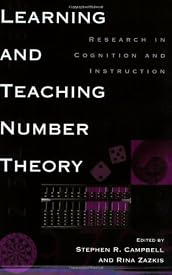
Learning and Teaching Number Theory: Research in Cognition and Instruction

(Mathematics, Learning, and Cognition: Monograph Series of the Journal of Mathematical Behavior)

Stephen R. Campbell, Rina Zazkis

Ablex Publishing | 2001 | 206 páginas  | rar - pdf | 1,1 Mb

link (password: matav)

Number theory has been a perennial topic of inspiration and importance throughout the history of philosophy and mathematics. Despite this fact, surprisingly little attention has been given to research in learning and teaching number theory per se. This volume is an attempt to redress this matter and to serve as a launch point for further research in this area. Drawing on work from an international group of researchers in mathematics education, this volume is a collection of clinical and classroom-based studies in cognition and instruction on learning and teaching number theory. Although there are differences in emphases in theory, method, and focus area, these studies are bound through similar constructivist orientations and qualitative approaches toward research into undergraduate students' and preservice teachers' subject content and pedagogical content knowledge.
Collectively, these studies draw on a variety of cognitive, linguistic, and pedagogical frameworks that focus on various approaches to problem solving, communicating, representing, connecting, and reasoning with topics of elementary number theory, and these in turn have practical implications for the classroom. Learning styles and teaching strategies investigated involve number theoretical vocabulary, concepts, procedures, and proof strategies ranging from divisors, multiples, and divisibility rules, to various theorems involving division, factorization, partitions, and mathematical induction.

Contents
1 Toward Number Theory as a Conceptual Field 1
Stephen R. Campbell and Rina Zazkis
2 Coming to Terms with Division: Preservice Teachers’ Understanding 15
Stephen R. Campbell
3 Conceptions of Divisibility: Success and Understanding 41
Anne Brown, Karen Thomas, and Georgia Tolias
4 Language of Number Theory: Metaphor and Rigor 83
Rina Zazkis
5 Understanding Elementary Number Theory at the Undergraduate Level: A Semiotic Approach 97
Pier Luigi Ferrari
6 Integrating Content and Process in Classroom Mathematics 117
Anne R. Teppo
7 Patterns of Thought and Prime Factorization 131
Anne Brown
8 What Do Students Do with Conjectures? Preservice Teachers’ Generalizations on a Number Theory Task 139
Laurie D. Edwards and Rina Zazkis
9 Generic Proofs in Number Theory 157
Tim Rowland
10 The Development of Mathematical Induction as a Proof Scheme: A Model for DNR-Based Instruction 185
Guershon Harel
11 Reflections on Mathematics Education Research Questions in Elementary Number Theory 213
Annie Selden and John Selden
Author Index 231
Subject Index 235

About the Contributors 243


Outros livros da mesma autora, disponíveis no blog:


- Zazkis, R. & Campbell, S. R. (Eds). (2006). Number theory in mathematics education: Perspectives and prospects. Lawrence Erlbaum Press.
- Zazkis, R. (2011). Relearning mathematics: A challenge for prospective elementary school teachers. Information Age Publishing. Charlotte, NC.

Capítulos em livros, da mesma autora, disponíveis no blog:

- Zazkis, R. & Gadowsky, K. (2001). Attending to transparent features of opaque representations of natural numbers. In A. Cuoco (Ed.), NCTM 2001 Yearbook: The roles of representation in school mathematics (pp. 41-52). Reston, VA: NCTM.

-  Zazkis, R. (2008). Divisibility and transparency of number representations. In M. P. Carlson & C. Rasmussen (Eds.), Making the Connection: Research and practice in undergraduate mathematics (pp. 81-92). MAA notes. 

sexta-feira, 17 de setembro de 2010

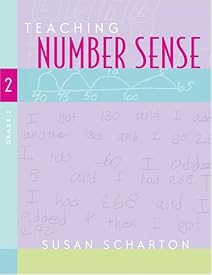
Teaching Number Sense: Grade 2


Susan Scharton

Math Solutions | 2005 | 200 páginas | PDF | 2,262 MB

link
link1

This title is part of a three-book Teaching Number Sense series that focuses on the critical role that number sense plays in developing mathematical understanding. Number sense encompasses a wide range of abilities, including being able to make reasonable estimates and to think and reason flexibly. These lessons help students develop good number intuition and the ability to see numbers as tools, not barriers. By encouraging young children to reason their way to solutions, teachers help students form a solid foundation upon which all of their later mathematical understanding will be built.
Lessons in this book are organized in an accessible, easy-to-read format that includes an overview, a materials list, the lesson duration, step-by-step teaching directions, and vignettes of how the lesson actually unfolded in a classroom. Each lesson concludes with a list of assessment questions to help guide teacher observations. In this book, children learn to compose and decompose larger numbers, develop their computation strategies, strengthen their sense of place value, and sharpen their estimation skills.

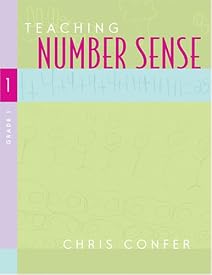
Teaching Number Sense, Grade 1


Chris Confer

Math Solutions | 2005 | 160 páginas | PDF | 1,345 MB

link
link1
depositfiles.com


This title is part of a three-book Teaching Number Sense series that focuses on the critical role that number sense plays in developing mathematical understanding. Number sense encompasses a wide range of abilities, including being able to make reasonable estimates and to think and reason flexibly. These lessons help students develop good number intuition and the ability to see numbers as tools, not barriers. By encouraging young children to reason their way to solutions, teachers help students form a solid foundation upon which all of their later mathematical understanding will be built.Lessons in this book are organized in an accessible, easy-to-read format that includes an overview, a materials list, the lesson duration, step-by-step teaching directions, and vignettes of how the lesson actually unfolded in a classroom. Each lesson concludes with a list of assessment questions to help guide teacher observations. In this book, children build their understanding of counting, number relationships, and landmark numbers. They also develop computation strategies, further their understanding of composing and decomposing numbers, and develop a beginning sense of place value.

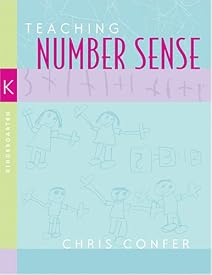
Teaching Number Sense: Kindergarten


Chris Confer
Math Solutions | 2005 | 152 páginas | PDF | 3,2 MB

link

link1This title is part of a three-book Teaching Number Sense series that focuses on the critical role that number sense plays in developing mathematical understanding. Number sense encompasses a wide range of abilities, including being able to make reasonable estimates and to think and reason flexibly. These lessons help students develop good number intuition and the ability to see numbers as tools, not barriers. By encouraging young children to reason their way to solutions, teachers help students form a solid foundation upon which all of their later mathematical understanding will be built.Lessons in this book are organized in an accessible, easy-to-read format that includes an overview, a materials list, the lesson duration, step-by-step teaching directions, and vignettes of how the lesson actually unfolded in a classroom. Each lesson concludes with a list of assessment questions to help guide teacher observations. In this book, children investigate number relationships, practice problem solving using landmark numbers, and explore ways to count, compose, and decompose numbers.

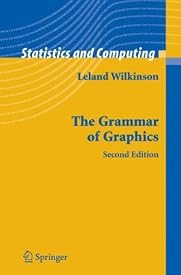
The Grammar of Graphics

(Statistics and Computing)
Leland Wilkinson

Springer | 2005 - 2ª edição | 694 páginas | PDF | 13,4 MB

link direto 
link
link1
mediafire.com


This book was written for statisticians, computer scientists, geographers, researchers, and others interested in visualizing data. It presents a unique foundation for producing almost every quantitative graphic found in scientific journals, newspapers, statistical packages, and data visualization systems. While the tangible results of this work have been several visualization software libraries, this book focuses on the deep structures involved in producing quantitative graphics from data. What are the rules that underlie the production of pie charts, bar charts, scatterplots, function plots, maps, mosaics, and radar charts? Those less interested in the theoretical and mathematical foundations can still get a sense of the richness and structure of the system by examining the numerous and often unique color graphics it can produce. The second edition is almost twice the size of the original, with six new chapters and substantial revision. Much of the added material makes this book suitable for survey courses in visualization and statistical graphics."This fascinating book deconstructs the process of producing graphics and in doing so raises many fascinating questions on the nature and representation of information...This second edition is almost twice the size of the original, with six new chapters and substantial revisions." Short Book Reviews of the International Statistical Institute, December 2005"When the first edidtion of this book appeared in 2000 it was much praised. I called it a tour de force of the highest order. (Wainer, 2001), Edward Wegman (2000) argued that it was destined to become a classic. Now, six years later this very fine book has been much improved." Howard Wainer for Psychometrika"...The second edition is an impressive expansion beyond a quite remarkable first edition. The text remains dense and even more encyclopedic, but it is a pleasure to read, whether a novice or an expert in graphics...this book is a bargain...The second edition is a must-have volume for anyone interested in graphics." Thomas E. Bradstreet for the Journal of the American Statistical Association, December 2006"I find myself still thinking about the book and its ideas, several weeks after I finished reading it. I love that kind of book." Mark Bailey for Techometrics, Vol. 49, No. 1, February 2007"Warts and all, The Grammar of Graphics is a richly rewarding work, an outstanding achievement by one of the leaders of statistical graphics. Seek it out." Nicholas J. Cox for the Journal of Statistical Software, January 2007
.

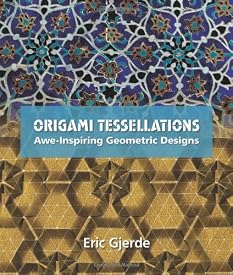
Origami Tessellations: Awe-Inspiring Geometric Designs


Eric Gjerde

AK Peters | 2008 | 128 páginas | PDF | 20 Mb

link
scribd.com


Paper artist Eric Gjerde demonstrates 25 of his favorite tessellations and turns them into folding projects for newcomers as well as experienced origamists. With step-by-step instructions, illustrated crease patterns, and how-to photos, you'll learn to create these wonderful designs yourself.

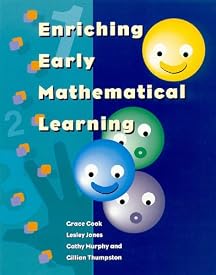
Enriching Early Mathematical Learning


Grace Cook, Lesley Jones, Cathy Murphy, Gillian Thumpston

Open University Press | 1997 | 96 páginas |  PDF | 4 Mb

link
link1

This book is a rich resource intended to support teachers and teachers in training with their teaching of mathematics in the early years. It comprises twenty activities which can be used as starting points. For each activity there are suggestions about how children might respond and guidance as to how the children may be further developed as learners. Support is also given to enable the teacher to embed the learning in a theoretical framework and make links with the National Curriculum.
All of the activities have been tried and tested in school and suggestions are made about the way in which these might be fitted into general classroom topics. There is a strong focus on formative assessment and how this can inform future planning.


Special features include:«
* Very accessible to teachers
* Attractive and user friendly format
* Detailed support for introducing and extending activities which cover each area
of the National Curriculum
* Focus on using and applying maths at the early stages of Key Stage 1.