sexta-feira, 4 de junho de 2010

The Language of Functions and Graphs: An Examination Module for Secondary Schools

Malcolm Swan

Shell Centre & Joint Matriculation Board | 1982 | 240 páginas | PDF | 17,321 Mb


primas-project.eu

The Language of Functions and Graphs is now regarded as a classic book on the teaching and assessment of graph interpretation skills.
It focuses on developing fluency in using various mathematical representations to describe and analyse the real world, and on the teaching tactics needed to handle pupil discussion in groups and with the whole class. Unit A of the classroom materials tackles the interpretation and sketching of scatter graphs and line graphs - an area where most pupils need help if they are to go beyond the plotting and reading of points to the global meaning of the graph; this material is accessible to a wide range of abilities. Unit B develops modeling skills - the search for patterns in a realistic situation and their expression in verbal, graphical and algebraic forms: this unit is more challenging. Each Unit takes about two weeks of mathematics time in the 13-16 age range. In addition there is a collection of further problems, as well as the assessment tasks with marking schemes for GCSE.
"By addressing the query of 'how do you assess open ended problem solving', the Shell team generated a classic resource, from which has grown the substantial literature of alternative assessment of today." - AAMT
"The materials are very well produced with attractive worksheets and an abundance of materials from which to select." - Mathematical Gazett

quinta-feira, 3 de junho de 2010

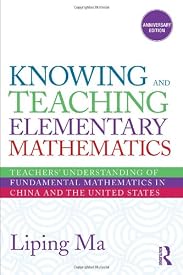
Knowing and Teaching Elementary Mathematics: Teachers' Understanding of Fundamental Mathematics in China and the United States


(Studies in Mathematical Thinking and Learning Series)

Liping Ma

Routledge | 2010 | 232 páginas |  pdf  | 2 Mb

link
link1
scribd.com

Studies of teachers in the U.S. often document insufficient subject matter knowledge in mathematics. Yet, these studies give few examples of the knowledge teachers need to support teaching, particularly the kind of teaching demanded by recent reforms in mathematics education. Knowing and Teaching Elementary Mathematics describes the nature and development of the knowledge that elementary teachers need to become accomplished mathematics teachers, and suggests why such knowledge seems more common in China than in the United States, despite the fact that Chinese teachers have less formal education than their U.S. counterparts.
The anniversary edition of this bestselling volume includes the original studies that compare U.S and Chinese elementary school teachers’ mathematical understanding and offers a powerful framework for grasping the mathematical content necessary to understand and develop the thinking of school children. Highlighting notable changes in the field and the author’s work, this new edition includes an updated preface, introduction, and key journal articles that frame and contextualize this seminal work.

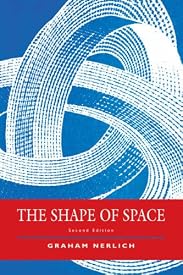
The Shape of Space


Graham Nerlich

Cambridge University Press | 1994 | 308 páginas | pdf | 6 Mb

link
link1

djvu - 2,8 Mb
link
link1
link2

This is a revised and updated edition of Graham Nerlich's classic book (1976). It develops a metaphysical account of space that treats it as a real and concrete entity, showing that shape plays a key explanatory role in space and spacetime theories. Arguing that geometrical explanation is very like causal explanation, Professor Nerlich prepares the ground for philosophical argument and investigates how different spaces would affect perception differently. Along the way Professor Nerlich criticizes and rejects conventionalism as a non-realist metaphysics of space, concluding that there is, in fact, no problem of underdetermination for this aspect of spacetime theories, while offering an extensive discussion of the relativity of motion. • Revised and updated edition of classic work (1st edition published 1976) • Clear and well-written account of key topic in philosophy of science, suitable for teaching on graduate courses • No other book approaches this topic with same authority or from perspective of physical geometry
Índice

Introduction; 1. Space and spatial relations; 2. Hands, knees and absolute space; 3. Euclidean and other shapes; 4. Geometrical structures in space and spacetime; 5. Shapes and the imagination; 6. The aims of conventionalism; 7. Against conventionalism; 8. Reichenbach's treatment of topology; 9. Measuring space: fact or convention?; 10. The relativity of motion; Bibliography; Index.


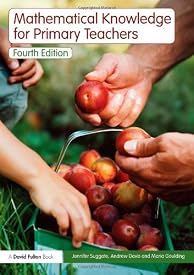
Mathematical Knowledge for Primary Teachers


Jennifer Suggate, Andrew Davis, Maria Goulding

Routledge | 2010 | 328 páginas | RAR - PDF | 3,28 Mb

link

Descrição:
Now in its fourth edition, the bestselling text Mathematical Knowledge for Primary Teachers provides trainee teachers with clear information about the fundamental mathematical ideas taught in primary schools.With rigorous and comprehensive coverage of all the mathematical knowledge primary teachers need, the text goes beyond rules and routines to help readers deepen their understanding of mathematical ideas and increase their confidence in teaching these ideas. Fully updated to incorporate recommendations of the Williams review, new sections are included covering talk for learning in mathematics, with an emphasis placed on the language and vocabulary used in arithmetic contexts.Throughout the book, knowledge is linked to the TDA standards for Qualified Teacher Status, and features include:‘Check’ questions to test the reader’s understanding ‘Challenges’, to increase teachers’ confidence and stretch their mathematical abilities ‘Links with the classroom’ to emphasise the relevance of ideas to the classroom context Straightforward coverage from theory to practice for all aspects of the Mathematics framework.The book is accompanied by a Companion Website, which contains further visual activities and support, designed to scaffold and support the reader’s own understanding. Essential reading for all practising and trainee primary teachers, this book is ideal for those who wish to increase their mathematical understanding and confidence in presenting mathematics in the classroom.

Contents
Note to fourth edition Dedication Acknowledgements Introduction PART ONE: SETTING THE SCENE 1. Mathematical understanding 2. Language 3. Problem solving and proof PART TWO: NUMBER AND ALGEBRA 4. Properties of numbers and operations 5. Counting, place value, addition and subtraction 6. Multiplication and division 7. Integers 8. Fractions, decimals and percentages 9. Understanding algebra 10. Graphs and functions PART THREE: MEASUREMENT 11. Length 12. Area 13. Capacity and volume 14. Mass and weight 15. Angles and compass directions 16. Time PART FOUR: SHAPE 17. 2-D shape 18. 2-D shape applications and investigations 19. 3-D shape PART FIVE: DATA HANDLING 20. Data handling 21. Probability

Introduction to the History of Mathematics


Howard Eves

Holt, Rinehart & Winston | 1969 | 480 páginas | djvu | 8,9 Mb

link
link1
uploading.com

Descrição: This classic best-seller by a well-known author introduces mathematics history to math and math education majors. Suggested essay topics and problem studies challenge students. CULTURAL CONNECTIONS sections explain the time and culture in which mathematics developed and evolved. Portraits of mathematicians and material on women in mathematics are of special interest.

segunda-feira, 17 de maio de 2010

Mathematics Education as a Research Domain: A Search for Identity: An ICMI Study


(New ICMI Study Series)
Anna Sierpinska, Jeremy Kilpatrick

Springer | 1998 | 600 páginas |

Part1
pdf  | 15 Mb
link

Part 2
pdf | 16 Mb
link

pdf | 85 Mb
link

In 1978, in the foreword to Weeding and Sowing: A Preface to a Science of Mathematics Education, Hans Freudenthal wrote that his book is a preface to a science that does not exist. Almost 20 years later, does his claim still hold true? The present book is the result of the reflection of many individuals in mathematics education on this and related questions. Is mathematics education a science? Is it a discipline? In what sense? What is its place within other domains of research and academic disciplines? What accounts for its specificity? In the book, the reader will find a range of possible answers to these questions, a variety of analyses of the actual directions of research in different countries, and a number of visions for the future of research in mathematics education. The book is a result of an ICMI Study, whose theme was formulated as: `What is Research in Mathematics Education and What are Its Results?'. One important outcome of this study was the realization of the reasons for the difficulty of the questions that the study was posing, leading possibly to a set of other questions, better suited to the actual concerns and research practices of mathematics education researchers. The book addresses itself to researchers in mathematics education and all those working in their neighborhood who are concerned with the problems of the definition of this new scientific domain emerging at their borders.
Table of contents

Foreword.
I. The Study Conference.
II. Mathematics Education as a Research Discipline.
III. Goals, Orientations and Results of Research in Mathematics Education.
IV. Different Research Paradigms in Mathematics Education.
V. Evaluation of Research in Mathematics Education.
VI. Mathematics Education and Mathematics.
Continuing the Search.


sábado, 15 de maio de 2010

Statistical Literacy at School: Growth and Goals


(Studies in Mathematical Thinking and Learning Series)

Jane M. Watson

Lawrence Erlbaum Associates | 2006 | 320 páginas | rar - pdf | 12,7 Mb

link (password: matav) - novo ficheiro

pdf | 36Mb - link

This book reveals the development of students' understanding of statistical literacy. It provides a way to "see" student thinking and gives readers a deeper sense of how students think about important statistical topics. Intended as a complement to curriculum documents and textbook series, it is consistent with the current principles and standards of the National Council of Teachers of Mathematics.

The term "statistical literacy" is used to emphasize that the purpose of the school curriculum should not be to turn out statisticians but to prepare statistically literate school graduates who are prepared to participate in social decision making. Based on ten years of research--with reference to other significant research as appropriate--the book looks at students' thinking in relation to tasks based on sampling, graphical representations, averages, chance, beginning inference, and variation, which are essential to later work in formal statistics. For those students who do not proceed to formal study, as well as those who do, these concepts provide a basis for decision making or questioning when presented with claims based on data in societal settings.

Statistical Literacy at School: Growth and Goals:
*establishes an overall framework for statistical literacy in terms of both the links to specific school curricula and the wider appreciation of contexts within which chance and data-handling ideas are applied;
*demonstrates, within this framework, that there are many connections among specific ideas and constructs;
*provides tasks, adaptable for classroom or assessment use, that are appropriate for the goals of statistical literacy;
*presents extensive examples of student performance on the tasks, illustrating hierarchies of achievement, to assist in monitoring gains and meeting the goals of statistical literacy; and
*includes a summary of analysis of survey data that suggests a developmental hierarchy for students over the years of schooling with respect to the goal of statistical literacy.

Statistical Literacy at School: Growth and Goals is directed to researchers, curriculum developers, professionals, and students in mathematics education as well those across the curriculum who are interested in students' cognitive development within the field; to teachers who want to focus on the concepts involved in statistical literacy without the use of formal statistical techniques; and to statisticians who are interested in the development of student understanding before students are exposed to the formal study of statistics.


Contents
Preface vii
1 Purpose and Foundations 1
2 Sampling—A Good Start 27
3 Graphs—How Best to Represent the Data 55
4 Average—What Does It Tell Us? 97
5 Chance—Precursor to Probability 127
6 Beginning Inference—Supporting a Conclusion 187
7 Variation—The Underlying Phenomenon 217
8 Statistical Literacy—A Global Goal 247
Further Reading 275
References 281
Author Index 297

Subject Index 303