quinta-feira, 7 de janeiro de 2010

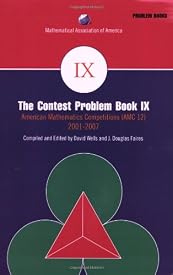
The Contest Problem Book IX

(Maa Problem Books) (Bk. 9)
David M. Wells, J. Douglas Faires
The Mathematical Association of America | 2008 | 200 páginas | RAR - PDF | 910 kb

link (password : matav)

djvu | 1,56 Mb
link

Descrição: This is the ninth book of problems and solutions from the American Mathematics Competitions (AMC) contests. It chronicles 325 problems from the thirteen AMC 12 contests given in the years between 2001 and 2007. The authors were the joint directors of the AMC 12 and the AMC 10 competitions during that period.
The problems have all been edited to ensure that they conform to the current style of the AMC 12 competitions. Graphs and figures have been redrawn to make them more consistent in form and style, and the solutions to the problems have been both edited and supplemented.
A problem index at the back of the book classifies the problems into subject areas of Algebra, Arithmetic, Complex Numbers, Counting, Functions, Geometry, Graphs, Logarithms, Logic, Number Theory, Polynomials, Probability, Sequences, Statistics, and Trigonometry. A problem that uses a combination of these areas is listed multiple times.
The problems on these contests are posed by members of the mathematical community in the hope that all secondary school students will have an opportunity to participate in problem-solving and an enriching mathematical experience.

The Bakhshali Manuscript: An Ancient Treatise Of Indian Mathematics


Svami Satya Prakash Saraswati, Dr. Usha Jyotishmati.

 Dr. Ratna Kumari Svadhyaya Sansthana | ISBN: N/A | 1979 | PDF | 111 pages | 10,7 mb

link

Descrição: In the year 1881 A.D., at a village named Bakhshali near Peshawar, a farmer found a manuscript during excavation. About 70 leaves were found, and are now famous as theBakhshali Manuscript. Western scholars estimate its date as about third or fourth century A.D. It is devoted mostly to arithmetic and algebra, with a few problems on geometry and mensuration.

Introduction
Chajakputra, the scribe 1
How the text was found 1
The manuscript 5
The script 6
The language 7
Order & arrangement of folios 7
Contents of the manuscript 8
Generalized arithmetic & algebra 10
Text is of Indian form 11
Is the work homogeneous? 12
The script (details) 12
An indigenous Hindu treatise 13
Various opinions about its age 14
Bakhshali manuscript older than the present manuscript 15
Bakhshali work, a commentary 16
Present manuscript, a copy 18
Exposition & method 20
Fundamental operations 32
Square roots and surds 35
Rule of three 40
Calculation of errors & process of reconciliation 41
Negative sign 45
Least common multiple 47
Arithmetical notation 50
Regula falsi 52
Known still earlier in India 54
The rupona method 55
Proofs 59
Solutions 65
Symbols for the unknown 66
Plan of writing equations 70
Certain complex series 71
Systems of linear equations 72
Quadratic indeterminate equations 77
Happy collaboration of the East & West 78
Appendix: Weights & measures 81
The Bakhshali text (Translated in Devanagiri script) 1-71


The Big Idea: Pythagoras & His Theorem


Paul Strathern

Arrow Books Ltd | 1997 | 96 páginas | PDF | 19 Mb

Faltam as páginas 30 e 31

4shared.com
depositfiles.com
link
link1

djvu - 392 kb
link
link1

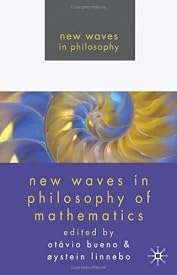
New Waves in Philosophy of Mathematics


Otavio Bueno, Oystein Linnebo
Palgrave Macmillan | 2009 | 320 páginas | pdf  | 1,514 Mb

philosophy.ru (link direto)
link
link1

Descrição: In this book, thirteen promising young researchers write on what they take to be the right philosophical account of mathematics and discuss where the philosophy of mathematics ought to be going. New trends are revealed, such as an increasing attention to mathematical practice, a reassessment of the canon, and inspiration from philosophical logic.
Thirteen up-and-coming researchers in the philosophy of mathematics have been invited to write on what they take to be the right philosophical account of mathematics, examining along the way where they think the philosophy of mathematics is and ought to be going. A rich and diverse picture emerges. Some broader tendencies can nevertheless be detected: there is increasing attention to the practice, language and psychology of mathematics, a move to reassess the orthodoxy, as well as inspiration from philosophical logic.

Índice
Series Preface
Acknowledgements
Notes on Contributors
Introduction: O.Bueno & Ø.Linnebo
PART I: REASSESSING THE ORTHODOXY IN THE PHILOSOPHY OF MATHEMATICS
New Waves on an Old Beach: Neo-Fregean Philosophy of Mathematics Today; R.Cook
Reducing Arithmetic to Set Theory; A.Paseau
PART II: THE QUESTION OF REALISM IN MATHEMATICS
Mathematical Fictionalism; O.Bueno
Truth in Mathematics: The Question of Pluralism; P.Koellner
'Algebraic' Approaches to Mathematics; M.Leng
PART III: MATHEMATICAL PRACTICE AND THE METHODOLOGY OF MATHEMATICS
Mathematical Accidents and the End of Explanation; A.Baker
Applying Inconsistent Mathematics; M.Colyvan
Towards a Philosophy of Applied Mathematics; C.Pincock
PART IV: MATHEMATICAL LANGUAGE AND THE PSYCHOLOGY OF MATHEMATICS
Formal Tools and the Philosophy of Mathematics; T.Hofweber
The Individuation of the Natural Numbers; Ø.Linnebo
Towards a Trivialist Account of Mathematics; A.Rayo
PART V: FROM PHILOSOPHICAL LOGIC TO THE PHILOSOPHY OF MATHEMATICS
On Formal and Informal Provability; H.Leitgeb
Quantification without a Domain; G.Uzquiano
Index

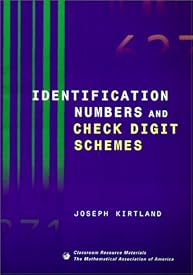
Identification Numbers and Check Digit Schemes


(Classroom Resource Materials)
Joseph Kirtland
The Mathematical Association of America | 2001 | 174 páginas | pdf | 3,32 Mb


link
link1

Descrição: This book develops the mathematical skills necessary for the investigation of the increasingly pervasive codes used to identify everything from credit cards to books to supermarket goods. An important part of such codes is the check digit, which can point out when an error has been made, either accidentally in transmission, or deliberately in an attempt at fraud. Mathematics plays a crucial role in designing and verifying such check digit schemes. Beginning undergraduates and pre-university students should find this book both accessible and fun. In the process of describing the identification number schemes, the author introduces many fundamental areas of discrete mathematics, including modular arithmetic and group theory, with emphasis on their applications. A unique point of the book is the way it offers students the possibility of writing papers summarizing a given topic to improve their understanding. It also contains pointers into the literature for further reading.

quarta-feira, 23 de dezembro de 2009

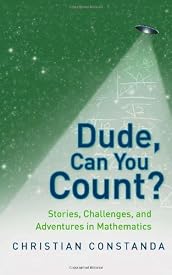
Dude, Can You Count? Stories, Challenges and Adventures in Mathematics


Christian Constanda

Springer | 2010 | 294 páginas |  pdf | 2,95 Mb

link
link1
scribd.com


Descrição: Imagine algebra class meets The Hitchhiker’s Guide to the Galaxy…Meet JJ, an unusual character with a unique vantage position from which he can measure and monitor humanity’s progress. Armed with a device that compels all around it to tell the truth, JJ offers a satirical evaluation of our attitudes to numeracy and logic, touching upon several aspects of life on Earth along the way, from the criminal justice system and people’s use of language to highway driving and modern art.A collection of mathematically-flavored stories and jokes, interlaced with puzzles, paradoxes and problems, fuse together in an entertaining, free-flowing narrative that will engage and amuse anyone with an interest in the issues confronting society today. JJ demonstrates how a lack of elementary mathematical knowledge can taint our work and general thinking and reflects upon the importance of what is arguably our most valuable weapon against ignorance: a sound mathematical education.What is JJ’s prognosis for our future? There’s only one way to find out...

The Development of Modern Logic


Leila Haaparanta

Oxford University Press, USA | 2009 | 1008 páginas | pdf | 6 Mb

mohamedrabeea.com (link direto)
link
link1

Descrição: This edited volume presents a comprehensive history of modern logic from the Middle Ages through the end of the twentieth century. In addition to a history of symbolic logic, the contributors also examine developments in the philosophy of logic and philosophical logic in modern times. The book begins with chapters on late medieval developments and logic and philosophy of logic from Humanism to Kant. The following chapters focus on the emergence of symbolic logic with special emphasis on the relations between logic and mathematics, on the one hand, and on logic and philosophy, on the other. This discussion is completed by a chapter on the themes of judgment and inference from 1837-1936. The volume contains a section on the development of mathematical logic from 1900-1935, followed by a section on main trends in mathematical logic after the 1930s. The volume goes on to discuss modal logic from Kant till the late twentieth century, and logic and semantics in the twentieth century; the philosophy of alternative logics; the philosophical aspects of inductive logic; the relations between logic and linguistics in the twentieth century; the relationship between logic and artificial intelligence; and ends with a presentation of the main schools of Indian logic.
The Development of Modern Logic includes many prominent philosophers from around the world who work in the philosophy and history of mathematics and logic, who not only survey developments in a given period or area but also seek to make new contributions to contemporary research in the field. It is the first volume to discuss the field with this breadth of coverage and depth, and will appeal to scholars and students of logic and its philosophy.