quarta-feira, 22 de julho de 2009

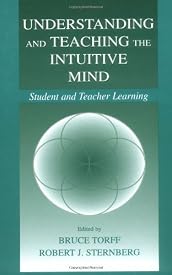
Understanding and Teaching the Intuitive Mind: Student and Teacher Learning


(Educational Psychology Series)
Bruce Torff, Robert J. Sternberg

Lawrence Erlbaum | 2001 | 288 páginas |  PDF | 1,16 Mb

link

com especial interesse o 2.º capítulo (pp. 29 a 56):
Intuitive mathematics: theoretical and educational implications
Talia Ben-Zeev e Jon Star

on-line: gseacademic.harvard.edu ou msu.edu


Descrição: The intuitive mind is a powerful force in the classroom and often an undetected one. Intuitive conceptions--knowledge or knowledge-structures that individuals acquire and use largely without conscious reflection or explicit instruction--sometimes work to facilitate learning in the classroom and other contexts. But learning may also be impeded by intuitive conceptions, and they can be difficult to dislodge as needed. The literatures in psychology and education include a large and diverse body of theory and research on intuitive conceptions, but this work is limited in some respects. This volume contributes in four ways to overcome these limitations. Understanding and Teaching the Intuitive Mind: Student and Teacher Learning:
* pulls together diverse theoretical and methodological approaches to the origin, structure, function, and development of intuitive conceptions;
* explores a diversity of academic disciplines--paying equal attention not only to mathematics and science, the fields in which intuitive concepts have been studied most extensively, but also to the social sciences, arts, and humanities;
* explicitly links theory and research to educational implications and classroom applications; and
* focuses not only on students' intuitive conceptions but also on teachers' intuitive beliefs about learning and teaching.
Although the viewpoints of the contributors are diverse, they share the belief that educational practices have much to gain by systematic studies of the intuitive learner and teacher. This volume offers state-of-the-art, research-based information and support for psychologists, teacher educators, educational administrators, teachers, prospective teachers, and others who seek to develop educational practices that are cognizant of (and responsive to) the intuitive conceptions of students and teachers.

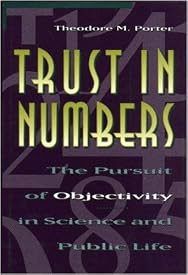
Trust in numbers. The pursuit of objectivity in science


Theodore M. Porter

Princeton University Press | 1995 | 328 páginas | pdf | 2,6 Mb

link
link1

Descrição: This investigation of the overwhelming appeal of quantification in the modern world discusses the development of cultural meanings of objectivity over two centuries. How are we to account for the current prestige and power of quantitative methods? The usual answer is that quantification is seen as desirable in social and economic investigation as a result of its successes in the study of nature. Theodore Porter is not content with this. Why should the kind of success achieved in the study of stars, molecules, or cells be an attractive model for research on human societies? he asks. And, indeed, how should we understand the pervasiveness of quantification in the sciences of nature? In his view, we should look in the reverse direction: comprehending the attractions of quantification in business, government, and social research will teach us something new about its role in psychology, physics, and medicine. Drawing on a wide range of examples from the laboratory and from the worlds of accounting, insurance, cost-benefit analysis, and civil engineering, Porter shows that it is "exactly wrong" to interpret the drive for quantitative rigor as inherent somehow in the activity of science except where political and social pressures force compromise. Instead, quantification grows from attempts to develop a strategy of impersonality in response to pressures from outside. Objectivity derives its impetus from cultural contexts, quantification becoming most important where elites are weak, where private negotiation is suspect, and where trust is in short supply.

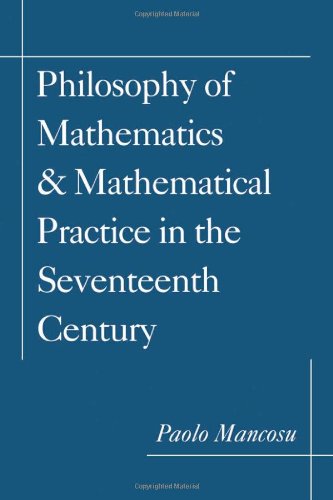
Philosophy of Mathematics and Mathematical Practice in the Seventeenth Century

Paolo Mancosu

Oxford University Press, USA | 1996 | 288 páginas |  pdf | 7,7 Mb

link
link1

djvu - 2,35 Mb
link
link1

Descrição: The seventeenth century saw dramatic advances in mathematical theory and practice. With the recovery of many of the classical Greek mathematical texts, new techniques were introduced, and within 100 years, the rules of analytic geometry, geometry of indivisibles, arithmetic of infinites, and calculus were developed. Although many technical studies have been devoted to these innovations, Mancosu provides the first comprehensive account of the relationship between mathematical advances of the seventeenth century and the philosophy of mathematics of the period. Starting with the Renaissance debates on the certainty of mathematics, Mancosu leads the reader through the foundational issues raised by the emergence of these new mathematical techniques, including the influence of the Aristotelian conception of science in Cavalieri and Guldin, the foundational relevance of Descartes' Geometrie, the relation between geometrical and epistemological theories of the infinite, and the Leibnizian calculus and the opposition to infinitesimalist procedures. In the process Mancosu draws a sophisticated picture of the subtle dependencies between technical development and philosophical reflection in seventeenth century mathematics.

The Philosophy of Mathematical Practice

Paolo Mancosu

Oxford University Press, USA | 2008 | 460 páginas | pdf | 2 Mb

link direto
link
link1

Descrição: Contemporary philosophy of mathematics offers us an embarrassment of riches. Among the major areas of work one could list developments of the classical foundational programs, analytic approaches to epistemology and ontology of mathematics, and developments at the intersection of history and philosophy of mathematics. But anyone familiar with contemporary philosophy of mathematics will be aware of the need for new approaches that pay closer attention to mathematical practice. This book is the first attempt to give a coherent and unified presentation of this new wave of work in philosophy of mathematics. The new approach is innovative at least in two ways. First, it holds that there are important novel characteristics of contemporary mathematics that are just as worthy of philosophical attention as the distinction between constructive and non-constructive mathematics at the time of the foundational debates. Secondly, it holds that many topics which escape purely formal logical treatment--such as visualization, explanation, and understanding--can nonetheless be subjected to philosophical analysis.
The Philosophy of Mathematical Practice comprises an introduction by the editor and eight chapters written by some of the leading scholars in the field. Each chapter consists of a short introduction to the general topic of the chapter followed by a longer research article in the area. The eight topics selected represent a broad spectrum of contemporary philosophical reflection on different aspects of mathematical practice: diagrammatic reasoning and representational systems; visualization; mathematical explanation; purity of methods; mathematical concepts; the philosophical relevance of category theory; philosophical aspects of computer science in mathematics; the philosophical impact of recent developments in mathematical physics.

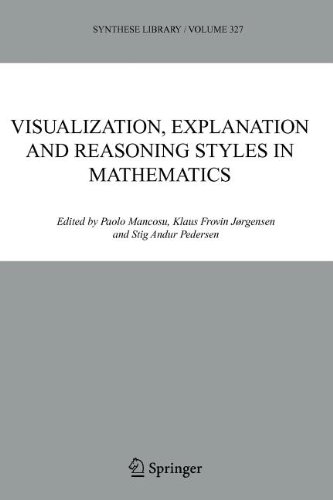
Visualization, Explanation and Reasoning Styles in Mathematics


Paolo Mancosu, Klaus Frovin Jørgensen , Stig Andur Pedersen (Editores)

Springer | 2005 | 300 páginas | 4,4 Mb

scribd.com
link

Conteúdos:


Part I. Mathematical Reasoning And Visualization.
P. Mancosu: Visualization in Logic and Mathematics. 

1. Diagrams and Images in the Late Nineteenth Century. 
2. The Return of the Visual as a Change in Mathematical Style. 
3. New Directions of Research and Foundations of Mathematics. Acknowledgements. Notes. References.
M. Giaquinto: From Symmetry Perception to Basic Geometry. Introduction. 
1. Perceiving a Figure as a Square. 
2. A Geometrical Concept for Squares. 
3. Getting the Belief. 
4. Is It Knowledge? 
5. Summary. Notes. References.
J.R. Brown: Naturalism, Pictures, and Platonic Intuitions. 
1. Naturalism. 
2. Platonism. 
3. Godel's Platonism. 
4. The Concept of Observable. 
5. Proofs and Intuitions. 
6. Maddy's Naturalism. 
7. Refuting the Continuum Hypothesis. Acknowledgements. Appendix: Freiling's "Philosophical" Refutation of CH. References.
M. Giaquinto: Mathematical Activity. 
1. Discovery. 
2. Explanation. 
3. Justification. 
4. Refining and Extending the List of Activities. 
5. Concluding Remarks. Notes. References.
Part II. Mathematical Explanation and Proof Styles.
J. Høyrup: Tertium Non Datur: On Reasoning Styles in Early Mathematics. 

1. Two Convenient Scapegoats. 
2. Old Babylonian Geometric Proto-algebra. 
3. Euclidean Geometry. 
4. Stations on the Road. 
5. Other Greeks. 
6. Proportionality - Reasoning and its Elimination. Notes. References.
K. Chemla: The Interplay Between Proof and AIgorithm in 3rd Century China: The Operation as Prescription of Computation and the Operation as Argument. 
1. Elements of Context. 
2. Sketch of the Proof. 
3. First Remarks on the Proof. 
4. The Operation as Relation of Transformation. 
5. The Essential Link Between Proof and AIgorithm. 
6. Conclusion. Appendix. Notes. References.
J. Tappenden: Proof Style and Understanding in Mathematics I: Visualization, Unification and Axiom Choice. 
1. Introduction - a "New Riddle" of Deduction. 
2. Understanding and Explanation in Mathematical Methodology: The Target. 
3. Understanding, Unification and Explanation – Friedman. 
4. Kitcher: Pattems of Argument. 
5. Artin and Axiom Choice: "Visual Reasoning" Without Vision. 
6. Summary - the "new Riddle of Deduction". Notes. References.
J. Hafner and P. Mancosu: The Varieties of Mathematical Explanations. 
1. Back to the Facts Themselves. 
2. Mathematical Explanation or Explanation in Mathematics? 
3. The Search for Explanation within Mathematics. 
4. Some Methodological Comments on the General Project. 
5. Mark Steiner on Mathematical Explanation. 
6. Kummer's Convergence Test. 
7. A Test Case for Steiner's Theory. Appendix. Notes. References.
R. Netz: The Aesthetics of Mathematics: A Study. 
1. The Problem Motivated. 
2. Sources of Beauty in Mathematics. 
3. Conclusion. Notes. References.
Index

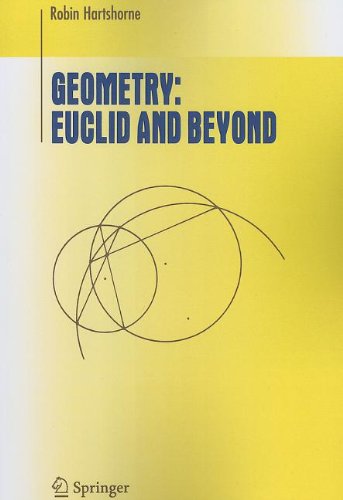
Geometry: Euclid and Beyond

Robin Hartshorne

Springer | 2005 | 544 páginas | djvu | 5 Mb
link
link1
link2

pdf - 24 Mb
link
link1

Descrição: This book offers a unique opportunity to understand the essence of one of the great thinkers of western civilization. A guided reading of Euclid's Elements leads to a critical discussion and rigorous modern treatment of Euclid's geometry and its more recent descendants, with complete proofs. Topics include the introduction of coordinates, the theory of area, geometrical constructions and finite field extensions, history of the parallel postulate, the various non-Euclidean geometries, and the regular and semi-regular polyhedra. The text is intended for junior- to senior-level mathematics majors.

Mathematics: The Loss of Certainty

Morris Kline

Oxford University Press, USA | 1982 | 384 páginas | djvu | 4 Mb

link
link1
depositfiles.com
ishare.iask.sina.com.cn


Descrição: This work stresses the illogical manner in which mathematics has developed, the question of applied mathematics as against 'pure' mathematics, and the challenges to the consistency of mathematics' logical structure that have occurred in the twentieth century.