segunda-feira, 25 de maio de 2009
Calculus: Readings from The Mathematics Teacher
National Council of Teachers of Mathematics | 1977 | 230 páginas | Djvu | 4 Mb
link
link1
Descrição: Many of the suggestions that calculus instructors have published as articles from 1908 through 1973 are included in this book of reading. The main criterion for selecting an item was whether it would be helpful to teachers and students; therefore, those which dealt exclusively with curricular structure were not included. The selected articles are arranged into the following eleven categories: (1) Historical Overview; (2) Pedagogical Overview; (3) Functions; (4) Limits; (5) Differentiation; (6) Indeterminate Forms; (7) Integration; (8) Numerical and Mechanical Methods; (9) Infinite Series; (10) Special Numbers--The base of natural logarithms and pi; and (11) General Applications. Some of the above categories are subdivided. Articles within each subcategory are arranged chronologically, incorporating corrections of any noted typographical errors.
The Nature and Role of Algebra in the K-14 Curriculum
Proceedings of a National Symposium(Compass Series)
National Council of Teachers of Mathematics, Mathematical Sciences Education Board, National Research Council
National Academies Press | 1998 | 206 páginas
on-line: nap.edu
pdf - 7 Mb - link
Methods of effectively teaching algebraic thinking in elementary schools as well as secondary schools is the topic of the following 19 papers. Papers include: (1) "Transforming Algebra from an Engine of Inequity to an Engine of Mathematical Power by 'Algebrafying' the K-12 Curriculum" (J. Kaput); (2) "Developing a Coherent and Focused K-12 Algebra Curriculum" (E. Phillips); (3) "Enhancing Algebraic Reasoning with Technology" (G. Akst); (4) "Algebra for Everyone? With or Without Technology?" (M. Norman); (5) "How Might Technology Enhance Algebraic Reasoning?" (R. Zbiek); (6) "What Do We Know about K-14 Students' Learning of Algebra?" (J. Confrey); (7) "Algebra: What All Students Can Learn" (S. Williams and D. Molina); (8) "Improving K-14 Algebra Instruction: A Discussion of Teachers' Responsibilities and Students' Opportunities" (B. Moore-Harris); (9) "Capturing Patterns and Functions: Variables and Joint Variation" (G. Lappan); (10) "Functions and Relations: A Unifying Theme for School Algebra in Grades 9-12" (C. Hirsch); (11) "Middle School Algebra from a Modeling Perspective" (G. Kleiman); (12) "Why Modeling Matters" (L. Godbold); (13) "Modeling: Changing the Mathematics Experience in Postsecondary Classrooms" (R. Dance); (14) "Algebraic Structure in the Mathematics of Elementary-School Children" (C. Tierney); (15) "Structure in School Algebra (Middle School)" (M. van Reeuwijk); (16) "The Role of Algebraic Structure in the Mathematics Curriculum of Grades 11-14" (G. Foley); (17) "Language and Representation in Algebra: A View from the Middle" (R. Billstein); (18) "Teaching Algebra: Lessons Learned by a Curriculum Developer" (D. Resek); and (19) "The Nature and Role of Algebra: Language and Representation" (D. Hughes Hallett). (ASK)
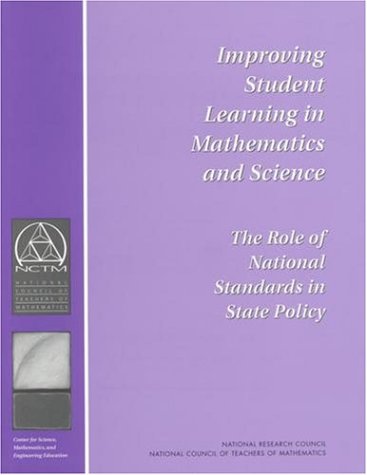
Improving Student Learning in Mathematics and Science: The Role of National Standards in State Policy

(Compass Series)
National Council of Teachers of Mathematics, Mathematics, and Engineering Education Center for Science, National Research Council
National Academies Press | 1997 | 56 páginas |219 kb
online: nap.edu
domingo, 24 de maio de 2009
Calculus: Concepts and Contexts

James Stewart
Brooks Cole | 2000 | 1184 páginas | pdf | 17 Mb
link direto
link
James Stewart's well-received CALCULUS: CONCEPTS AND CONTEXTS, Second Edition follows in the path of the other best-selling books by this remarkable author. The First Edition of this book was highly successful because it reconciled two schools of thought: it skillfully merged the best of traditional calculus with the best of the reform movement. This new edition continues to offer the balanced approach along with Stewart's hallmark features: meticulous accuracy, patient explanations, and carefully graded problems. The content has been refined and the examples and exercises have been updated. In addition, CALCULUS: CONCEPTS AND CONTEXTS, Second Edition now includes a free CD-ROM for students that contains animations, activities, andhomework hints. The book integrates the use of the CD throughout by using icons that show students when to use the CD to deepen their understanding of a difficult concept. In CALCULUS: CONCEPTS AND CONTEXTS, this well respected author emphasizes conceptual understanding - motivating students with real world applications and stressing the Rule of Four in numerical, visual, algebraic, and verbal interpretations. All concepts are presented in the classic Stewart style: with simplicity, character, and attention to detail. In addition to his clear exposition, Stewart also creates well thought-out problems and exercises. The definitions are precise and the problems create an ideal balance between conceptual understanding and algebraic skills.
Perspectives on the History of Mathematical Logic

Thomas Drucker
Birkhäuser Boston | 2008 | 196 páginas |
pdf | 10 Mb - link
djvu - 1,5 Mb
link direto
link
Descrição: This volume offers insights into the development of mathematical logic over the last century. Arising from a special session of the history of logic at an American Mathematical Society meeting, the chapters explore technical innovations, the philosophical consequences of work during the period, and the historical and social context in which the logicians worked. The discussions herein will appeal to mathematical logicians and historians of mathematics, as well as philosophers and historians of science
.
terça-feira, 19 de maio de 2009
The Roles of Representation in School Mathematics

2001 Yearbook
Albert A. Cuoco, Frances R. Curcio
National Council of Teachers of Mathematics (NCTM) | 2001 | 282 páginas | PDF | 3,6 Mb
link
Descrição: The focus of NCTM's 2001 Yearbook is one aspect of how students learn mathematics–in particular, how they learn to form abstractions and build mathematical representations of phenomena. It explains how students come to develop mathematical habits of mind, and even how they develop misunderstandings about mathematics. Discussions on the nature and roles of representation, the use of representation tools for gaining insights, various symbol systems used in mathematics, and the role of context in the interplay between modeling and representation make this an excellent resource for teachers who want to make smart decisions about content and pedagogy.
Conteúdospt. 1. Roles for representations.
Systems of representations and the development of mathematical concepts / Gerald Goldin, Nina Shteingold
Representation and abstraction in young children's numerical reasoning / Constance Kamii, Lynn Kirkland, Barbara A. Lewis
Algebra : what are we teaching / Mark Saul
Attending to transparent features of opaque representations of natural numbers / Rina Zazkis, Karen Gadowsky
pt. 2. Tools for thinking.
The influence of language on mathematical representations / Irene T. Miura
The role of tools in supporting students' development measuring conceptions / Michelle Stephan ... [et al.] Promoting the use of diagrams as tools for thinking / Carmel Diezmann, Lyn English
Constructing a foundation for the fundamental theorem of calculus / Mary J. Schnepp, Ricardo Nemirovsky
Mapping diagrams : another view of functions / Mark Bridger, Maxine Bridger
A multirepresentational journey through the law of cosines / Daniel Scher
Representations of reversal : an exploration of Simpson's paradox / Lawrence Mark Lesser
pt. 3. Symbols and symbol systems.
Presenting and representing : from fractions to rational numbers / Susan J. Lamon
Representations of patterns and functions : tools for learning / Wendy N. Coulombe, Sarah B. Berenson
Promoting multiple representations in algebra / Alex Friedlander, Michal Tabach
From Fibonacci numbers to fractals : recursive patterns and subscript notation / Deborah S. Franzblau, Lisa B. Warner
Tracing the origins and extensions of Michael's representation / Regina D. Kiczek, Carolyn A. Maher, Robert Speiser
pt. 4. The role of context.
Listen to their pictures : an investigation of children's mathematical drawings / Kristine Reed Woleck
Using literature to invite mathematical representations / Phyllis Whitin, David Whitin
Representation in realistic mathematics education / Margaret R. Meyer
Charting a visual course to the concept of function / Michal Yerushalmy, Beba Shternberg
Teaching mathematical modeling and the skills of representation / Joshua Paul Abrams.
domingo, 17 de maio de 2009
Euclidean & Non-Euclidean Geometries: Development and History

Marvin Jay Greenberg
W. H. Freeman | 1993 | 512 páginas | djvu | 4,16 Mb
link
link1
PDF - 19 Mb
link direto
link
scribd.com
This is the definitive presentation of the history, development and philosophical significance of non-Euclidean geometry as well as of the rigorous foundations for it and for elementary Euclidean geometry, essentially according to Hilbert. Appropriate for liberal arts students, prospective high school teachers, math. majors, and even bright high school students. The first eight chapters are mostly accessible to any educated reader; the last two chapters and the two appendices contain more advanced material, such as the classification of motions, hyperbolic trigonometry, hyperbolic constructions, classification of Hilbert planes and an introduction to Riemannian geometry.
Subscrever:
Mensagens (Atom)