quinta-feira, 7 de maio de 2009

Australian Mathematics Teacher

Australian Mathematics TeacherAustralian Association of Mathematics Teachers

Diversos artigos da revista

Nenhum link disponível

quarta-feira, 6 de maio de 2009

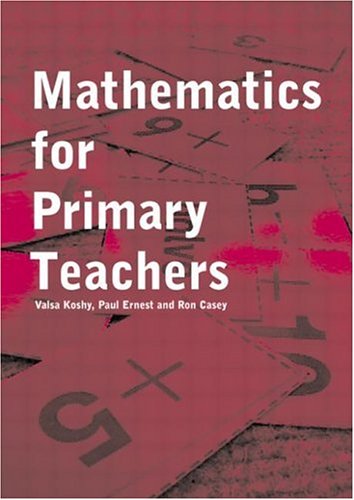
Mathematics for Primary Teachers


Valsa Koshy, Paul Ernest e Ron Casey

RoutledgeFalmer | 2000 | 240 páginas | PDF | 3,5 Mb

link
uploading.com

This book combines accessible explanations of mathematical concepts with practical advice on effective ways of teaching the subject. Section A provides a framework of good practice. Section B aims to support and enhance teachers subject knowledge in mathematical topics beyond what is taught to primary children. Each chapter also highlights teaching issues and gives examples of tasks relevant to the classroom. Section C is a collection of papers from tutors from four universities centred around the theme of effective teaching and quality of learning during this crucial time for mathematics education.


Contents
1. Teaching and learning mathematics
2. Whole numbers
3. Fractions, decimals and percentages
4. Number patterns and sequences
5. Measures
6. Shape and space
7. Probability and statistics
8. Mathematical proof
9. Effective teaching of numeracy
10. Mental mathematics
11. Children's mistakes and misconceptions
12. Using writing to scaffold children's explanations in mathematics
13. Differentiation
Appendices.


terça-feira, 5 de maio de 2009

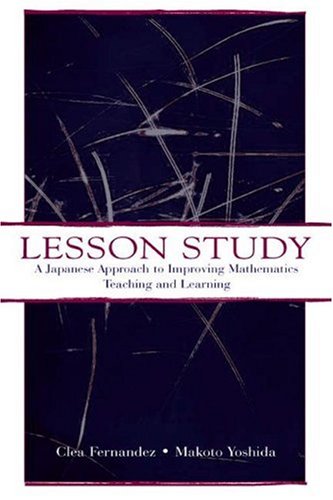
Lesson Study: A Japanese Approach To Improving Mathematics Teaching and Learning


(Studies in Mathematical Thinking and Learning)
Clea Fernandez, Makoto Yoshida

Lawrence Erlbaum | 2004 | 264 páginas | PDF | 15 Mb

link 

Lesson study is a popular professional development approach in Japan whereby teachers collaborate to study content, instruction, and how students solve problems and reach for understanding in order to improve elementary mathematics instruction and learning in the classroom.

This book is the first comprehensive look at the system and process of lesson study in Japan. It describes in detail the process of how teachers conducted lesson study--how they collaborated in order to develop a lesson, what they talked about during the process, and what they looked at in order to understand deeply how students were learning. Readers see the planning of a mathematics lesson, as well as how much content knowledge the teachers have. They observe students' problem solving strategies and learn how Japanese teachers prepare themselves to identify those strategies and facilitate the students' discussion.

Written for mathematics teachers, educational researchers, school administrators interested in teachers' professional development, and professional developers, this landmark volume provides an in-depth understanding of lesson study that can lead to positive changes in teachers' professional development and in teaching and learning in the United States.

Helping Children Learn Mathematics

Jeremy Kilpatrick, Jane Swafford

National Academies Press | 2002 | 52 páginas

on-line: nap.edu

sjsd.k12.mo.us (link direto)
link

Results from national and international assessments indicate that school children in the United States are not learning mathematics well enough. Many students cannot correctly apply computational algorithms to solve problems. Their understanding and use of decimals and fractions are especially weak. Indeed, helping all children succeed in mathematics is an imperative national goal. However, for our youth to succeed, we need to change how we're teaching this discipline. Helping Children Learn Mathematics provides comprehensive and reliable information that will guide efforts to improve school mathematics from pre-kindergarten through eighth grade. The authors explain the five strands of mathematical proficiency and discuss the major changes that need to be made in mathematics instruction, instructional materials, assessments, teacher education, and the broader educational system and answers some of the frequently asked questions when it comes to mathematics instruction. The book concludes by providing recommended actions for parents and caregivers, teachers, administrators, and policy makers, stressing the importance that everyone work together to ensure a mathematically literate society.

On Evaluating Curricular Effectiveness: Judging the Quality of K-12 Mathematics Evaluations

Committee for a Review of the Evaluation Data on the Effectiveness of NSF-Supported and Commercially Generated Mathematics Curriculum Materials, National Research Council

National Academies Press | 2004 | 288 páginas

on-line: nap.edu
pdf - link


This book reviews the evaluation research literature that has accumulated around 19 K 12 mathematics curricula and breaks new ground in framing an ambitious and rigorous approach to curriculum evaluation that has relevance beyond mathematics. The committee that produced this book consisted of mathematicians, mathematics educators, and methodologists who began with the following charge:
  • Evaluate the quality of the evaluations of the thirteen National Science Foundation (NSF)-supported and six commercially generated mathematics curriculum materials;
  • Determine whether the available data are sufficient for evaluating the efficacy of these materials, and if not;
  • Develop recommendations about the design of a project that could result in the generation of more reliable and valid data for evaluating such materials.
  • The committee collected, reviewed, and classified almost 700 studies, solicited expert testimony during two workshops, developed an evaluation framework, established dimensions/criteria for three methodologies (content analyses, comparative studies, and case studies), drew conclusions on the corpus of studies, and made recommendations for future research.

High School Mathematics at Work: Essays and Examples for the Education of All Students


Mathematical Sciences Education Board, National Research Council

National Academies Press | 1998 | 192 páginas

on-line: books.nap.edu

PDF - 1,16 Mb

link
depositfiles.com


This book is a collection of thought-provoking essays that frame basic issues, provide background, and suggest ways to strengthen the mathematical education of all students. The essays present ideas for making mathematical education meaningful for all students--how to meet the practical needs of students entering the work force after high school as well as the needs of those going on to postsecondary education. The essays take up issues such as: finding common ground between science and mathematics education standards and improving the articulation from school to work. High School Mathematics at Work provides thoughtful views from mathematicians, educators, and other experts, and identifies rich possibilities for teaching mathematics and preparing students for the technological challenges of the future.

Improving Mathematics Education: Resources for Decision Making

Steve Leinwand, Gail Burrill (Editors)

National Research Council, Mathematical Sciences Education Board Committee on Decisions That Count

National Academies Press | 2001 | 60 páginas | PDF | 1 Mb

on-line: nap.edu
link
link1

The mathematics students need to learn today is not the same mathematics that their parents and grandparents needed to learn. When today's students become adults, they will face new demands for mathematical proficiency that school mathematics should attempt to anticipate. Moreover, mathematics is a realm no longer restricted to a select few. All young Americans must learn to think mathematically, and they must think mathematically to learn. (Adding It Up, p. 1) 

During the late 1980s and 1990s, events such as publication of the National Council of Teachers of Mathematics (NCTM) Curriculum and Evaluation Standards (NCTM, 1989), the formation of the National Education Goals Panel, and the call for high expectations for all students spurred demands for the improvement of mathematics teaching and learning. As educators struggled to implement changes or to understand what change might mean in their own systems, the Mathematical Sciences Education Board (MSEB) recognized the need to provide support for those involved in this struggle. So, the Board began work on a document that would provide guidance for educators and other stakeholders making crucial decisions regarding their mathematics programs. 

Table of  Contents

Front Matter i-x 
1 Introduction 1-4 
2 What Should We Teach? 5-9 
3 How Should We Teach? 10-18 
4 What Preparation and Support Do Teachers Need 19-29 
5 How Do We Know That What We Are Doing Is Working? 30-34 
6 What Must Change 35-39 
7 Conclusion 40-46 
Securing Copies of the Resources Summarized 47-47 
References 48-49