domingo, 26 de abril de 2009

Vite matematiche Protagonisti del ’900 da Hilbert a Wiles


C. Bartocci, R. Betti, A. Guerraggio, R. Lucchetti
(em italiano)

Springer | 2007 | 335 páginas | pdf | 4 Mb

link
link1

Lo scibile matematico si espande a un ritmo vertiginoso. Nel corso degli ultimi cinquant'anni sono stati dimostrati più teoremi che nei precedenti millenni della storia umana. Per illustrare la ricchezza della matematica del Novecento, il presente volume porta sulla ribalta alcuni dei protagonisti di questa straordinaria impresa intellettuale, che ha messo a nostra disposizione nuovi e potenti strumenti per indagare la realtà che ci circonda.

Presentando matematici famosi accanto ad altri meno noti al grande pubblico – da Hilbert a Gödel, da Turing a Nash, da De Giorgi a Wiles – i ritratti raccolti in questo volume ci presentano personaggi dal forte carisma personale, dai vasti interessi culturali, appassionati nel difendere l’importanza delle proprie ricerche, sensibili alla bellezza, attenti ai problemi sociali e politici del loro tempo.

Ne risulta un affresco che documenta la centralità della matematica nella cultura, non solo scientifica ma anche filosofica, artistica e letteraria, del nostro tempo, in un continuo gioco di scambi e di rimandi, di corrispondenze e di suggestioni.

Aritmetica: un approccio computazionale


(Convergenze)
Giulio Cesare Barozzi
(em italiano)

Springer | 2006 | 124 páginas | pdf | 682 kb

link
link1

Il volume si propone di fornire una prima introduzione alla teoria elementare dei numeri, rivolta agli insegnanti (e ai futuri insegnanti) di matematica. Esso vuole costituire un invito e una preparazione per la lettura di opere più impegnative di cui c'è gran copia nella letteratura di lingua inglese e (ultimamente grazie proprio a Springer) una buona presenza anche in lingua italiana. Esso si caratterizza per avere una "approccio computazionale" cioè per favorire l'uso di un software (scegliendolo tra i più diffusi oggi in commercio) ai fini della costruzione di un laboratorio di calcolo.

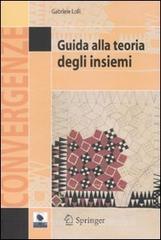
Guida alla teoria degli insiemi

(Convergenze)
Gabriele Lolli
(em italiano)

Springer | 2008 | 148 páginas | pdf | 1 Mb

link
link1

Il libro vuole aiutare a studiare la teoria degli insiemi indicando l'articolazione della teoria, a partire dal concetto di infinito per arrivare alla definizione dei numeri, sia finiti sia infiniti, con la diramazione tra ordinali e cardinali; insiste sulle proprietà degli insiemi numerabili, e sul continuo. Non sostituisce un manuale, perché non ci sono tutte le dimostrazioni ma solo alcune, considerate importanti, che danno il gusto dello stile di questa materia.
Ricorda come la teoria sia nata dalle esigenze dell'analisi matematica e come sia legata al problema dei fondamenti; discute il riduzionismo e presenta anche la teoria alternativa rivale delle categorie.
Distingue la teoria propria dell'infinito dal linguaggio insiemistico che pervade la matematica.
Nelle applicazioni si insiste sul principio di induzione e sulle definizioni induttive, e sulla derivazione delle proprietà degli insiemi finiti, con tutte le definizioni equivalenti di finito, e si indica lo studio delle versioni effettive dei risultati teorici, in particolare la definizione esplicita di funzioni ed enumerazioni, fino gettare un ponte con la teoria della calcolabilità, in vista dell'insegnamento.

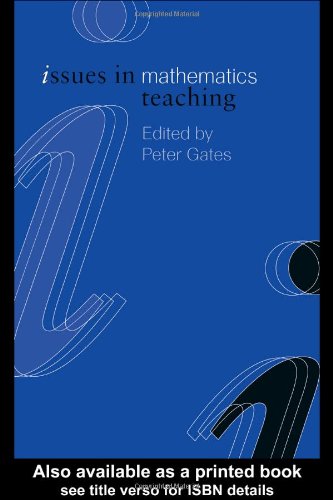
Issues in Mathematics Teaching

(Issues in Subject Teaching)
Peter Gates

Routledge Falmer | 2002 | 336 páginas | pdf | 1,5 Mb

link
link1

Referência em MathEdu

Descrição: This book presents the key debates that the mathematics teacher will need to understand, reflect on and engage in as part of their professional development. Issues in Mathematics Teaching is suitable for those at initial training level right through to practicing mathematics teachers. Its accessible structure enables the reader to pursue the issues raised as each chapter includes suggestions for further reading and questions for reflection or debate.

Contents
List of tables vii
List of figures viii
Contributors ix
Glossary xvi
Introduction: How to make the most of this book 1
PETER GATES
PART I- Setting the scene; raising the issues 5
1 What is an/at issue in mathematics education? 7
PETER GATES
PART II - Issues in the social context of mathematics education 21
2 Mathematics teaching in the real world 23
TONY COTTON
3 Language, social class and underachievement in school mathematics 38
ROBYN ZEVENBERGEN
4 Gender, reason and emotion in secondary mathematics classrooms 51
CARRIE PAECHTER
5 Ethnicity and mathematics education 64
DEREK KASSEM
6 ‘We’ve still got to learn!’ Students’ perspectives on ability grouping and mathematics achievement 77
JO BOALER AND DYLAN WILIAM
7 What values do you teach when you teach mathematics? 93

ALAN BISHOP
8 Policy, practices and principles in teaching numeracy: what makes a difference? 105
MIKE ASKEW
PART III- Issues in the teaching and learning of mathematics 121
9 Teaching mathematics resourcefully 123
KEVIN DELANEY
10 Dealing with misconceptions in mathematics 147
ALCOLM SWAN
11 Adjusting to the newcomer: roles for the computer in mathematics classrooms 166
JANET AINLEY
12 Reading mathematics texts 180
PAUL DOWLING
13 Personal, spiritual, moral, social and cultural issues in teaching mathematics 197
JAN WINTER
PART IV- Issues in the assessment of mathematics 215
14 Making judgements about pupils’ mathematics 217
ANNE WATSON
15 The place of pupil writing in learning, teaching and assessing mathematics 232
CANDIA MORGAN
16 Social class and ‘real-life’ mathematics assessments 245
BARRY COOPER
PART V- Issues in the culture of mathematics teaching 259
17 Inclusion, learning and teaching mathematics: beliefs and values 261
MIKE OLLERTON
18 Critical mathematics education 277
PAUL ERNEST
19 Comparing international practice in the teaching of mathematics 294
PAUL ANDREWS
Subject index 312

Author index 315

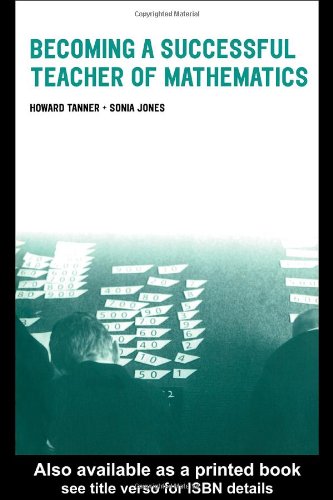
Becoming a Successful Teacher of Mathematics

Sonia Jones, Howard Tanner

RoutledgeFalmer | 2001 | 224 páginas |  pdf |

link

Referência em MathEdu

Becoming a Successful Teacher of Maths is a practical guide for newly qualified teachers of secondary mathematics. It develops the essential core knowledge, skills and understanding demanded by the new DfEE requirements for courses of initial teacher training. It is based on research findings relating to the organisation and management of maths classrooms, teaching approaches, assessment and the common misconceptions which often hinder pupils' progress in key areas of the National Curriculum. Theoretical principles are exemplified through case-study material. Suggestions for school-based activities are made. While being a practical 'how to' guide for beginning teachers, it also offers critical insights for more experienced teachers reflecting on their practice.

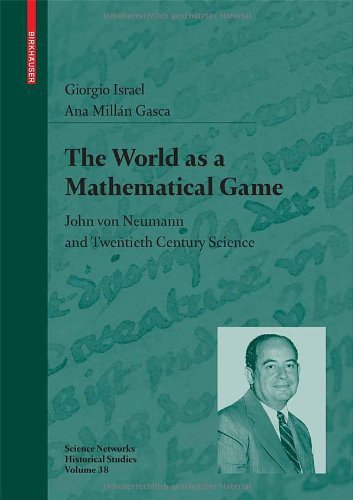
The World as a Mathematical Game: John von Neumann and Twentieth Century Science


(Science Networks. Historical Studies)
Giorgio Israel, Ana Millán Gasca


Birkhäuser Basel | 2009 | 207 páginas | pdf | 1,3 Mb

link direto
link

depositfiles.com (PDF - 1,7 Mb)


Galileo and Newton’s work towards the mathematisation of the physical world; Leibniz’s universal logical calculus; the Enlightenment’s mathematique sociale. John von Neumann inherited all these aims and philosophical intuitions, together with an idea that grew up around the Vienna Circle of an ethics in the form of an exact science capable of guiding individuals to make correct decisions. With the help of his boundless mathematical capacity, von Neumann developed a conception of the world as a mathematical game, a world globally governed by a universal logic in which individual consciousness moved following different strategies: his vision guided him from set theory to quantum mechanics, to economics and to his theory of automata (anticipating artificial intelligence and cognitive science). This book provides the first comprehensive scientific and intellectual biography of John von Neumann, a man who perhaps more than any other is representative of twentieth century science.

From the reviews:

“All the most important features of von Neumann’s impact on 20th-century economics – from the spread of the axiomatic method to the popularization of several analytical techniques to the idea itself of ‘modelization’ as the only proper way to investigate economic phenomena … it follows that this book is a real boon, as well as a must-read, for every historian or economist wishing to understand how, and by whom, modern neoclassical economics has been shaped in the first two or three decades after World War II.” (Nicola Giocoli, History of Economic Ideas, Vol. 18 (1), 2010)

“The World as a Mathematical Game says that the book ‘provides the first comprehensive scientific and intellectual biography of John von Neumann’. It covers the ground well and thoroughly in 175 pages of text, moving chronologically through his astonishing career. … The authors have written their book for a general audience. … In any event, it is good to have this outline of von Neumann’s work.” (Underwood Dudley, The Mathematical Association of America, October, 2009)

quinta-feira, 23 de abril de 2009

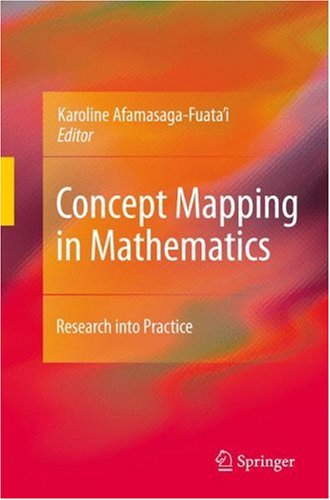
Concept Mapping in Mathematics: Research into Practice


Karoline Afamasaga-Fuata'i (Ed.)

Springer | 2009 | 225 páginas | PDF | 11 Mb

link

Concept Mapping in Mathematics: Research into Practice is the first comprehensive book on concept mapping in mathematics. It provides the reader with an understanding of how the meta-cognitive tool, namely, hierarchical concept maps, and the process of concept mapping can be used innovatively and strategically to improve planning, teaching, learning, and assessment at different educational levels. This collection of research articles examines the usefulness of concept maps in the educational setting, with applications and examples ranging from primary grade classrooms through secondary mathematics to pre-service teacher education, undergraduate mathematics and post-graduate mathematics education. A second meta-cognitive tool, called vee diagrams, is also critically examined by two authors, particularly its value in improving mathematical problem solving.

Thematically, the book flows from a historical development overview of concept mapping in the sciences toapplications of concept mapping in mathematics by teachers and pre-service teachers as a means of analyzing mathematics topics, planning for instruction and designing assessment tasks including applications by school and university students as learning and review tools. This book provides case studies and resources that have been field tested with school and university students alike. The findings presented have implications for enriching mathematics learning and making problem solving more accessible and meaningful for students.

The theoretical underpinnings of concept mapping and of the studies in the book include Ausubel’s cognitive theory of meaningful learning, constructivist and Vygotskian psychology to name a few. There is evidence particularly from international studies such as PISA and TIMSS and mathematics education research, which suggest that students’ mathematical literacy and problem solving skills can be enhanced through students collaborating and interacting as they work, discuss and communicate mathematically. This book proposes the meta-cognitive strategy of concept mapping as one viable means of promoting, communicating and explicating students’ mathematical thinking and reasoning publicly in a social setting (e.g., mathematics classrooms) as they engage in mathematical dialogues and discussions.

Concept Mapping in Mathematics: Research into Practice is of interest to researchers, graduate students, teacher educators and professionals in mathematics education.

Contents
Part I A Historical Overview of Concept Mapping
1 The Development and Evolution of the Concept Mapping Tool Leading to a New Model for Mathematics Education . . 3
Joseph D. Novak and Alberto J. Canas
Part II Primary Mathematics Teaching and Learning
2 Analysing the “Measurement” Strand Using Concept Maps and Vee Diagrams. . 19
Karoline Afamasaga-Fuata’i
3 Concept Mapping as a Means to Develop and Assess Conceptual Understanding in Primary Mathematics Teacher Education . . 47
Jean Schmittau and James J. Vagliardo
4 Using Concept Maps and Vee Diagrams to Analyse the “Fractions” Strand in Primary Mathematics   . 59
Karoline Afamasaga-Fuata’i
5 Concept Maps as Innovative Learning and Assessment Tools in Primary Schools  . . 87
Karoline Afamasaga-Fuata’i and Greg McPhan
Part III Secondary Mathematics Teaching and Learning
6 Evidence of Meaningful Learning in the Topic of ‘Proportionality’ in Second Grade Secondary Education . . . 117
Edurne Pozueta and Fermın M. Gonz´alez
7 Concept Mapping as a Means to Develop and Assess Conceptual Understanding in Secondary Mathematics Teacher Education . 137
Jean Schmittau
8 Concept Mapping a Teaching Sequence and Lesson Plan for “Derivatives” . . 149
Karoline Afamasaga-Fuata’i
9 Curricular Implications of Concept Mapping in Secondary Mathematics Education . . 171
James J. Vagliardo
10 Using Concept Maps and Gowin’s Vee to Understand Mathematical Models of Physical Phenomena  . . 189
Maria S. Ram´ırez De Mantilla, Mario Asp´ee, Irma Sanabria,, and Neyra Tellez
11 Applying Concept Mapping to Algebra I . . . . 217
William Caldwell
Part IV University Mathematics Teaching and Learning
12 Enhancing Undergraduate Mathematics Learning Using Concept Maps and Vee Diagrams. . . . 237
Karoline Afamasaga-Fuata’i
13 Concept Mapping: An Important Guide for the Mathematics Teaching Process . . 259
Rafael Perez Flores
14 Concept Mapping and Vee Diagramming “Differential Equations” . . . 279
Karoline Afamasaga-Fuata’i
15 Using Concept Maps to Mediate Meaning in Undergraduate Mathematics . . 299
Karoline Afamasaga-Fuata’i
Part V Future Directions
16 Implications and Future Research Directions. . 329
Karoline Afamasaga-Fuata’i