domingo, 15 de março de 2009

A History of Mathematics: From Mesopotamia to Modernity

Luke Hodgkin

Oxford University Press, USA | 2005 | 294 páginas| PDF


math-cs.aut.ac.ir (link direto)
static.schoolrack.com (linkdireto)
f3.tiera.ru (linkdireto)
link


A History of Mathematics: From Mesopotamia to Modernity covers the evolution of mathematics through time and across the major Eastern and Western civilizations. It begins in Babylon, then describes the trials and tribulations of the Greek mathematicians. The important, and often neglected, influence of both Chinese and Islamic mathematics is covered in detail, placing the description of early Western mathematics in a global context. The book concludes with modern mathematics, covering recent developments such as the advent of the computer, chaos theory, topology, mathematical physics, and the solution of Fermat's Last Theorem. Containing more than 100 illustrations and figures, this text, aimed at advanced undergraduates and postgraduates, addresses the methods and challenges associated with studying the history of mathematics. The reader is introduced to the leading figures in the history of mathematics (including Archimedes, Ptolemy, Qin Jiushao, al-Kashi, al-Khwasizmi, Galileo, Newton, Leibniz, Helmholtz, Hilbert, Alan Turing, and Andrew Wiles) and their fields. An extensive bibliography with cross-references to key texts will provide invaluable resource to students and exercises (with solutions) will stretch the more advanced reader.

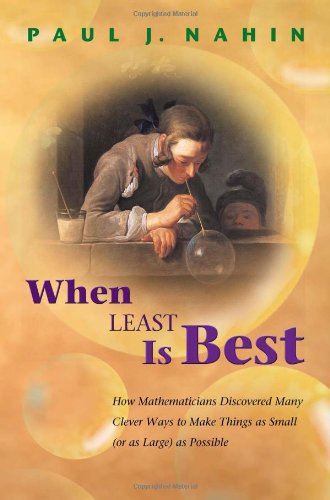
When Least Is Best: How Mathematicians Discovered Many Clever Ways to Make Things as Small (or as Large) as Possible

Paul J. Nahin

Princeton University Press | 2007 | 400 páginas | Djvu | 2,4 MB

link
link1
link2

What is the best way to photograph a speeding bullet? Why does light move through glass in the least amount of time possible? How can lost hikers find their way out of a forest? What will rainbows look like in the future? Why do soap bubbles have a shape that gives them the least area?

By combining the mathematical history of extrema with contemporary examples, Paul J. Nahin answers these intriguing questions and more in this engaging and witty volume. He shows how life often works at the extremes--with values becoming as small (or as large) as possible--and how mathematicians over the centuries have struggled to calculate these problems of minima and maxima. From medieval writings to the development of modern calculus to the current field of optimization, Nahin tells the story of Dido's problem, Fermat and Descartes, Torricelli, Bishop Berkeley, Goldschmidt, and more. Along the way, he explores how to build the shortest bridge possible between two towns, how to shop for garbage bags, how to vary speed during a race, and how to make the perfect basketball shot.

Written in a conversational tone and requiring only an early undergraduate level of mathematical knowledge, When Least Is Best is full of fascinating examples and ready-to-try-at-home experiments. This is the first book on optimization written for a wide audience, and math enthusiasts of all backgrounds will delight in its lively topics.

Companion Encyclopedia of the History and Philosophy of the Mathematical Sciences


Vol. 2
(Routledge reference)
Grattan-Guinness I

Routledge | 1992 | 1819 páginas | epub | 7,22 Mb

link

Comentário em: MAA

Mathematics is one of the most basic -- and most ancient -- types of knowledge. Yet the details of its historical development remain obscure to all but a few specialists. The two-volume Companion Encyclopedia of the History and Philosophy of the Mathematical Sciences recovers this mathematical heritage, bringing together many of the world's leading historians of mathematics to examine the history and philosophy of the mathematical sciences in a cultural context, tracing their evolution from ancient times to the twentieth century.
In 176 concise articles divided into twelve parts, contributors describe and analyze the variety of problems, theories, proofs, and techniques in all areas of pure and applied mathematics, including probability and statistics. This indispensable reference work demonstrates the continuing importance of mathematics and its use in physics, astronomy, engineering, computer science, philosophy, and the social sciences. Also addressed is the history of higher education in mathematics. Carefully illustrated, with annotated bibliographies of sources for each article, The Companion Encyclopedia is a valuable research tool for students and teachers in all branches of mathematics.

Contents of Volume 1: -Ancient and Non-Western Traditions -The Western Middle Ages and the Renaissance -Calculus and Mathematical Analysis -Functions, Series, and Methods in Analysis -Logic, Set Theories, and the Foundations of Mathematics -Algebras and Number Theory

Contents of Volume 2: -Geometries and Topology -Mechanics and Mechanical Engineering -Physics, Mathematical Physics, and Electrical Engineering -Probability, Statistics, and the Social Sciences -Higher Education andInstitutions -Mathematics and Culture -Select Bibliography, Chronology, Biographical Notes, and Index

Prince of Mathematics: Carl Friedrich Gauss


M. B. W. Tent

A K Peters Ltd | 2006 | 264 páginas| PDF | 14 Mb

link
link1

djvu - 1,3 Mb

link
link1

The author narrates the life of Carl Friedrich Gauss, the 18th century mathematician, from his prodigious childhood to his extraordinary achievements that earned him the title "Prince of Mathematics". Along the way, the author introduces her readers to a different culture, the era of small states in Germany where advancement on merits, such as Gauss, was supported by enlightened rulers, competing for intellectual excellence and economic advantage through scientific progress in their small states. Based on extensive research of original and secondary sources, the author has created an historical narrative that will inspire young readers and even curious adults with a story full of human touch and personal achievement.

Gauss: A Biographical Study

Walter K. Buhler

Springer | 1981 | 208 páginas | djvu | 2 MB

link direto
link
link1

This book describes the life of the mathematician and scientist Carl Friedrich Gauss. Gauss lived in a period of extraordinary political and social developments, even measured by the standards of our own fast moving and eventful age. He was 12 years old when the French Revolution broke out, 29 when the seemingly eternal, l000-year-old Holy Roman Empire was dissolved, 38 when Napoleon was defeated, and over 70 when Germany had its own liberal revolution in 1848. During the same period, the so-called first industrial revolution took place, with its lasting and incisive effects on everyday life and the political and social order. It is clear that all this affected Gauss's life in an explicit and tangible way.

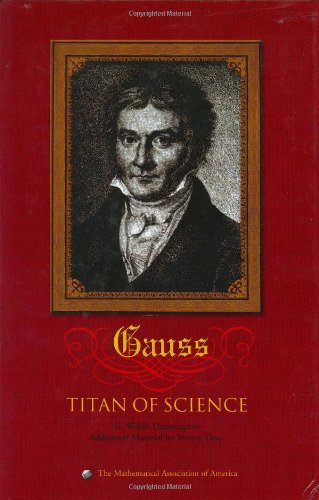
Carl Friedrich Gauss: Titan of Science

(Spectrum) 

G. Waldo Dunnington


The Mathematical Association of America | 2004 | 568 páginas | DjVu | 8,69 MB

link direto
link
link1

Referência em: MathEduc

This biography of Gauss, Germany's greatest mathematician, is easily the most comprehensive in English. Long out of print and very rare in the used book market, this valuable piece of scholarship is being reissued in an augmented form with additional material by the eminent British mathematical historian, Jeremy Gray.

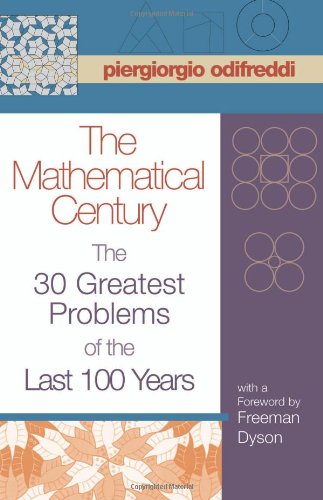
The Mathematical Century: The 30 Greatest Problems of the Last 100 Years

Piergiorgio Odifreddi

Princeton University Press | 2004 | 224 páginas |

(djvu - 1,6 Mb)

link
libgen.info
libgen.info

(PDF | 7,8 MB)
scribd.com

Referência em: MathEduc


The twentieth century was a time of unprecedented development in mathematics, as well as in all sciences: more theorems were proved and results found in a hundred years than in all of previous history. In The Mathematical Century, Piergiorgio Odifreddi distills this unwieldy mass of knowledge into a fascinating and authoritative overview of the subject. He concentrates on thirty highlights of pure and applied mathematics. Each tells the story of an exciting problem, from its historical origins to its modern solution, in lively prose free of technical details.

Odifreddi opens by discussing the four main philosophical foundations of mathematics of the nineteenth century and ends by describing the four most important open mathematical problems of the twenty-first century. In presenting the thirty problems at the heart of the book he devotes equal attention to pure and applied mathematics, with applications ranging from physics and computer science to biology and economics. Special attention is dedicated to the famous "23 problems" outlined by David Hilbert in his address to the International Congress of Mathematicians in 1900 as a research program for the new century, and to the work of the winners of the Fields Medal, the equivalent of a Nobel prize in mathematics.

This eminently readable book will be treasured not only by students and their teachers but also by all those who seek to make sense of the elusive macrocosm of twentieth-century mathematics.


TABLE OF CONTENTS:
Foreword xi
Acknowledgments xvii
Introduction 1
CHAPTER 1: THE FOUNDATIONS 8
1.1. The 1920s: Sets 10
1.2. The 1940s: Structures 14
1.3. The 1960s: Categories 17
1.4. The 1980s: Functions 21
CHAPTER TWO: PURE MATHEMATICS 25
2.1. Mathematical Analysis: Lebesgue Measure (1902) 29
2.2. Algebra: Steinitz Classification of Fields (1910) 33
2.3. Topology: Brouwer's Fixed-Point Theorem (1910) 37
2.4. Number Theory: Gelfand Transcendental Numbers (1929) 39
2.5. Logic: Gödel's Incompleteness Theorem (1931) 43
2.6. The Calculus of Variations: Douglas's Minimal Surfaces (1931) 47
2.7. Mathematical Analysis: Schwartz's Theory of Distributions (1945) 52
2.8. Differential Topology: Milnor's Exotic Structures (1956) 56
2.9. Model Theory: Robinson's Hyperreal Numbers (1961) 59
2.10. Set Theory: Cohen's Independence Theorem (1963) 63
2.11. Singularity Theory: Thom's Classification of Catastrophes (1964) 66
2.12. Algebra: Gorenstein's Classification of Finite Groups (1972) 71
2.13. Topology: Thurston's Classification of 3-Dimensional Surfaces (1982) 78
2.14. Number Theory: Wiles's Proof of Fermat's Last Theorem (1995) 82
2.15. Discrete Geometry: Hales's Solution of Kepler's Problem (1998) 87
CHAPTER THREE: APPLIED MATHEMATICS 92
3.1. Crystallography: Bieberbach's Symmetry Groups (1910) 98
3.2. Tensor Calculus: Einstein's General Theory of Relativity (1915) 104
3.3. Game Theory: Von Neumann's Minimax Theorem (1928) 108
3.4. Functional Analysis: Von Neumann's Axiomatization of Quantum Mechanics (1932) 112
3.5. Probability Theory: Kolmogorov's Axiomatization (1933) 116
3.6. Optimization Theory: Dantzig's Simplex Method (1947) 120
3.7. General Equilibrium Theory: The Arrow-Debreu Existence Theorem (1954) 122
3.8. The Theory of Formal Languages: Chomsky's Classification (1957) 125
3.9. Dynamical Systems Theory: The KAM Theorem (1962) 128
3.10. Knot Theory: Jones Invariants (1984) 132
CHAPTER FOUR: MATHEMATICS AND THE COMPUTER 139
4.1. The Theory of Algorithms: Turing's Characterization (1936) 145
4.2. Artificial Intelligence: Shannon's Analysis of the Game of Chess (1950) 148
4.3. Chaos Theory: Lorenz's Strange Attractor (1963) 151
4.4. Computer-Assisted Proofs: The Four-Color Theorem of Appel and Haken (1976) 154
4.5. Fractals: The Mandelbrot Set (1980) 159
CHAPTER FIVE: OPEN PROBLEMS 165
5.1. Arithmetic: The Perfect Numbers Problem (300 BC) 166
5.2. Complex Analysis: The Riemann Hypothesis (1859) 168
5.3. Algebraic Topology: The Poincare Conjecture (1904) 172
5.4. Complexity Theory: The P=NP Problem (1972) 176
Conclusion 181
References and Further Reading 187
Index 189