terça-feira, 10 de março de 2009

Radical Constructivism in Mathematics Education


(Mathematics Education Library, vol. 7)

E. von Glasersfeld

Springer | 1991 | 272 páginas | PDF | 3 Mb

link
link1
link2

Referência em: MathEduc

This book is a collection of essays forming a mosaic of theory, research, and practice directed at the task of spreading mathematical knowledge based on the learning theory of constructivism. The authors collectively address questions raised by the observation that current practice frequently generate in the student an aversion to mathematics. Each author, having extensive experience in teaching as well as educational research, approaches the problem with the conviction that knowledge is not simply transferred from one individual to another, but actively built up by each learner in his or her own mind. This notion is today embraced by all who call themselves "constructivists". The 11 essays include: (1) "There Is No More Safety in Numbers: A New Conception of Mathematics Teaching" (Philip Steedman); (2) "Mathematical Discussions" (John Richards); (3) "Notations and Representations as Mediators of Constructive Processes" (James Kaput); (4) "Making Math Mean" (Jack Lochhead); (5) "Treatment of Refutations: Aspects of the Complexity of a Constructivist Approach to Mathematics Learning" (Nicolas Balacheff); (6) "Learning to Listen: A Student's Understanding of Powers of Ten" (Jere Confrey); (7) "Understanding Students' Beliefs about Probability" (Clifford Konold); (8) "A Constructivist Approach to Second Grade Mathematics" (Paul Cobb, Terry Wood, and Erna Yankel); (9) "The Constructivist Teaching Experiment: Illustrations and Implications" (Leslie Steffe); (10) "Didactic Constructivism" (Jan van den Brink); and (11) "Two Layers of Constructivist Curricular Interaction" (Robert Underhill).

Manual de Matemáticas para Maestros


Juan D. Godino.

Departamento de Didáctica de la Matemática - Facultad de Ciencias de la Educación
Universidad de Granada | 2002 | 456 páginas | PDF | 8,08 Mb

Link direto:
ugr.es

Signs of the Inka Khipu: Binary Coding in the Andean Knotted-String Records


Gary Urton

University of Texas Press | 2003 | 216 páginas | PDF | 7,4 MB

link
link1

In an age when computers process immense amounts of information by the manipulation of sequences of 1s and 0s, it remains a frustrating mystery how prehistoric Inka recordkeepers encoded a tremendous variety and quantity of data using only knotted and dyed strings. Yet the comparison between computers and khipu may hold an important clue to deciphering the Inka records. In this book, Gary Urton sets forth a pathbreaking theory that the manipulation of fibers in the construction of khipu created physical features that constitute binary-coded sequences which store units of information in a system of binary recordkeeping that was used throughout the Inka empire.
Urton begins his theory with the making of khipu, showing how at each step of the process binary, either/or choices were made. He then investigates the symbolic components of the binary coding system, the amount of information that could have been encoded, procedures that may have been used for reading the khipu, the nature of the khipu signs, and, finally, the nature of the khipu recording system itself—emphasizing relations of markedness and semantic coupling. This research constitutes a major step forward in building a unified theory of the khipu system of information storage and communication based on the sum total of construction features making up these extraordinary objects.

The Social Life of Numbers: A Quechua Ontology of Numbers and Philosophy of Arithmetic


Gary Urton

University of Texas Press | 1997 | 267 páginas | PDF | 28 MB

link
link1

Referência em: MathEduc

Unraveling all the mysteries of the khipu—the knotted string device used by the Inka to record both statistical data and narrative accounts of myths, histories, and genealogies—will require an understanding of how number values and relations may have been used to encode information on social, familial, and political relationships and structures. This is the problem Gary Urton tackles in his pathfinding study of the origin, meaning, and significance of numbers and the philosophical principles underlying the practice of arithmetic among Quechua-speaking peoples of the Andes.
Based on fieldwork in communities around Sucre, in south-central Bolivia, Urton argues that the origin and meaning of numbers were and are conceived of by Quechua-speaking peoples in ways similar to their ideas about, and formulations of, gender, age, and social relations. He also demonstrates that their practice of arithmetic is based on a well-articulated body of philosophical principles and values that reflects a continuous attempt to maintain balance, harmony, and equilibrium in the material, social, and moral spheres of community life.

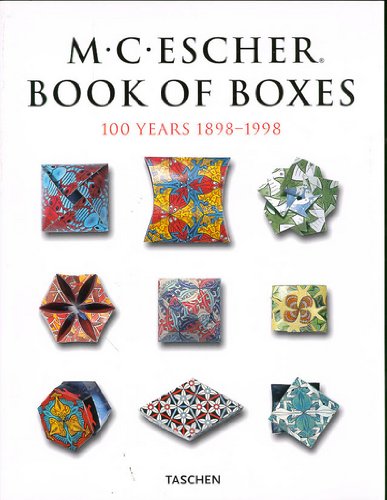
M.C. Escher, Book of Boxes: 100 Years 1898-1998

(Taschen Specials)
M. C. Escher

Benedikt Taschen Verlag | 1998 | 24 páginas | PDF | 3,6 Mb

4shared.com
scribd.com
libgen.info
bookfi.org

A look at the boxes designed by M.C. Escher

M. C. Escher's Legacy: A Centennial Celebration

Doris Schattschneider, Michele Emmer

Springer | 2005 | 458 páginas | PDF | 29 Mb


Referência em: MathEduc

.. This conference [an international congress held in June of 1998 in Rome and Ravello, Italy, to celebrate the centennial of the birth of Escher] resulted in an immensely interesting collection of articles presented in the book M.C.Escher's Legacy, A Centennial Celebration". ... Although Escher himself is no longer among us, M.C.Escher's Legacy, like a garden of continually blooming flowers, allows us to appreciate his heritage anew." Reza Sarhangi, Notices of the AMS, April 2003 "... It is a handsome volume, and contains articles from 41 people, which cover a wide range of artistic and analytical endeavour. ... A quick dip into each section produces small gems. ... there is enough here to provide rich pickings for any interested party, no matter what their particular discipline is. Embedded in the various articles are even snippets which illuminate Escher's intentions, and his relationships with his mathematician friends (Coxeter, Penrose, Ernst et al). Even though short, these are rewarding to read. If you are an educator in any of the fields mentioned in the paragraph below, this book is immediately worth a look... If I was a librarian of an institution which encompassed any two of fine arts, mathematics philosophy, physical science, psychology, I would definitely demand its purchase: if as many as three of them, demand it loudly! ... the CD-ROM ... is an excellent addition to the book, and contains much more material, including "video" excerpts from some of the lectures.)" Warren Brisley, Australian Mathematical Society GAZETTE, Volume 30, Number 2, May 2003


Table of Contents
Preface
  • Celebrating Escher
  • Escher, in Rome, Again
Contents
Escher’s Fondness for Animals
Selection is Distortion
Ravello: An Escherian Place
Mystery, Classicism, Elegance:an Endless Chase After Magic
M.C. Escher and C.v.S. Roosevelt
Escher’s Sense of Wonder
In Search of M.C. Escher’s MetaphysicalUnconscious
Parallel Worlds: Escher and Mathematics,Revisited
M.C. Escher in Italy: The Trail Back
Islamic Patterns: The Spark in Escher’s Genius
Space Time with M.C. Escher and R. Buckminster Fuller
Between Illusion and Reality
Painting After M.C. Escher
M.C. Escher: Art, Math, and Cinema
Organic Structures Related to M.C. Escher’s Work
Extending Escher’s Recognizable-Motif Tilings to Multiple-Solution Tilings and Fractal Tilings
A Circle Limit in Stone
Portrait of Escher: Behind the Mirror
Life After Escher: A (Young) Artist’s Journey
Sharing some Common Interests of M.C. Escher
New Expressions in Tessellating Art: Layered Three-Dimensional Tessellations
The Mirrors of the Master
Tilings and Other Unusual Escher-Related Prints
Escher-Like Patterns from Pentagonal Tilings
Not the Tiles, but the Joints: A little BridgeBetween M.C. Escher and Leonardo da Vinci
Architecture, Perspective and Scenography in the Graphic Work of M.C. Escher:From Vredeman de Vries to Luca Ronconi
Hand with Reflective Sphere to Six-Point Perspective Sphere
Families of Escher Patterns
The Trigonometry of Escher’s Woodcut Circle Limit III
Escher in the Classroom
Chaotic Geodesic Motion: An Extension of M.C. Escher’s Circle Limit Designs
Rotations and Notations
Folding Rings of Eight Cubes
Dethronement of the Symmetry Plane
Computer Games Based on Escher’s Spatial Illusions
Escher’s World: Structure, Symmetry, Sense
Adapting Escher’s Rules for ‘‘Regular Divisionof the Plane’’ to Create TesselMania!®
M.C. Escher at the Museum:An Educator’s Perspective
Escher, Napoleon, Fermat and the Nine-point Centre
The Symmetry Mystique
Escher-Like Tessellations on Spherical Models
Appendix

Didáctica de la Estadística


Carmen Batanero

Grupo de Investigación en Educación Estadística | 2001 | 201 páginas | PDF |

link direto

Para mais livros e artigos sobre o ensino da estatística:
ugr.es