quarta-feira, 25 de fevereiro de 2009

Beyond Constructivism: Models and Modeling Perspectives on Mathematics Problem Solving, Learning, and Teaching

Richard A. Lesh, Helen M. Doerr

Lawrence Erlbaum| 2003 | 331 páginas | PDF | 30 Mb

link

Referência em: MathEduc

This book has two primary goals. On the level of theory development, the book clarifies the nature of an emerging "models and modeling perspective" about teaching, learning, and problem solving in mathematics and science education. On the level of emphasizing practical problems, it clarifies the nature of some of the most important elementary-but-powerful mathematical or scientific understandings and abilities that Americans are likely to need as foundations for success in the present and future technology-based information age. Beyond Constructivism: Models and Modeling Perspectives on Mathematics Problem Solving, Learning, and Teaching features an innovative Web site housing online appendices for each chapter, designed to supplement the print chapters with digital resources that include example problems, relevant research tools and video clips, as well as transcripts and other samples of students' work: modeling/ This is an essential volume for graduate-level courses in mathematics and science education, cognition and learning, and critical and creative thinking, as well as a valuable resource for researchers and practitioners in these areas.
Table of Contents
Contents
Preface
PART I: INTRODUCTION TO A MODELS AND MODELING PERSPECTIVE
1 Foundations of a Models and Modeling Perspective on Mathematics Teaching, Learning, and Problem Solving
Richard Lesh and Helen M. Doerr
2 Model Development Sequences
Richard Lesh, Kathleen Cramer, Helen M. Doerr, Thomas Post, and Judith S. Zawojewski
3 Origins and Evolution of Model-Based Reasoning in Mathematics and Science
Richard Lehrer and Leona Schauble
4 Piagetian Conceptual Systems and Models for Mathematizing Everyday Experiences
Richard Lesh and Guadalupe Carmona
5 A Semiotic Look at Modeling Behavior
Paul E. Kehle and Frank K. Lester, Jr.
6 A Modeling Perspective on Teacher Development
Helen M. Doerr and Richard Lesh
7 A Modeling Approach for Providing Teacher Development
Roberta Y. Schorr and Richard Lesh
8 A Modeling Approach to Describe Teacher Knowledge
Karen Koellner Clark and Richard Lesh
9 Task-Analysis Cycles as Tools for Supporting Students' Mathematical Development
Kay McClain
10 Explanations Why? The Role of Explanations in Answers to (Assessment) Problems
Martin van Reeuwijk and Monica Wijers
PART HI: MODELS AND MODELING AS VIEWED BY HEAVY USERS OF MATHEMATICS
11 What Mathematical Abilities Are Needed for Success Beyond School in a Technology-Based Age of Information?
Richard Lesh, Judith S. Zawojewski, and Guadalupe Carmona
12 The EPICS Model in Engineering Education: Perspectives on Problem-Solving Abilities Needed for Success Beyond Schools
William Oakes and Anthony G. Rud, Jr.
13 The Case for Cases
Geza Kardos
14 Introduction to an Economic Problem: A Models and Modeling Perspective
Charalambos D. Aliprantis and Guadalupe Carmona
15 A Models and Modeling Perspective on Technology-Based Representational Media
Tristan Johnson and Richard Lesh
16 A Models and Modeling Perspective on Skills for the High Performance Workplace
Melissa J. Dark
PART IV: MODELS AND MODELING IN PROBLEM SOLVING AND LEARNING
17 Ends-in-View Problems
Lyn English and Richard Lesh
18 A Models and Modeling Perspective on Problem Solving
Judith S. Zawojewski and Richard Lesh
19 A Models and Modeling Perspective on the Role of Small Group Learning Activities
Judith S. Zawojewski, Richard Lesh, and Lyn English
20 Local Conceptual Development of Proof Schemes in a Cooperative Learning Setting
Guershon Harel and Richard Lesh
21 A Models and Modeling Perspective on Metacognitive Functioning in Everyday Situations Where Problem Solvers Develop Mathematical Constructs
Richard Lesh, Frank K. Lester, Jr., and Margret Hjalmarson
22 Interest, Identity, and Social Functioning: Central Features of Modeling Activity
James A. Middleton, Richard Lesh, and Michelle Heger
PART V: MODELS AND MODELING BEFORE AND AFTER MIDDLE SCHOOL
23 Beyond Constructivism: An Improved Fitness Metaphor for the Acquisition of Mathematical Knowledge
Susan J. Lamon
24 Using a Translation Model for Curriculum Development and Classroom Instruction
Kathleen Cramer
25 Integrating a Models and Modeling Perspective With Existing Research and Practice
Marilyn Carlson, Sean Larsen, and Richard Lesh
26 Models of Functions and Models of Situations: On the Design of Modeling-Based Learning Environments
Beba Shternberg and Michal Yerushalmy
27 From Problem Solving to Modeling: The Evolution of Thinking About Research on Complex Mathematical Activity
Frank K. Lester, Jr., and Paul E. Kehle
28 In What Ways Does a Models and Modeling Perspective Move Beyond Constructivism?
Richard Lesh and Helen M. Doerr
References
Author Index
Subject Index

Topics in Elementary Geometry


O. Bottema

Springer | 2008 | 142 páginas | PDF| 1,2 MB

This small book has for a long time been a unique place to find classical results from geometry, such as Pythagoras' theorem, the nine-point circle, Morley's triangle, Poncelet's polygons, and many other subjects. In addition, this book contains recent, geometric theorems which have been obtained in this classical field over the past years. There are 27 independent chapters on a wide range of topics in elementary plane Euclidean geometry, at a level just beyond what is usually taught in a good high school or college geometry course. The selection of topics is intelligent, varied, and stimulating. In a small space the author provides many thought-provoking ideas. This book will fit in well with the increasing interest for geometry in research and education. This book was originally published in Dutch, and this will be the first English translation.


terça-feira, 24 de fevereiro de 2009

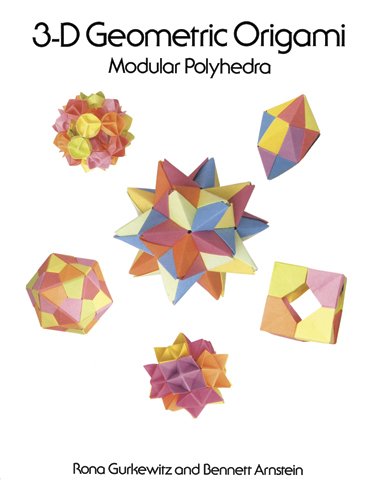
3-D Geometric Origami: Modular Polyhedra


Rona Gurkewitz, Bennett Arnstein

Dover Publications | 1996 | 80 pages | PDF | 5,7 Mb

scribd.com

Innovative, stimulating and challenging book combines the art of paperfolding with making polyhedra-based models. Projects range from the relatively simple cube and tetrahedron to such mind-boggling fabrications as the double pentagonal pyramid and the truncated hexadecahedron. Instructions and diagrams included.


Key to Algebra

Este resumo não está disponível. Clique aqui para ver a mensagem.

Decimais

Key to Decimals: Decimal Concepts
Book 1 (Key to Decimals)
Steven Rasmussen, Spreck Rosekraus,

Key Curriculum Press | 1985 | PDF | 7 MB | 45 páginas

rapidshare.com
rapidshare.com


Key to Decimals: Adding, Subtracting, Multiplying
Book 2 (Key to Decimals)

Key Curriculum Press | 1985 | PDF | 5,1 MB | 48 páginas
uploading.com


Key to Decimals: Dividing
Book 3 (Key to Decimals)
Steven Rasmussen, Spreck Rosekraus
Key Curriculum Press | 1985 | PDF | 5 MB | 47 páginas

uploading.com


Key to Decimals: Answers and Notes
Steven Rasmussen, Spreck Rosekraus
Key Curriculum Press | 1993 | PDF | 11,4 MB | 48 páginas

uploading.com

Statistics in Action, Understanding a World of Data


Ann E. Watkins; Richard L. Scheaffer e George W. Cobb

Key Curriculum Press | 2008 - 2ª edição | 894 páginas | pdf | 28 MB

Ano de escolaridade: 11.º ano

link
link1

Contents
A Note to Students from the Authors ix
Statistical Reasoning: Investigating a
Claim of Discrimination 2
1.1 Discrimination in the Workplace: Data Exploration 4
1.2 Discrimination in the Workplace: Inference 11
Chapter Summary 20
Exploring Distributions 26
2.1 Visualizing Distributions: Shape, Center, and Spread 28
2.2 Graphical Displays of Distributions 42
2.3 Measures of Center and Spread 56
2.4 Working with Summary Statistics 74
2.5 The Normal Distribution 83
Chapter Summary 95
Relationships Between Two Quantitative Variables 104
3.1 Scatterplots 106
3.2 Getting a Line on the Pattern 116
3.3 Correlation: The Strength of a Linear Trend 140
3.4 Diagnostics: Looking for Features That the Summaries Miss 162
3.5 Shape-Changing Transformations 179
Chapter Summary 203
Sample Surveys and Experiments 216
4.1 Why Take Samples, and How Not To 219
4.2 Random Sampling: Playing It Safe by Taking Chances 231
4.3 Experiments and Inference About Cause 243
4.4 Designing Experiments to Reduce Variability 262
Chapter Summary 278
Probability Models 286
5.1 Constructing Models of Random Behavior 288
5.2 Using Simulation to Estimate Probabilities 301
5.3 The Addition Rule and Disjoint Events 315
5.4 Conditional Probability 325
5.5 Independent Events 339
Chapter Summary 349
Probability Distributions 356
6.1 Random Variables and Expected Value 358
6.2 The Binomial Distribution 382
6.3 The Geometric Distribution 393
Chapter Summary 402
Sampling Distributions 408
7.1 Generating Sampling Distributions 410
7.2 Sampling Distribution of the Sample Mean 426
7.3 Sampling Distribution of the Sample Proportion 446
Chapter Summary 458
Inference for Proportions 466
8.1 Estimating a Proportion with Confi dence 468
8.2 Testing a Proportion 490
8.3 A Confi dence Interval for the Diff erence of Two Proportions 518
8.4 A Signifi cance Test for the Diff erence of Two Proportions 526
8.5 Inference for Experiments 539
Chapter Summary 554
Inference for Means 560
9.1 A Confi dence Interval for a Mean 562
9.2 A Signifi cance Test for a Mean 580
9.3 When Things Aren’t Normal 602
9.4 Inference for the Diff erence Between Two Means 616
9.5 Paired Comparisons 640
Chapter Summary 663
Chi-Square Tests 672
10.1 Testing a Probability Model: The Chi-Square Goodness-of-Fit Test 674
10.2 The Chi-Square Test of Homogeneity 692
10.3 The Chi-Square Test of Independence 711
Chapter Summary 728
Inference for Regression 736
11.1 Variation in the Slope from Sample to Sample 739
11.2 Making Inferences About Slopes 755
11.3 Transforming for a Better Fit 771
Chapter Summary 790
Statistics in Action: Case Studies 798
12.1 Mum’s the Word! 800
12.2 Keeping Tabs on Americans 803
12.3 Baseball: Does Money Buy Success? 810
12.4 Martin v. Westvaco Revisited: Testing for Discrimination
Against Employees 817
Statistical Tables 824
Table A: Standard Normal Probabilities 824
Table B: t-Distribution Critical Values 826

Referência em: MathEduc

Discovering Algebra - An Investigative Approach


Jerald Murdock, Ellen Kamischke, e Eric Kamischke

Key Curriculum Press | 2007 - 2ª edição | 721 páginas | pdf | 21 MB

Anos de escolaridade: 8.º a 10.º ano

link direto
link
link1


Discovering Algebra will help you reach more of your students with meaningful activities that help them connect abstract mathematical concepts to concrete experiences.
The Discovering Algebra approach improves learning in many ways:

Investigations at the beginning of each lesson help you give all your students—regardless of their mathematical backgrounds—a shared experience from which to base their learning.
You will be able to teach an algebra course that is both rigorous and accessible to your students because the investigations give meaning to mathematics that all students, regardless of their skill level, can understand.
The investigations will often prompt more advanced students to dig deeper, giving you a natural way to extend the lesson and connect algebra to other topics.
Investigations, visual representations, and opportunities for discussion enable you to integrate multiple teaching modes into your classroom so that visual, auditory, and kinesthetic learners all benefit.
These investigations will also provide you with another tool to use when reviewing and building upon concepts in class. Many teachers tell us that their students find it easier to remember previously taught mathematical concepts and skills when reminded of the classroom activity that helped them learn the concept.