sexta-feira, 20 de fevereiro de 2009

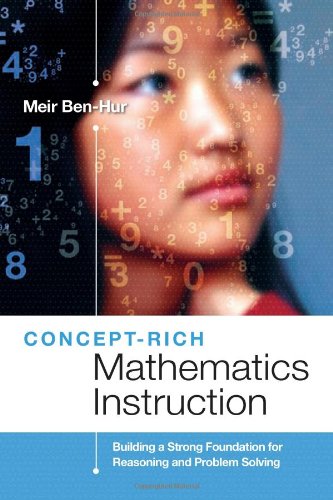
Concept-Rich Mathematics Instruction: Building a Strong Foundation for Reasoning and Problem Solving

Meir Ben-Hur

Association for Supervision & Curriculum Deve | 2006 | 151 páginas | PDF

4shared.com/
link


Have you ever wondered why students too often have only a rudimentary understanding of mathematics, why even rich and exciting hands-on learning does not always result in "real" learning of new concepts? The answer lies in whether students have actually learned mathematical concepts, rather than merely memorizing facts and formulas.

Concept-Rich Mathematics Instruction is based on the constructivist view that concepts are not simply facts to be memorized and later recalled, but rather knowledge that learners develop through an active process of adapting to new experiences.

The teacher's role is critical in this process. When teachers prompt students to reflect on their experiences and report and answer questions verbally, students must re-examine and even revise their concepts of reality.

Meir Ben-Hur offers expert guidance on all aspects of Concept-Rich Mathematics Instruction, including
*Identifying the core concepts of the mathematics curriculum.
*Planning instructional sequences that build upon concepts that students already understand.
*Designing learning experiences that provoke thoughtful discussions about new concepts and prepare students to apply these concepts on their own.
*Identifying student errors, particularly those caused by preconceptions, as important sources of information and as key instructional tools.
*Conducting classroom dialogues that are rich in alternative representations.
*Using a variety of formative assessment methods to reveal the state of students’ learning.
*Incorporating problem-solving activities that provoke cognitive dissonance and enhance students' cognitive competence.

Concept-Rich Mathematics Instruction is grounded in the belief that all students can learn to think mathematically and solve challenging problems. If you're looking for a powerful way to improve students' performance in mathematics and move closer to fulfilling the NCTM standards, look no further: this approach provides the building blocks for constructing a first-class mathematics program.

The Concise Encyclopedia of Statistics

Yadolah Dodge

Springer | 2008 | 616 páginas | PDF | 3 Mb

link direto
link
4shared.com

The Concise Encyclopedia of Statistics presents the essential information about statistical tests, concepts, and analytical methods in language that is accessible to practitioners and students of the vast community using statistics in medicine, engineering, physical science, life science, social science, and business/economics.

The reference is alphabetically arranged to provide quick access to the fundamental tools of statistical methodology and biographies of famous statisticians. The more than 500 entries include definitions, history, mathematical details, limitations, examples, references, and further readings. All entries include cross-references as well as the key citations. The back matter includes a timeline of statistical inventions. This reference will be an enduring resource for locating convenient overviews about this essential field of study.

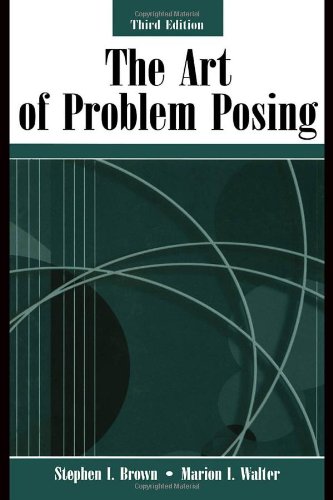
The Art of Problem Posing / L´arte del Problem Posing

Stephen I. Brown, Marion I. Walter

Lawrence Erlbaum | 2004 | 192 páginas | PDF | 8 MB

scribd.com
link

Referência em: MathEduc


The new edition of this classic book describes and provides a myriad of examples of the relationships between problem posing and problem solving, and explores the educational potential of integrating these two activities in classrooms at all levels. The Art of Problem Posing, Third Edition encourages readers to shift their thinking about problem posing (such as where problems come from, what to do with them, and the like) from the "other" to themselves and offers a broader conception of what can be done with problems. Special features include: an exploration of the logical relationship between problem posing and problem solving; sketches, drawings, and diagrams that illustrate the schemes proposed; and a special section on writing in mathematics.

In the updated third edition, the authors specifically:
*address the role of problem posing in the NCTM Standards;
*elaborate on the concept of student as author and critic;
*include discussion of computer applications to illustrate the potential of technology to enhance problem posing in the classroom;
*expand the section on diversity/multiculturalism; and
*broaden discussion of writing as a classroom enterprise.

This book offers present and future teachers at the middle school, secondary school, and higher education levels ideas to enrich their teaching and suggestions for how to incorporate problem posing into a standard mathematics curriculum.

Review

The text is easy to read and actively involves the reader. The Art of Problem Solving has the potential to influence significantly the way teachers think about the nature of mathematics and what it means to 'do' mathematics. The authors invision that this will, in turn, influence mathematics students of all ages as they engage in solving problems they themselves have posed.
—Mathematics Teacher

When first published in 1983,...provided an innovative approach to mathematics education and problem solving. The third edition features several new highlights, including computer examples that show how technology affects problem posing, discussion of the concept of student as author and critic, and analysis of how the 'standards' in math education incorporate problem-posing techniques.
—ED - Harvard Graduate School of Education

The audience for this book is any college mathematics students, present and future teachers of mathematics, as well as any person interested in problem posing.
—School Science and Mathematics Journal


L'arte del Problem Posing
Stephen I. Brown, Marion I. Walter
(versão em italiano)

Pdf | 2,65 MB

nenhum link disponível

The Thirteen Books of Euclid's Elements


( Books 1 to 13 ) - 3 volumes
Thomas L. Heath

Dover Publications | 1956 | 464 + 436 +546 páginas | Djvu | 12,8 + 31,7 + 28,3 MB

Volume 1 of 3-volume set containing complete English text of all 13 books of the Elements plus critical apparatus analyzing each definition, postulate, and proposition. Covers textual and linguistic matters; mathematical analyses of Euclid's ideas; commentators; refutations, supports, extrapolations, reinterpretations, and historical notes. Vol. 1 includes Introduction, Books I and II of Elements, lines, angles, intersections, etc.

vol.1  link direto
vol.2 - link direto
vol.3  - link direto

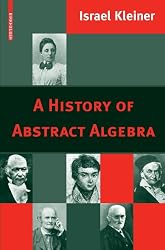
A History of Abstract Algebra

Israel Kleiner

Birkhauser | 2007 | 175 páginas | PDF | 3,6  Mb

link direto
4shared.com


Comentário em: MAA

Prior to the nineteenth century, algebra meant the study of the solution of polynomial equations. By the twentieth century algebra came to encompass the study of abstract, axiomatic systems such as groups, rings, and fields. This presentation provides an account of the history of the basic concepts, results, and theories of abstract algebra.
The development of abstract algebra was propelled by the need for new tools to address certain classical problems that appeared unsolvable by classical means. A major theme of the approach in this book is to show how abstract algebra has arisen in attempts to solve some of these classical problems, providing context from which the reader may gain a deeper appreciation of the mathematics involved.
Key features:
* Begins with an overview of classical algebra
* Contains separate chapters on aspects of the development of groups, rings, and fields
* Examines the evolution of linear algebra as it relates to other elements of abstract algebra
* Highlights the lives and works of six notables: Cayley, Dedekind, Galois, Gauss, Hamilton, and especially the pioneering work of Emmy Noether
* Offers suggestions to instructors on ways of integrating the history of abstract algebra into their teaching
* Each chapter concludes with extensive references to the relevant literature
Mathematics instructors, algebraists, and historians of science will find the work a valuable reference. The book may also serve as a supplemental text for courses in abstract algebra or the history of mathematics.

Educational Algebra: A Theoretical and Empirical Approach

Mathematics Education Library , Vol. 43
Eugenio Filloy, Teresa Rojano , Luis Puig

Springer | 2007 | 288 páginas | PDF | 2,5 Mb

4shared.com (RAR - 1,6 Mb)

link

Referência em: MathEduc

Given its abstract nature and the highly syntactical competence required by the use of symbolic algebra, research on its teaching and learning must rely on approaches that include semiotic concepts and analyses that recall the history of algebraic ideas, among others. Educational Algebra: A Theoretical and Empirical Approach deals with a theoretical perspective on the study of school algebra, in which both components (semiotics and history) occur. This perspective runs opposite to general theoretical models, since it submits components for the design of local frameworks for theoretical analysis. The Methodological design allows for the interpretation of specific phenomena and the inclusion, within such interpretative frameworks, of evidence not included in more general treatments. Such is the case of phenomena observed in subjects who are initiating the study of symbolic algebra, involving the production of personal sign systems at the intermediate level or the level previous to the mathematical sign system which is to be learned.
Disciplines such as Linguistics, Logic, Psycholinguistics, Semiotics, general Cognitive Psychology, Mathematics Psychology, Mathematics Epistemology, History of Mathematics, and others have carried out research on the same topics approached by Mathematics Education and have redefined their results within the framework of their respective fields. Specifically, theorists in Linguistics, Information Processing and Didactics of Mathematics have done important work on the notion of code. Today, this notion is a key element to interpreting the idea of representation in the new explanatory models of cognitive problems placed by alternative teaching approaches, including those involving a technological environment. Additionally, Psycholinguistics and Artificial Intelligence in procedural models of human abilities have intended to explain how and why users of mathematical language naturally and commonly make mistakes in syntactical procedures.
Educational Algebra: A Theoretical and Empirical Approach adds to previous developments with priority given to a pragmatic perspective on "meaning in use" over "formal meaning". The bulk of these approaches and others of similar nature have lead to a focus on competence rather than on a users activity with mathematical language.
Such a shift in perspective has fundamental implications on the way mathematical language is studied. Essentially, Grammarthe abstract formal systemand Pragmaticsthe principles of the use of languageare complementary domains in this volume. Both are related to different teaching models, whether new or traditional, used in helping students to become competent users of Algebra. Because of this, Educational Algebra: A Theoretical and Empirical Approach will be of interest to researchers and practitioners within the mathematics education field

Advanced Mathematical Thinking

(Mathematics Education Library, vol. 11)
David Tall

Kluwer Academic Publishers | 1991 | 316 páginas | PDF

link1
rapidshare.com


This book is the first major study of advanced mathematical thinking as performed by mathematicians and taught to students in senior high school and university. Its three main parts focus on the nature of advanced mathematical thinking, the theory of its cognitive development, and reviews of cognitive research. Topics covered include the psychology of advanced mathematical thinking, the processes involved, mathematical creativity, proof, the role of definitions, symbols, and reflective abstraction. The reviews of recent research concentrate on cognitive development and conceptual difficulties with the notions of functions, limits, infinity, analysis, proof, and the use of the computer. They provide a wide overview and an introduction to current thinking which is highly appropriate for the college professor in mathematics or the general mathematics educator

Consulte a página de David Tall, onde este tem on-line uma série de artigos sobre o "pensamento matemático avançado":

http://www.warwick.ac.uk/staff/David.Tall/themes/amt.html