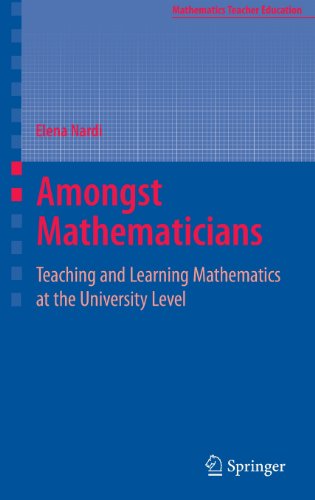
(Mathematics Teacher Education, 3)
Elena Nardi
Springer | 2008 | 349 páginas | pdf |4,7 Mb
This book offers a unique perspective on ways in which mathematicians: perceive their students' learning; teach; reflect on their teaching practice. Elena Nardi achieves this by employing two fictional, yet entirely data-grounded, characters to create a conversation on these important issues. The construction of these characters is based on large bodies of data including intense focused group interviews with mathematicians and extensive analyses of students' written work, collected and analyzed over a substantial period.
TABLE OF CONTENTSPROLOGUE 1
CHAPTER ONE - BACKGROUND AND CONTEXT
Summary 3
1. TALUM: a general introduction 4
2. A certain type of TALUM research 6
3. The TALUM studies the book draws on 9
CHAPTER TWO - METHOD, PROCESS AND PRESENTATION
Summary 15
1. Data samples and M 16
2. The dialogic format
The Narrative Approach 18
From interview transcripts to Dialogue: an application of the Narrative Approach 24
3. Style, format and thematic breakdown of Chapters 3 – 8 29
NOTE TO READER: A RECOMMENDATION ON HOW TO READ CHAPTERS 3-8 39
CHAPTER THREE - THE ENCOUNTER WITH FORMAL MATHEMATICAL REASONING: CONCEPTUALISING ITS SIGNIFICANCE AND ENACTING ITS TECHNIQUES
Summary 41
Episodes
1. The tension between familiar (numerical, concrete) and unfamiliar (rigorous, abstract): resorting to the familiarity of number 42
2. The tension between general and particular: 48
Constructing examples 49
Applying the general to the particular 51
3. Using definitions towards the construction of mathematical arguments: Weaving the use of definitions into the construction of a mathematical argument 57
Making the fine choice between algebraic manipulation and employment of a definition 60
4. Logic as building block of mathematical arguments: reconciling with inconclusiveness 64
5. Proof by Contradiction Spotting contradiction 70
Syndrome of the Obvious 79
6. Proof by Mathematical Induction: from n to n+1 83
7. Proof by Counterexample: the variable effect of different types of counterexample 89
Special Episodes
1. School Mathematics, UK 93
2. Inequalities 102
3. Mathematical reasoning in the context of Group Theory 103
4. Algebra / Geometry 106
CHAPTER FOUR - MEDIATING MATHEMATICAL MEANING THROUGH VERBALISATION, SYMBOLISATION AND VISUALISATION
Summary 111
Episodes
0. To appear and to be: Conquering the ‘genre’ speech of university mathematics 112
1. Strings of Symbols and Gibberish – Symbolisation and Efficiency 120
Desperate juggling of axioms and random mathematics 121
To-ing and fro-ing between mathematics and language 125
2. Premature Compression:
Why is det(aIn) = an true? 134
Why is xox = xox-1 ⇒ x = x-1 true? 136
3. Visualisation and the role of diagrams 139
4. Undervalued or Absent Verbalisation and the Integration of Words, Symbols and Diagrams 151
Special Episodes
1. The Group Table 152
Out-takes
1. Typed Up 159
CHAPTER FIVE - THE ENCOUNTER WITH THE CONCEPT OF FUNCTION
Summary 161
Episodes
1. Concept Images and Concept Definition
Domineering presences (function-as-formula), conspicuous absences (domain / range) 162
The Students’ Turbulent Relationship with the Concept Definition 166
2. Relationship with Graphs: Attraction, Repulsion, Unease and Uncertainty 168
3. The Troubling Duality at the Heart of a Concept: Function as Process, Function as Object 172
Special Episodes
1. The Tremendous Function-Lookalike That is Tanx 176
2. Polynomials and the Deceptive Familiarity of Essentially Unknown Objects 177
Out-takes
1. History Relived 179
2. Evocative Terms for 1-1 and Onto 180
3. RR: A Grotesque and Vulgar Symbol? 180
CHAPTER SIX
THE ENCOUNTER WITH THE CONCEPT OF LIMIT
Summary 181
Episodes
1. Beginning to Understand the Necessity For A Formal Definition of Convergence 182
2. Beyond the ‘Formalistic Nonsense’: Understanding the Definition of Convergence Through Its Verbalisation and Visualisation – Symbolisation As A Safer Route? 185
3. The Mechanics of Identifying and Proving A Limit In Search of N 193
Identifying the Limit of a Sequence 194
Special Episodes
1. Ignoring the ‘Head’ of a Sequence 195
Out-takes
1. ≥ or > N? 199
2. Series 200
3. Continuity and Differentiability 200
CHAPTER SEVEN - UNDERGRADUATE MATHEMATICS PEDAGOGY
Summary 205
Episodes
1. Interaction / Participation
Enhancing students’ mathematical expression through interactive interrogation of their thinking 206
Building students’ understanding through ‘Socratic dialogue’ 206
Facilitating students’ realisation of their responsibility towards their own learning 207
Benefiting from the rich environment of a one-to-one tutorial 208
Students’ resistance to participatory teaching 212
Conditioning interaction effectively 212
2. Introducing, contextualising the importance of new ideas 215
3. Concept Image Construction 217
4. Abstraction/Rigor Vs Concretisation, Intuition and Exemplification Abstraction 220
Formalism
a. Fostering the significance of mathematical literacy 224
b. The fuzzy didactical contract of university mathematics 229
Numerical experiments 234
Pictures
a. The pedagogical potential, and the strongly personal nature, of pictures 237
b. Building students’ understanding of convergence through the use of visual representations 238
c. Strengthening students’ understanding of injective and surjective functions using Venn diagrams 239
d. Strengthening students’ understanding of functional properties through construction and examination of function graphs 240
e. Negotiating meanings and appropriateness of pictures as a means of strengthening students’ concept images in Group Theory 241
The ‘toolbox’ perspective 247
The skill and art in trial-and-error: making appropriate / clever choices when deciding the steps of a proof 248
Special Episodes
1. Teaching without examples 250
2. Do not Teach Indefinite Integration 251
3. Teaching of functions, process – object, polynomials 253
4. Rules of attraction 254
5. Content coverage 255
Out-takes
1. Does learning happen anyway? 255
CHAPTER EIGHT - FRAGILE, YET CRUCIAL: THE RELATIONSHIP BETWEEN MATHEMATICIANS AND RESEARCHERS IN MATHEMATICS EDUCATION
Summary 257
Episodes
1. Benefits
Benefits from using mathematics education research 258
Benefits from engaging with mathematics education research 260
2. Reflection and critique of the practices of RME – there’s something about the way you… Do Research (an evaluation of Qualitative Inquiry and conditions under which it could work for mathematicians)
a. …currently 264
b. … and other ways you could be doing it! 273
Theorise (or: on the R C Moore diagram) 276
Write up 280
Disseminate 281
Special Episodes
1. The Reviews 285
EPILOGUE 293 - POST-SCRIPT Amongst Mathematicians: Making of, Coming to be 297
Beginnings… 297
Initial proposal 299
Flash forward… 302
Back to initial planning 304
A modified proposal 304
First trials and reviews 308
BIBLIOGRAPHY 311
THEMATIC INDEX: Mathematical Topics 333
THEMATIC INDEX: Learning and Teaching 335
AUTHOR INDEX 337