terça-feira, 1 de abril de 2014

Construction Mathematics


Surinder Virdi, Roy Baker e Narinder Kaur Virdi

Routledge |  2014 - 2ª edição |336 páginas | rar - pdf | 3 Mb

link (password : matav)

Construction Mathematics is an introductory level mathematics text, written specifically for students of construction and related disciplines.
  • Learn by tackling exercises based on real-life construction maths. Examples include: costing calculations, labour costs, cost of materials and setting out of building components.
  • Suitable for beginners and easy to follow throughout.
  • Learn the essential basic theory along with the practical necessities.
The second edition of this popular textbook is fully updated to match new curricula, and expanded to include even more learning exercises. End of chapter exercises cover a range of theoretical as well as practical problems commonly found in construction practice, and three detailed assignments based on practical tasks give students the opportunity to apply all the knowledge they have gained.
Construction Mathematics addresses all the mathematical requirements of Level 2 construction NVQs from City & Guilds/CITB and Edexcel courses, including the BTEC First Diploma in Construction. Additional coverage of the core unit Mathematics in Construction and the Built Environment from BTEC National Construction, Civil Engineering and Building Services courses makes this an essential revision aid for students who do not have Level 2 mathematics experience before commencing their BTEC National studies. This is also the ideal primer for any reader who wishes to refresh their mathematics knowledge before going into a construction HNC or BSc.

Contents
1. Using a Scientific Calculator 
2. Numbers
3.Basic Algebra 
4. Indices and Logarithms 
5. Standard Form, Significant Figures and Estimation 
6. Transposition and Evaluation of Formulae 
7. Fractions and Percentages 
8. Graphs 
9. Units and their Conversion 
10. Geometry 
11. Areas (1) 
12. Volumes (1) 
13. Trigonometry (1) 
14. Setting Out 
15. Costing - Materials and Labour 
16. Statistics 
17. Areas and Volumes (2) 
18. Areas and Volumes (3) 
19. Trigonometry (2) 
20. Computer Techniques 
21. Assignments 
Appendix 1 Concrete Mix 
Appendix 2 Solutions for Excercises 
Appendix 3 Assignment Solutions


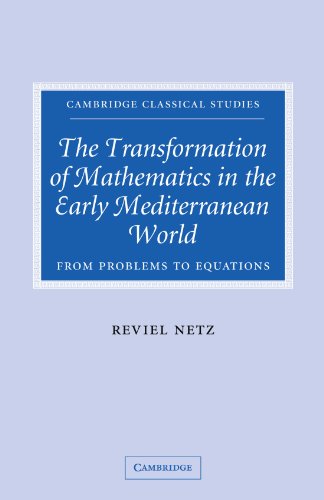
The Transformation of Mathematics in the Early Mediterranean World: From Problems to Equations

Reviel Netz 

Cambridge University Press | 2007 | páginas | pdf | 731 kb


link direto
link
link1

The transformation of mathematics from its ancient Greek practice to its development in the medieval Arab-speaking world is approached by focusing on a single problem proposed by Archimedes and the many solutions offered. From a practice of mathematics based on the localized solution (originating in the polemical practices of early Greek science), we see a transition to a practice of mathematics based on the systematic approach (grounded in the deuteronomic practices of Late Antiquity and the Middle Ages). A radically new interpretation is accordingly offered of the historical trajectory of pre-modern mathematics.


CONTENTS
Acknowledgments page viii
Introduction 1
1 The problem in the world of Archimedes 11
1.1 The problem obtained 11
1.2 The problem solved by Archimedes 16
1.3 The geometrical nature of Archimedes’ problem 19
1.4 The problem solved by Dionysodorus 29
1.5 The problem solved by Diocles 39
1.6 The world of geometrical problems 54
2 From Archimedes to Eutocius 64
2.1 The limits of solubility: Archimedes’ text 66
2.2 The limits of solubility: distinguishing Archimedes from Eutocius 71
2.3 The limits of solubility: the geometrical character of Archimedes’ approach 85
2.4 The limits of solubility: Eutocius’ transformation 91
2.5 The multiplication of areas by lines 97
2.6 The problem in the world of Eutocius 121
3 From Archimedes to Khayyam 128
3.1 Archimedes’ problem in the Arab world 129
3.2 A note on Al-Khwarizmi’s algebra 137
3.3 Khayyam’s solution within Khayyam’s algebra 144
3.4 The problem solved by Khayyam 155
3.5 Khayyam’s equation and Archimedes’ problem 160
3.6 Khayyam’s polemic: the world of Khayyam and the world of Archimedes 171
3.7 How did the problem become an equation? 181
Conclusion 187
References 193
Index 196


Outros livros do mesmo autor:


A Historian Looks Back: The Calculus as Algebra and Selected Writings

(Spectrum)

Judith V. Grabiner

 Mathematical Association of America |  2010 |304 páginas | rar - pdf | 1,7 Mb

link (password: matav)

Judith Grabiner, the author of A Historian Looks Back, has long been interested in investigating what mathematicians actually do, and how mathematics actually has developed. She addresses the results of her investigations not principally to other historians, but to mathematicians and teachers of mathematics. This book brings together much of what she has had to say to this audience.
The centerpiece of the book is The Calculus as Algebra: J.-L. Lagrange, 1736-1813. The book describes the achievements, setbacks, and influence of Lagrange s pioneering attempt to reduce the calculus to algebra. Nine additional articles round out the book describing the history of the derivative; the origin of delta-epsilon proofs; Descartes and problem solving; the contrast between the calculus of Newton and Maclaurin, and that of Lagrange; Maclaurin s way of doing mathematics and science and his surprisingly important influence; some widely held myths about the history of mathematics; Lagrange s attempt to prove Euclid s parallel postulate; and the central role that mathematics has played throughout the history of western civilization.
The development of mathematics cannot be programmed or predicted. Still, seeing how ideas have been formed over time and what the difficulties were can help teachers find new ways to explain mathematics. Appreciating its cultural background can humanize mathematics for students. And famous mathematicians struggles and successes should interest -- and perhaps inspire -- researchers. Readers will see not only what the mathematical past was like, but also how important parts of the mathematical present came to be.

Contents
Introduction .. . . xi
Part I. The Calculus as Algebra .. . . .1
Preface to the Garland Edition .. .3
Acknowledgement. . . .7
Introduction . . . . .9
1. The Development of Lagrange’s Ideas on the Calculus: 1754–1797 .. . 17
2. The Algebraic Background of the Theory of Analytic Functions . . . 37
3. The Contents of the Fonctions Analytiques . . . 63
4. From Proof-Technique to Definition: The Pre-History of Delta-Epsilon Methods . . 81
Conclusion .  . . .101
Appendix . .103
Bibliography .. . .105
Part II. Selected Writings  . .125
1. The Mathematician, the Historian, and the History of Mathematics . . . .127
2. Who Gave You the Epsilon? Cauchy and the Origins of Rigorous Calculus∗ . . . 135
3. The Changing Concept of Change: The Derivative from Fermat to Weierstrass† . . 147
4. The Centrality of Mathematics in the History of Western Thought† . . . 163
5. Descartes and Problem-Solving† . . . .175
6. The Calculus as Algebra, the Calculus as Geometry: Lagrange, Maclaurin, and Their Legacy . .191
7. Was Newton’s Calculus a Dead End? The Continental Influence of Maclaurin’s Treatise of Fluxions∗ . . 209
8. Newton, Maclaurin, and the Authority of Mathematics∗ .. .229
9. Why Should Historical Truth Matter to Mathematicians? Dispelling Myths while PromotinMaths . . .243
10. Why Did Lagrange “Prove” the Parallel Postulate?∗ .  . 257
Index .. . 275
About the Author .  . .287

segunda-feira, 31 de março de 2014

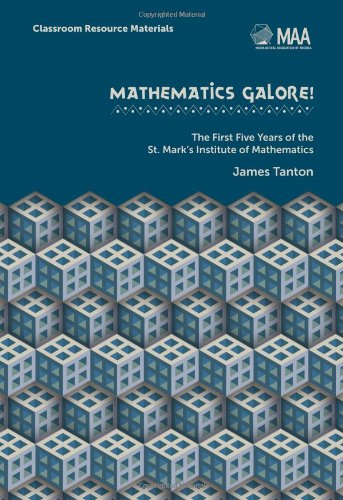
Mathematics Galore!, The First Five Years of the St. Mark’s Institute of Mathematics


 (Classroom Resource Materials)

James Tanton 


Mathematical Association of America | 2012 | 289 | pdf | 3,3 Mb


link


Mathematics Galore! Showcases some of the best activities and student outcomes of the St. Mark s Institute of Mathematics and invites you to engage the mathematics yourself! Revel in the delight of deep intellectual play and marvel at the heights to which young scholars can rise. See some great mathematics explained and proved via natural and accessible means.
Based on 26 essays ( newsletters ) and eight additional pieces,Mathematics Galore! offers a large sample of mathematical tidbits and treasures, each immediately enticing, and each a gateway to layers of surprising depth and conundrum. Pick and read essays in no particular order and enjoy the mathematical stories that unfold. Be inspired for your courses, your math clubs and your math circles, or simply enjoy for yourself the bounty of research questions and intriguing puzzlers that lie within.

Contents
Introduction;
Newsletters and commentaries;
1. Arctangents;
2. Benford's Law;
3. Braids;
4. CLIP Theory;
5. Dots and dashes;
6. Factor trees;
7. Folding fractions and conics;
8. Folding patterns and dragons;
9. Folding and pouring;
10. Fractions;
11. Integer triangles;
12. Lattice polygons;
13. Layered tilings;
14. The middle of a triangle;
15. Partitions;
16. Personalized polynomials;
17. Playing with Pi;
18. Pythagoras's Theorem;
19. On reflection;
20. Repunits and primes;
21. The Stern-Brocot Tree;
22. Tessellations;
23. Theon's ladder and squangular numbers;
24. Tilings and theorems;
25. The Tower of Hanoi;
26. Weird multiplication;
Appendices:
1. Numbers that are the sum of two squares;
2. Pick's theorem;
3. The Mobius function;
4. The Borsuk-Ulam theorem;
5. Galilean ratios;
6. A candy-sharing game;
7. Bending Buffon's needle;
8. On separating dots;
Indexes:
1. Index of terms;
2. Index of topics;
3. Classic theorems proved.


Outros livros do mesmo autor:


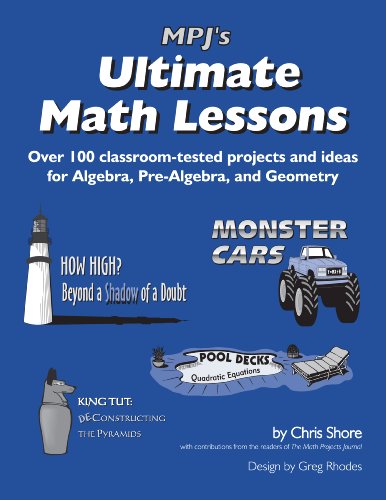
MPJ's Ultimate Math Lessons


Chris Shore

Math Projects Journal | 2011 | 294 páginas | rar - pdf | 22 Mb


link (password : matav)

MPJ's Ultimate Math Lessons is a resource for teachers of Algebra, Pre-Algebra, and Geometry in grades 6–12. It contains 80 innovative lessons and 27 thought-provoking articles taken directly from theMath Projects Journal, a periodical that, for more than six years, has helped teachers around the world improve student performance in mathematics.

Contents
Introduction
The MPJ Story
Acknowledgements
PRE-ALGEBRA LESSONS
How Big is Barbie
M&M Count and Crunch
Counting Fish
Donlt Break my Stride
4-Digit Problem
Wallflowers
The Postman Always Rings Twice
Piggy Banks
Candy Bars
Brownies
Beef Jerky
Playing with a Full Deck
ALGEBRA LESSONS
Number Tricks
11m Thinking of a Number...
Pig Pen Algebra
Rule Quest
Rising Water
The Student-Generated Word Problem
Algebra Walk
Staircases & Ramps
Tumbling Cars
Monster Cars
The Jogging Hare
CoolShoes.com
Land Cruiser
Stixture Problems
The Tortoise and The Hare
Rescue Mission
The X-Files
Olympic Swim Times
Robotic Disney
The Migratory Paths of Birds
Empty Box
The Pizza Box
Pool Decks
The Coin Fountain
Parabolic Pizza
Town Grid
The Billabong and the Bush
Zeno's Bouncing Ball
Calculator Logos
Original Works
GEOMETRY LESSONS
How High: Beyond a Shadow of a Doubt
How High: The Right Stuff
How High: Surveyor1s Trig Trick
How High: Do You Have the Inclination?
How High: The Chinese Difference
The Mason's Secret
The America1s Cup Sail
The Fire-Fish Story
Baseball Congruency
Shipping Conundrum
The Gum Drop
A Slice of Pi
Poison Weed
Polygon House
Swimming Pools
King Tut
The Luxor
The Shopkeeper1s Jar
Super Size ItI
Can There Be Giants?
Whatever Floats Your Boat
Shot Put Arc
Strike a Chord
Reflection Golf
Kaleidoscope
William Tell
The Selling of America
The Vector Map
Princess Dido and the Ox Skin
ARTICLES
QM14.5
TIMSS: A Call for Substance
TIMSS: A Tale of Three Countries
TIMSS: A TIMSS Primer
A Mountain of Vision
Portfolios
A Struggle Among Equals
Nuts & Bolts
Kicking the Habit
On a Good Day
Sleeping with the Enemy
Inside & Out
Measurement
Teaching Backwards
Ultimate Cosmic Power
Cannonballs and Concepts
Graphing for Meaning
Beavis and Barbie
Still All Full of Stuffinl
Godzilla or Godzuki
Sculpting Young Thinkers
Christmas Carols and Disco Tunes
Martian Math
The Economy of Thought
Universal Remote
The Railroad and the Kayak
Fluff-n-Stuff
Lesson Studies
Inspiration, Perspiration, Desperation
ADDITIONAL ACTIVITIES
The Dentists Puzzle
Psychic Probability
Around the World
Red Dot - Green Dot
The Tic-Tac Equation
The Handyman's Math Trick
Brother in the Box
Mega Translation
Age Trick
Math Walk
Twenty-One
Wipeout
Index

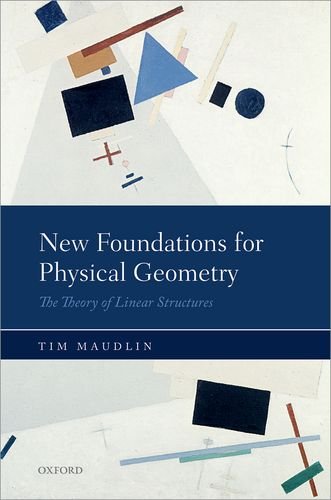
New Foundations for Physical Geometry: The Theory of Linear Structures

 
Tim Maudlin

Oxford University Press | 2014 | 374 páginas | rar - pdf | 1,94 Mb


link (password: matav)


Topology is the mathematical study of the most basic geometrical structure of a space. Mathematical physics uses topological spaces as the formal means for describing physical space and time. This book proposes a completely new mathematical structure for describing geometrical notions such as continuity, connectedness, boundaries of sets, and so on, in order to provide a better mathematical tool for understanding space-time. This is the initial volume in a two-volume set, the first of which develops the mathematical structure and the second of which applies it to classical and Relativistic physics.
The book begins with a brief historical review of the development of mathematics as it relates to geometry, and an overview of standard topology. The new theory, the Theory of Linear Structures, is presented and compared to standard topology. The Theory of Linear Structures replaces the foundational notion of standard topology, the open set, with the notion of a continuous line. Axioms for the Theory of Linear Structures are laid down, and definitions of other geometrical notions developed in those terms. Various novel geometrical properties, such as a space being intrinsically directed, are defined using these resources. Applications of the theory to discrete spaces (where the standard theory of open sets gets little purchase) are particularly noted. The mathematics is developed up through homotopy theory and compactness, along with ways to represent both affine (straight line) and metrical structure.
ContentsAcknowledgments x
Introduction 1
Metaphorical and Geometrical Spaces 6
A Light Dance on the Dust of the Ages 9
The Proliferation of Numbers 12
Descartes and Coordinate Geometry 14
John Wallis and the Number Line 16
Dedekind and the Construction of Irrational Numbers 20
Overview and Terminological Conventions 25
1. Topology and Its Shortcomings 28
Standard Topology 31
Closed Sets, Neighborhoods, Boundary Points, and Connected Spaces 33
The Hausdorff Property 36
Why Discrete Spaces Matter 45
The Relational Nature of Open Sets 47
The Bill of Indictment (So Far) 49
2. Linear Structures, Neighborhoods, Open Sets 54
Methodological Morals 54
The Essence of the Line 57
The (First) Theory of Linear Structures 59
Proto-Linear Structures 69
Discrete Spaces, Mr Bush’s Wild Line, the Woven Plane, and the Affine Plane 74
A Taxonomy of Linear Structures 79
Neighborhoods in a Linear Structure 81
Open Sets 85
Finite-Point Spaces 86
Return to Intuition 89
Directed Linear Structures 92
Linear Structures and Directed Linear Structures 96
Neighborhoods, Open Sets, and Topologies Again 97
Finite-Point Spaces and Geometrical Interpretability 99
A Geometrically Uninterpretable Topological Space 103
Segment-Spliced Linear Structures 104
Looking Ahead 107
Exercises 107
Appendix: Neighborhoods and Linear Structures 108
3. Closed Sets, Open Sets (Again), Connected Spaces 113
Closed Sets: Preliminary Observations 113
Open and Closed Intervals 114
IP-closed and IP-open Sets 115
IP-open Sets and Open Sets, IP-closed Sets and Closed Sets 117
Zeno’s Combs 120
Closed Sets, Open Sets, and Complements 123
Interiors, Boundary Points, and Boundaries 127
Formal Properties of Boundary Points 136
Connected Spaces 140
Chains and Connectedness 143
Directedness and Connectedness 148
Exercises 150
4. Separation Properties, Convergence, and Extensions 152
Separation Properties 152
Convergence and Unpleasantness 155
Sequences and Convergence 160
Extensions 163
The Topologist’s Sine Curve 165
Physical Interlude: Thomson’s Lamp 168
Exercises 172
5. Properties of Functions 174
Continuity: an Overview 174
The Intuitive Explication of Continuity and Its Shortcomings 175
The Standard Definition and Its Shortcomings 178
What the Standard Definition of “Continuity” Defines 183
The Essence of Continuity 186
Continuity at a Point and in a Direction 190
An Historical Interlude 192
Remarks on the Architecture of Definitions; Lineal Functions 194
Lines and Continuity in Standard Topology 199
Exercises 201
6. Subspaces and Substructures; Straightness and Differentiability 203
The Geometrical Structure of a Subspace: Desiderata 203
Subspaces in Standard Topology 205
Subspaces in the Theory of Linear Structures 206
Substructures 211
One Way Forward 218
Euclid’s Postulates and the Nature of Straightness 220
Convex Affine Spaces 227
Example: Some Conical Spaces 233
Tangents 235
Upper and Lower Tangents, Differentiability 244
Summation 253
Exercises 254
7. Metrical Structure 256
Approaches to Metrical Structure 256
Ratios Between What? 258
The Additive Properties of Straight Lines 260
Congruence and Comparability 262
Eudoxan and Anthyphairetic Ratios 274
The Compass 280
Metric Linear Structures and Metric Functions 285
Open Lines, Curved Lines, and Rectification 287
Continuity of the Metric 291
Exercises 294
Appendix: A Remark about Minimal Regular Metric Spaces 294
8. Product Spaces and Fiber Bundles 297
New Spaces from Old 297
Constructing Product Linear Structures 300
Examples of Product Linear Structures 303
Neighborhoods and Open Sets in Product Linear Structures 307
Fiber Bundles 309
Sections 313
Additional Structure 315
Exercises 318
9. Beyond Continua 320
How Can Continua and Non-Continua Approximate Each Other? 320
Continuous Functions 321
Homotopy 334
Compactness 339
Summary of Mathematical Results and Some Open Questions 345
Exercises 346
Axioms and Definitions 347

Bibliography 358
Index 361

Caliban's Problem Book: Mathematical, Inferential and Cryptographic Puzzles

Hubert C. Phillips

 Dover Publications | 1961 | 191 páginas | djvu | 1,4 Mb


link
link1