sábado, 1 de março de 2014

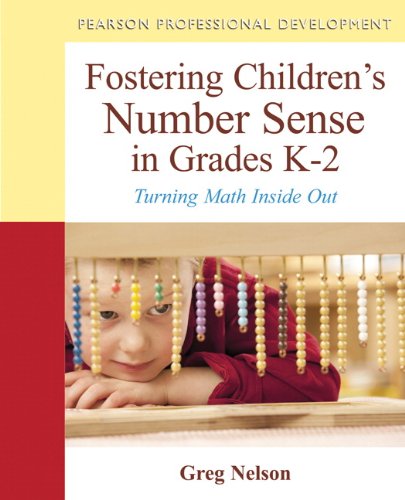
Fostering Children's Number Sense in Grades K-2: Turning Math Inside Out


(New 2013 Curriculum & Instruction Titles)

Gregory Nelson

Pearson | 2013 | 173 páginas | rar - pdf | 2,5 Mb

link (password: matav)

Fostering Children's Number Sense in Grades K-2 is a powerful, hands-on resource that helps in-service teachers, curriculum coaches, and math intervention specialists ensure children’s deep understanding of addition and subtraction in ways that enable long-term growth. Packed with child-centered instructional strategies, powerful and engaging learning materials, and revealing assessment tools, the book is clearly laid out and cross-referenced to the Common Core State Standards.


Contents
SECTION 1:  GETTING STARTED
Chapter 1:  Rethinking Number Sense
What math is not
Children’s readiness to be mathematicians
How we should teach math
What the experts and the research tell us
Math inside out
Chapter 2:  How to Teach Math This Way
Logistics
Space
Preparing the teaching materials
“Math time”
Work, not play
Learner-centered instruction
How we tend to teach…and why
Creating the learning community you want
Teacher-led lessons
The perils of group work
The role of the teacher as the children work
Keeping everyone safe
Authentic assessment
Teaching tips
Helping children talk about what they know
Three levels of vocabulary acquisition
Concrete before abstract
The same thing many ways
Errors are information
Competition
Answer keys, or no answer keys?
Study group discussion starters: Turning math inside out

SECTION 2:  EMERGENCE OF SECURE PLACE-VALUE AWARENESS
Chapter 3:  Place-Value Awareness Launch Points
What this is, and why it is important
What comes before, and how to get there
Logical quantification (K.NCC.4b)
Accurate counting to ten (K.NCC.1, K.NCC.4, K.NCC.5)
Connecting numerals to quantities (K.NCC.3)
Concepts and skills being reinforced at this developmental stage
The teen counting numbers have 10 as a base (K.NBT.1)
The use of zero as a place holder (1.NBT.2c)
The part-whole concept extended to the place value system (K.NBT.1, 1.NBT.2)
Place value versus face value (1.NBT.2)
The 10:1 relationship between units and tens (1.NBT.2a)
Directionality in reading multi-digit numerals (1.NBT.1)
Counting on using place value categories (K.CC.1, K.CC.2, 1.NBT.1)
Counting backwards through the decades
Estimating larger quantities
Greater than/less than in the place value system (1.NBT.3)
The relationship between hundreds and tens (2.NBT.1)
Launch points
Teen boards
Tens boards
Hands Up #1
“How Old Are We?” books
Hundreds board
Estimation activities (Unifix cubes; Cuisenaire rods; ten frames)
Race to a 100
Chapter 4:  Place-Value Awareness Check Points
Assessment probes
Cuisenaire teens
Hundred chain
Page walk
Hundreds board magic windows
Arrow math
Decade transition boards
How Many Now? — Variation #1
How Many Now? — Variation #2
How Many Now? — Variation #3
How Many Now? — Variation #4
Study group discussion starters: Secure place-value awareness

SECTION 3:  SECURE PART-WHOLE AWARENESS AND THE EMERGENCE OF ADDITION-SUBTRACTION FLUENCY
Chapter 5:  Addition-Subtraction Fluency Launch Points
What this is, and why it is important
What comes before, and how to get there
Basic part-whole awareness (K.OA.3)
Concepts and skills being reinforced in this chapter
Part-whole patterns for numbers up to 20 (K.OA.3, K.OA.4)
Decomposition and composition of numbers (K.OA.3, K.NBT.1, 1.OA.1, 1.OA.6)
The commutative property of addition (1.OA.3, 2.NBT.5, 2.NBT.6)
Addition and subtraction as inverse operations (1.OA.1, 1.OA.4, 1.OA.6, 1.NBT.4, 2.NBT.9)
Launch points
Hands Up #2 — Addition/subtraction
Ten-bar-in-a-cave game
Addition/subtraction using equal-arm balance scale
Addition/subtraction using ten-frames
Double-nines dominoes sorting
Domino trains or squares
Directional rods with addition/subtraction rack
Addition/subtraction using segmented Cuisenaire rods and 1-100 rack
Addition/subtraction using double-fives abacus
Chapter 6:  Addition-Subtraction Fluency Check Points
Assessment probes
Pursuit game
Ten-frame flash cards
Fact family triominoes
Parts Of calculator drill
Counting On calculator drill
Addition/subtraction war with playing cards
Addition/subtraction using torque balance scale
More teaching tips
Addition trumps subtraction
The perils of “Mad Minute” drills
Bridging from the concrete to paper-and-pencil
The real scoop on those dreaded word problems
The order in which number-sense based memorization develops
Study group discussion starters: Secure part-whole awareness and the emergence of addition-subtraction fluency

SECTION 4:  EXTENDING PLACE-VALUE AWARENESS
AND ADDITION-SUBTRACTION BEYOND THE HUNDREDS
Chapter 7:  Place-Value Fluency and Multi-Digit Addition-Subtraction Launch Points
Concepts and skills being reinforced in this chapter
A place value is determined by how many positions it is to the left of the units column (2.NBT.1, 2.NBT.4)
Zero as a place holder (2.NBT.1b, 2.NBT.3)
The maximum face value is 9 in any place-value column
10:1 exchange rates (2.NBT.1a, 2.NBT.7)
Exponential growth in a place-value system
The counting sequence in a place-value system
When combining or removing quantities, only digits in the same place-value location can be combined or decreased (2.NBT.5, 2.NBT.6, 2.NBT.7, 2.NBT.8, 2.NBT.9)
Composing and decomposing bundles of ten to move them from one place-value category to another can be done at any level of the place-value system as a tool of problem-solving (2.NBT.8, 2.NBT.11)
Standard algorithms can be used to efficiently solve multi-digit addition and subtraction problems, but alternative algorithms and strategies are sometimes preferable (2.NBT.10, 2.NBT.12, 2.NBT.13)
Launch points
200 board
Make-your-own place-value materials
Bank game with place-value blocks and place-value cards
Place-value materials sorter tray
Hundred and thousand extensions of ten-frames and Hand Game cards
Expanded notation strip
Modeling multi-digit addition-subtraction with exchanging
Mental math problem sets
Decimeter rods, meter rods, centimeter rods, metric measuring tape, and metric trundle wheel
Reading and writing really big numerals
Chapter 8:  Place-Value Fluency and Multi-Digit Addition-Subtraction Check Points
Assessment probes
Hundred-square in a cave game
Wacky numbers
I have, who has? game
Parts-of calculator drill
Skip-counting calculator drill
Target game
What’s wrong with this picture? sets
Final teaching tips
Words matter
Keeping children fluid
Teaching as improv
Collaboration and transformation
Keeping your eye on the prize
Study group discussion starters: Extended place-value awareness and addition-subtraction beyond the hundreds

Appendices
Appendix A:  Research-based teaching-learning paths
Appendix B:  Assessment templates — Use for individual child, tracking progress over time
Appendix C:  Assessment templates — Use for whole class, tracking outcomes of a particular lesson or activity

sexta-feira, 28 de fevereiro de 2014

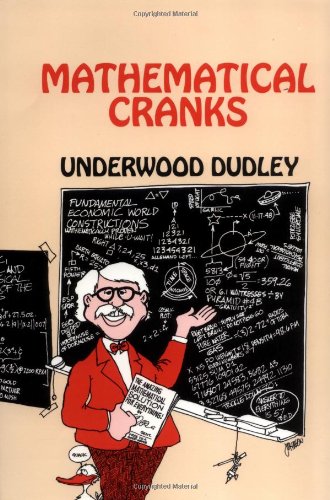
Mathematical cranks


Underwood Dudley 

The Mathematical Association of America | 1992 | páginas | djvu |4,6  Mb

link

A delightful collection of articles about people who claim they have achieved the mathematically impossible (squaring the circle, duplicating the cube); people who think they have done something they have not (proving Fermat's Last Theorem); people who pray in matrices; people who find the American Revolution ruled by the number 57; people who have in common eccentric mathematical views, some mild (thinking we should count by 12s instead of 10s), some bizarre (thinking that second-order differential equations will solve all problems of economics, politics and philosophy). This is a truly unique book. It is written with wit and style and is a part of folk mathematics.

Contents
Introduction v 
Alphabet, Application of Pyramid Height to the 1 
American Revolution, The Role of 57 in the 4 
Applied Mathematics 9 
Base for the Number System, The Best - 20 
Bitterness, Cranks' 32 
Calculus, Celestial 38 
Cantor's Diagonal Process 40 
Congressional Record, Mathematics in the 46 
Constant Society, The 50 
Consultation, Lack of, of Cranks with Experts 53 
Crank, Case Study of a 55. 
Crank, The Making of a 67 
Deduction, The Joy of 78 
Duplication of the Cube 86 
Ellipse, Circumference of an 93 
Encouraging Cranks, The Folly of 97 
Equations, Solving 102 
Fermat's Last Theorem 105 
Fermat's Little Theorem 135 
Fifth Postulate, Euclid's 137 
Four-Color Theorem, The ." 159 
Godel's Theorem 167 
Goldbach Conjecture, The 171 
Greed 179 
Incomprehensibility of Crank's Works 182 
Infinity, Difficulties with 184 
Insanity 189 
Legislating Pi 192 
Linear Programming, Conspiracy Involving 198 
Magic Squares 200 
Mail, Crank 205 
Megalomania 208 
Money to be Made in Mathematics, Lack of 222 
Nines, Casting Out 226 
Nonagons, Regular 231 
Notation, Nonstandard 235 
Number Theory, The Lure of 239 
Perfect Numbers 242 
Phi 245 
Prayer, Matrix 251 
Primes, The Secret of the 254 
Primes, Twin, Existence of Infinitely Many 256 
Prolificity, Crank's 260 
Puzzle, A 269 
Pythagoreans, Neo- 271 
Pythagoreans, The Mystery of the 274 
Quadrature of the Circle 279 
Set Theory 322 
Signs, The Rule of 324 
Solution to a Puzzle 330 
Sphere, Philosophy of the 331 
Statistics, Parameter Estimation in 334 
Taxonomy, Mathematical 337 
Time, Wasted ....! 339 
Topology, Applied 341 
Trisection of the Angle 342 
Van der Pol's Equation 349 
Notes 353 

Index 363

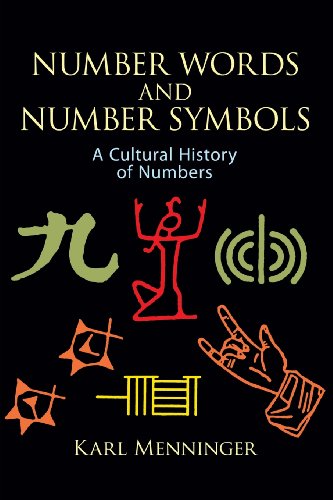
Number words and number symbols a cultural history of numbers


Karl Menninger


Dover Publications Inc. | 1992 | 512 páginas | epub | 15 Mb


link

Classic study discusses number sequence and language and explores written numerals and computations in many cultures. "The historian of mathematics will find much to interest him here both in the contents and viewpoint, while the casual reader is likely to be intrigued by the author's superior narrative ability.

A problem solving approach to mathematics for elementary school teachers


Rick Billstein, Shlomo Libeskind e Johnny W. Lott

 Pearson | 2012 - 11ª edição | 1042 páginas | rar - pdf | 30,4 Mb


link (password: matav)


More than 350,000 students have prepared for teaching mathematics with A Problem Solving Approach to Mathematics for Elementary School Teachers since its first edition, and it remains the gold standard today. This text not only helps students learn the material by promoting active learning and developing skills and concepts—it also provides an invaluable reference to future teachers by including professional development features and discussions of today’s standards.
The Eleventh Edition is streamlined to keep students focused on what is most important. The Common Core State Standards (CCSS) have been integrated into the book to keep current with educational developments. The Annotated Instructor’s Edition offers new Integrating Mathematics and Pedagogy (IMAP) video annotations, in addition to activity manual and e-manipulative CD annotations, to make it easier to incorporate active learning into your course. MyMathLab® is available to offer auto-graded exercises, course management, and classroom resources for future teachers.

Table of Contents
1. An Introduction to Problem Solving
1-1 Mathematics and Problem Solving
1-2 Explorations with Patterns
1-3 Reasoning and Logic: An Introduction
2. Numeration Systems and Sets
2-1 Numeration Systems
2-2 Describing Sets
2-3 Other Set Operations and Their Properties
3. Whole Numbers and Their Operations
3-1 Addition and Subtraction of Whole Numbers
3-2 Algorithms for Whole-Number Addition and Subtraction
3-3 Multiplication and Division of Whole Numbers
3-4 Algorithms for Whole-Number Multiplication and Division
3-5 Mental Mathematics and Estimation for Whole-Number Operations
4. Number Theory
4-1 Divisibility
4-2 Prime and Composite Numbers
4-3 Greatest Common Divisor and Least Common Multiple
Online Module: Clock & Modular Arithmetic
5. Integers
5-1 Integers and the Operations of Addition and Subtraction
5-2 Multiplication and Division of Integers
6. Rational Numbers and Proportional Reasoning
6-1 The Set of Rational Numbers
6-2 Addition, Subtraction, and Estimation with Rational Numbers
6-3 Multiplication and Division of Rational Numbers
6-4 Ratios, Proportions, and Proportional Reasoning
7. Decimals: Rational Numbers and Percent
7-1 Introduction to Decimals
7-2 Operations on Decimals
7-3 Nonterminating Decimals
7-4 Percents and Interest
8. Real Numbers and Algebraic Thinking
8-1 Real Numbers
8-2 Variables
8-3 Equations
8-4 Functions
8-5 Equations in a Cartesian Coordinate System
Online Module: Using Real Numbers in Equations
9. Probability
9-1 How Probabilities Are Determined
9-2 Multistage Experiments with Tree Diagrams and Geometric Probabilities
9-3 Using Simulations in Probability
9-4 Odds, Conditional Probability, and Expected Value
9-5 Using Permutations and Combinations in Probability
10. Data Analysis/Statistics: An Introduction
10-1 Designing Experiments/Collecting Data
10-2 Displaying Data: Part I
10-3 Displaying Data: Part II
10-4 Measures of Central Tendency and Variation
10-5 Abuses of Statistics
11. Introductory Geometry
11-1 Basic Notions
11-2 Linear Measure
11-3 Curves, Polygons, and Symmetry
11-4 More About Angles
Online Module: Networks
12. Congruence and Similarity with Constructions
12-1 Congruence through Constructions
12-2 Other Congruence Properties
12-3 Other Constructions
12-4 Similar Triangles and Similar Figures
Online Module: Trigonometry Ratios via Similarity
13. Congruence and Similarity with Transformations
13-1 Translations and Rotations
13-2 Reflections and Glide Reflections
13-3 Dilations
13-4 Tessellations of the Plane
14. Area, Pythagorean Theorem, and Volume
14-1 Areas of Polygons and Circles
14-2 The Pythagorean Theorem, Distance Formula, and Equation of a Circle
14-3 Geometry in Three Dimensions
14-4 Surface Areas
14-5 Volume, Mass, and Temperature
Online Appendices
Spreadsheets
Graphing calculators
Geometer’s Sketchpad
GeoGebra


A request from Ramadan Badawi

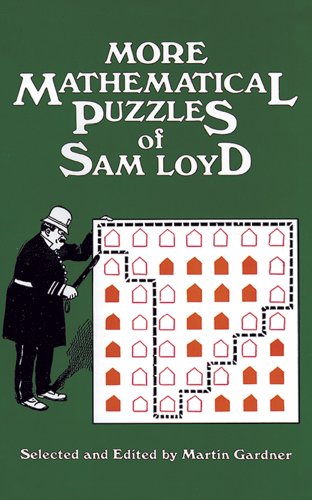
More Mathematical Puzzles of Sam Loyd


Sam Loyd e Martin Gardner

Dover Publications | 1960 | 201 páginas | djvu | 3,9 Mb

link

Gardner's second collection of amusing, thought-provoking problems and puzzles from Loyd's Cyclopedia — perhaps the most exciting collection of puzzles ever assembled in one volume. Arithmetic, algebra, speed and distance problems, game theory, counter and sliding block problems, similar topics. 166 problems.

Contents

Plane Geometry Problems
Geometrical Dissection Problems
Route, Tracing, and Topological Problems
Counter and Sliding Block Problems
Solid Geometry Problems 

Arithmetic and Algebraic Problems 
Speed and Distance Problems 
Game Theory Problems 
Operations Research Problems
Physics and Calculus Problems 

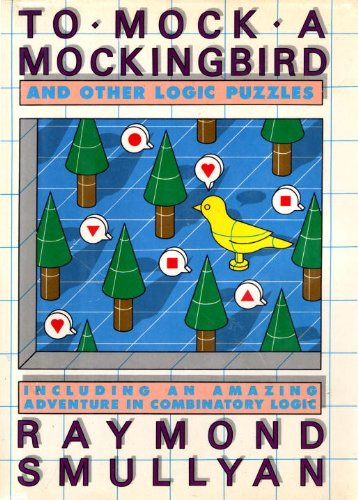
To mock a mockingbird


Raymond M. Smullyan 

Knopf | 1985 | 257 páginas | rar - epub | 2,11 Mb

link (password: matav)

In this entertaining and challenging new collection of logic puzzles, Raymond Smullyan—author of What Is the Name of This Book? And The Lady or the Tiger?—continues to delight and astonish us with his gift for making available, in the thoroughly pleasurable form of puzzles, some of the most important mathematical thinking of our time.
In the first part of the book, he transports us once again to that wonderful realm where knights, knaves, twin sisters, quadruplet brothers, gods, demons, and mortals either always tell the truth or always lie, and where truth-seekers are set a variety of fascinating problems. The section culminates in an enchanting and profound metapuzzle (a puzzle about a puzzle), in which Inspector Craig of Scotland Yard gets involved in a search of the Fountain of Youth on the Island of Knights and Knaves.
In the second and larger section, we accompany the Inspector on a summer-long adventure into the field of combinatory logic (a branch of logic that plays an important role in computer science and artificial intelligence). His adventure, which includes enchanted forests, talking birds, bird sociologists, and a classic quest, provides for us along the way the pleasure of solving puzzles of increasing complexity until we reach the Master Forest and—thanks to Gödel’s famous theorem—the final revelation.
To Mock a Mockingbird will delight all puzzle lovers—the curious neophytes as well as the serious students of logic, mathematics, or computer science.

Contents

Other Books by This Author
Title Page
Copyright
Dedication
Acknowledgments
Preface
PART I · LOGIC PUZZLES

1 The Prize—and Other Puzzles
2 The Absentminded Logician
3 The Barber of Seville
4 The Mystery of the Photograph
PART II · KNIGHTS, KNAVES, AND THE FOUNTAIN OF YOUTH

5 Some Unusual Knights and Knaves
6 Day-Knights and Night-Knights
7 Gods, Demons, and Mortals
8 In Search of the Fountain of Youth
PART III · TO MOCK A MOCKINGBIRD

9 To Mock a Mockingbird
10 Is There a Sage Bird?
11 Birds Galore
12 Mockingbirds, Warblers, and Starlings
13 A Gallery of Sage Birds
PART IV · SINGING BIRDS

14 Curry’s Lively Bird Forest
15 Russell’s Forest
16 The Forest Without a Name
17 Gödel’s Forest
PART V · THE MASTER FOREST

18 The Master Forest
19 Aristocratic Birds
20 Craig’s Discovery
PART VI · THE GRAND QUESTION!

21 The Fixed Point Principle
22 A Glimpse into Infinity
23 Logical Birds
24 Birds That Can Do Arithmetic
25 Is There an Ideal Bird?
Epilogue
Who’s Who Among the Birds