sexta-feira, 31 de janeiro de 2014

APOS Theory: A Framework for Research and Curriculum Development in Mathematics Education


Springer | 2014 | 270 páginas | pdf | 1,7 Mb


In spite of the fact that APOS Theory has been used extensively in numerous scholarly publications, in the design of textbooks, and in teaching practice, there is no single references that contains all the relevant information about its components, and provides guidance about its application. The goal of this book is to present the main elements of APOS theory. It should be useful for researchers who work with, or would like to learn more about, this theoretical approach, people who are interested in the way which mathematical conceptions are constructed according to this theory, Mathematics Education researchers, graduate students in Mathematics Education, and Mathematics instructors.

Chapter 1 Introduction.- Chapter 2 From Piaget’s Theory to APOS Theory: Reflective Abstraction in Learning Mathematics and the Historical Development of APOS Theory.- Chapter 3 Mental Structures and Mechanisms: APOS Theory and the Construction of Mathematical Knowledge.- Chapter 4 Genetic Decomposition.- Chapter 5 The Teaching of Mathematics Using APOS Theory.- Chapter 6 The APOS Paradigm for Research and Curriculum Development.- Chapter 7 Schemas, Their Development and Interaction.- Chapter 8 Totality as a Possible New Stage and Levels in APOS Theory.- Chapter 9 Use of APOS Theory to Teach Mathematics at Elementary School.- Chapter 10 Frequently Asked Questions.- Chapter 11 Conclusions.- Chapter 12 Annotated Bibliography.- References.- Index.

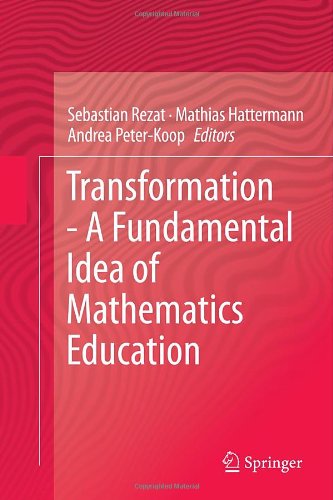
Transformation - A Fundamental Idea of Mathematics Education


Sebastian Rezat, Mathias Hattermann e Andrea Peter-Koop


Springer | 2014 | 417 páginas | rar -pdf |3,6 Mb

Password: matav

The diversity of research domains and theories in the field of mathematics education has been a permanent subject of discussions from the origins of the discipline up to the present. On the one hand the diversity is regarded as a resource for rich scientific development on the other hand it gives rise to the often repeated criticism of the discipline’s lack of focus and identity. As one way of focusing on core issues of the discipline the book seeks to open up a discussion about fundamental ideas in the field of mathematics education that permeate different research domains and perspectives. The book addresses transformation as one fundamental idea in mathematics education and examines it from different perspectives. Transformations are related to knowledge, related to signs and representations of mathematics, related to concepts and ideas, and related to instruments for the learning of mathematics. The book seeks to answer the following questions: What do we know about transformations in the different domains? What kinds of transformations are crucial? How is transformation in each case conceptualized?


Contents
Introduction
Sebastian Rezat, Mathias Hattermann
Part I
Introduction to Part I
Sebastian Rezat, Mathias Hattermann
1 How 18th Century Mathematics was Transformed into 19th Century School Curricula
                Heike Renate Biermann, Hans Niels Jahnke
2 A Framework for Examining the Transfor­mation of Mathematics and Mathematics Learning in the Transition from School to University: An Analysis of German Textbooks from Upper Secondary School and the First Semester
Maike Vollstedt, Aiso Heinze, Kristin Gojdka and Stefanie Rach
3 Knowledge Transformation between Secondary School and University Mathematics
                Oliver Deiser, Kristina Reiss
4 Student Transition to University Mathematics Education: Transformations of People, Tools and Practices
                Birgit Pepin
5 Overcoming the Gap between University and School Mathematics: The Impact of an Innovative Programme in Mathematics Teacher Education at the Justus-Liebig-University in Giessen
                Gabriele Kaiser, Nils Buchholtz
6 Mathematical Moments in a Human Life: Narratives on Transformation
                Barbro Grevholm
Discussion to Part I
Transitions in Learning Mathematics as a Challenge for People and Institutions
Rolf Biehler

Part II
Introduction to Part II
Sebastian Rezat, Mathias Hattermann
 7 Constructing Knowledge by Transformation: Diagrammatic Reasoning in Practice
                Gert Kadunz
8 Transforming Images in a DGS: The Semiotic Potential of the Dragging Tool for Introducing        the Notion of Conditional Statement
                Maria Alessandra Mariotti
9 Dynamic Representations of Complex Numbers: Opportunities to Learn in Teacher Training
                Reinhard Hölzl
10 Dynamic and Tangible Representations in Mathematics Education
                Colette Laborde, Jean-Marie Laborde
11 The Role of Social Aspects of Teaching and Learning in Transforming Mathematical Activity:      Tools, Tasks, Individuals and Learning Communities
                Vince Geiger
12 Designing a Simulator in Building Trades to Transform Vocational Education
                Annie Bessot
Discussion to Part II
Discussion I from an Epistemological Point of View: Representing and Meaning-making: The Transformation of Transformation
Falk Seeger
Discussion II from a Technological Point of View: Digital Technologies and Transformation in Mathematics Education
Rosamund Sutherland
Part III
Introduction to Part III
Sebastian Rezat, Mathias Hattermann
13 From Proof Image to Formal Proof – a Transformation
Tommy Dreyfus, Ivy Kidron
14 Elementary Stochastic Seeing in Primary Mathematics Classrooms – Epistemological Foundation and Empirical Evaluation of a Theoretical Construct
Judith Stanja, Heinz Steinbring
15 Understanding Geometric Work through its Development and its Transformations
                Alain Kuzniak
16 Small Steps to Promote “Mathematical Literacy”
                Lothar Profke
17 Transformation as a Fundamental Concept in Arithmetical Competence Modelling: An Example of Informatical Educational Science
                Josephus Klep
               
Discussion to Part III
Fundamental Ideas of Didactics – Reactions to the Suggested Meta-Theoretical Construct for Reflecting and Connecting Theories
Susanne Prediger

Epilogue

Rudolf Sträßer

As maravilhas da Matemática

Malba Tahan

BLOCH EDITORES | 1973 | 249 páginas| PDF

link direto

link

Sumário
1 — Estranho Vocabulário de Termos Incompreensíveis 13
2 — Os Mártires da Matemática 19
3 — O Papa que Foi Esquartejado 25
4 — Como Surgiram o + e o —? 29
5 — Numeração Pré-Colombiana 37
6 — Definições Euclidianas 41
7 — O Número Quatro na Mística Oriental e o Número Três Entre os Romanos 51
8 — As Aparências que Enganam 55
9 — A Curva Predileta dos Poetas 59
10 — O Heptágono Regular e Seu Peifume 65
11 — Um Repouso de Dezoito Séculos 69
12 — Os Ternos Pitagóricos e o Amor Sincero 73
13 — As Curvas Matemáticas nos Animais e nas Plantas 83
14 — O Problema das Bolas Misturadas 85
15 — A Geometria Ideal e a Realidade 89
16 — O Quadrado Mágico e o Jogo de Xadrez 91
17 — "Seu" Venâncio e as Dez Pontas de Cigarro 97
18 — Patas e Chifres no Palácio do Rei 101
19 — A Alta Matemática das Abelhas Geómetras 105
20 — O Número "Pi" Numa Trova Bem Rimada
21 — Círculos que se Tocam com Harmonia e Beleza 115
22 — O Milhão, Seu Retrato e Seu Prestígio 119
23 — A Estranha Numeração dos Maias 125
24 — Homens e Mulheres Numa Festa Mal Organizada 129
25 — Curiosidades Numéricas que Assombram os Calculistas 131
2 6 — 0 Problema dos Anjos de Efraim 133
27 — A Unidade Caçula: o Micrômetro 137
28 — A Pirâmide Humana de Newton 141
29 — A Curva Perfeita do Laço de Fita 145
30 — O Problema das Quinze Laranjeiras Bem Plantadas 151
31 — Filhos, Netos e Perucas em Equação 153
32 — Gato e Rato aos Pulos Uniformes 157
33 — A Idade Fantasiosa de Um Poeta 159
34 — O Palmo, o Palminho e Outras Medidas 163
35 — Goethe e a Tabuada da Feiticeira 169
36 — Problemas, Charadas e Enigmas 173
37 — Curva Patológica com Ponto Isolado 179
38 — Ao Reflorir Suave das Rosáceas 183
39 — O Simples Complicadíssimo e o Não-Simples Corriqueiro 189
40 — O Problema da Besta e a Solução do Sábio 193
41 — O Estranho Mistério dos Calculistas Famosos 195
42 — Circunferência Feita com Retas 197
43 — A Paixão e a Vez de Sofia Kovalevskaia 199
44 — Um Paradoxo Incrível no Infinito 203
45 — Quatro Símbolos Universais Famosos 207
46 — As Barricas Passam a Fronteira 215
47 — O Método Experimental em Matemática 219
48 — O Último e Famoso Teorema de Fermat 221
49 — O Ponto de Ouro, Sua Beleza e Seu Mistério 227
Índice das Curiosidades 251

Índice Alfabético de Nomes Citados 253

Sugestão de Jocélio Silveira

quinta-feira, 30 de janeiro de 2014

Student Voice in Mathematics Classrooms around the World


Berinderjeet Kaur, Glenda Anthony e Minoru Ohtani


Sense Publishers | 2013 | 262 páginas | pdf | 3,2 Mb


TABLE OF CONTENTS
Acknowledgements ix
1 The Learner’s Perspective Study: Attending to Student Voice
Glenda Anthony, Berinderjeet Kaur, Minoru Ohtani and David Clarke
2 Spoken Mathematics as an Instructional Strategy: The Public Discourse of Mathematics Classrooms in Different Countries
David Clarke, Li Hua Xu and May Ee Vivien Wan
3 Students Speaking Mathematics: Practices and Consequences for Mathematics Classrooms in Different Countries
David Clarke, Li Hua Xu and May Ee Vivien Wan
4 Students at the Front: Examples from a Beijing Classroom 53
Yiming Cao, Kan Guo, Liping Ding and Ida Ah Chee Mok
5 Participation of Students in Content-Learning Classroom Discourse: A Study of Two Grade 8 Mathematics Classes in Singapore
Berinderjeet Kaur
6 Martina’s Voice 89
Florenda Gallos Cronberg and Jonas Emanuelsson
7 What o Students Attend to? Students’ Task-Related Attention in Swedish Settings
Rimma Nyman and Jonas Emanuelsson
8 Students and heir Teacher in a Didactical Situation: A Case Study
Jarmila Novotná and Alena Hospešová
9 Developing Mathematical Proficiency and Democratic Agency through Participation – An Analysis of Teacher Student Dialogues in a Norwegian 9th Grade Classroom
Ole Kristian Bergem and Birgit Pepin
10 Matches or Discrepancies: Student Perceptions and Teacher Intentions in Chinese Mathematics Classrooms
Rongjin Huang and Angela T. Barlow
11 What Really Matters to Students? A Comparison between Hong Kong and Singapore Mathematics Lessons
Ida Ah Chee Mok, Berinderjeet Kaur, Yan Zhu and King Woon Yau
12 Student Perceptions of the ‘Good’ Teacher and ‘Good’ Learner in New Zealand Classrooms
Glenda Anthony
Appendix: The LPS Research Design 227
David Clarke
Author Index 243
Subject Index 247

Deleuze and the History of Mathematics: In Defense of the 'New'


(Continuum Studies in Continental Philosophy)

 Simon Duffy 

Bloomsbury Academic | 2013 | 225 páginas | rar -pdf | 968 kb

link 
password: matav

Gilles Deleuze's engagements with mathematics, replete in his work, rely upon the construction of alternative lineages in the history of mathematics, which challenge some of the self imposed limits that regulate the canonical concepts of the discipline. For Deleuze, these challenges are an opportunity to reconfigure particular philosophical problems - for example, the problem of individuation - and to develop new concepts in response to them. The highly original research presented in this book explores the mathematical construction of Deleuze's philosophy, as well as addressing the undervalued and often neglected question of the mathematical thinkers who influenced his work. 

In the wake of Alain Badiou's recent and seemingly devastating attack on the way the relation between mathematics and philosophy is configured in Deleuze's work, Simon Duffy offers a robust defence of the structure of Deleuze's philosophy and, in particular, the adequacy of the mathematical problems used in its construction. By reconciling Badiou and Deleuze's seeming incompatible engagements with mathematics, Duffy succeeds in presenting a solid foundation for Deleuze's philosophy, rebuffing the recent challenges against it.

Contents
Acknowledgments x
List of Abbreviations xii
Introduction 1
1 Leibniz and the Concept of the Infinitesimal 7
2 Maimon’s Critique of Kant’s Approach to Mathematics 47
3 Bergson and Riemann on Qualitative Multiplicity 89
4 Lautman’s Concept of the Mathematical Real 117
5 Badiou and Contemporary Mathematics 137
Conclusion 161
Notes 175
Bibliography 189
Index 201

quarta-feira, 29 de janeiro de 2014

New Teacher Identity and Regulative Government: The Discursive Formation of Primary Mathematics Teacher Education


Tony Brown, Olwen McNamara

Springer | 2005 | 198 páginas | pdf | 18,4 Mb

link


This book addresses the question of how we might better understand the task of teaching mathematics to young children. But rather than starting out with a conception of mathematics derived from mathematics’ own evolution, we center ourselves instead within the social practices that surround the teaching of the subject in British primary schools today. That is, we do not commence with an a priori conception of mathematics and see what people are saying about it. Rather, we start from what people are saying and see what this points to. We probe how the desires of society have manifested themselves in a societal decision to teach mathematics and how this decision now shapes what we call "mathematics". This extends and develops a conception of how language intervenes in the task of mathematics education presented elsewhere (Brown, 2001). In this present book however, we have a particular focus on trainee and new teachers, with a view to pinpointing how this conception of mathematics manifests itself in their evolving practices. We question how such teachers with many years of experience as a pupil in school might now re-orient themselves towards the demands of teaching mathematics. We also consider how for those charged with providing training for such individuals might better understand the process and impact of this training. The book further questions the way in which we might conceptualize the balance between nurturing teachers to become autonomous professionals responsible for developing and delivering the mathematics curriculum in schools and, alternatively, setting policies that prescribe practices to be followed. We consider whether we should focus our attention principally on the teachers themselves or on the professional space in which they operate.
The book is primarily concerned with examining how trainee teachers conceptualize their own professional development, from the time they enter university on a four-year course as prospective initial teacher training students through to their first year of teaching in primary school. It has a particular focus on how they understand mathematics and how they understand their own teaching of the subject in schools. It offers both empirical and theoretical perspectives.
Empirically, the book draws in particular on two studies conducted by the authors, funded by the UK Economic and Social Research Council and spanning a four-year period. Both of these studies were concerned with the professional development of trainee teachers with a particular focus on their phenomenological experience of the training process.
Theoretically, the book draws on recent work in the field of psychoanalysis, and in particular the work of Slavoj Zizek, as an approach to examining how individual trainee teachers encounter the social framework in which they operate. In tackling this we consider the "technologies of self" that produce teachers in schools. We also look at how we might theorize our empirical findings that locate the discursive formation of school mathematics.
To summarize the key strands: Firstly, we are keen to present an account of how trainee teachers understand their own journey into teaching mathematics in the primary school. Secondly, we wish to understand better the conception of mathematics in the primary school and how it might develop. Thirdly, we are keen to offer some discussion of how official policy as presented in government initiatives impacts on such teachers. Fourthly, we are concerned with better understanding the role that research in mathematics education might have in accounting for the process of trainees becoming teachers in the primary school and in stimulating development in this area. Finally, we try to offer a theoretical frame that accommodates evolving and alternative conceptions of mathematics, how it is taught and the social parameters that guide these conceptions.

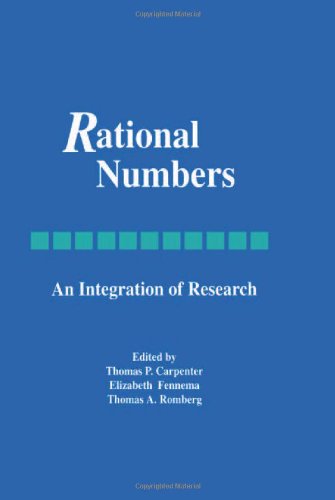
Rational numbers : an integration of research


(Studies in Mathematical Thinking and Learning Series)

Thomas P. Carpenter, Elizabeth Fennema e Thomas A. Romberg
Routledge | 1993 | 382 páginas | rar - pdf | 6,1 Mb


link (passord : matav)


Until recently there had been relatively little integration of programs of research on teaching, learning, curriculum, and assessment. However, in the last few years it has become increasingly apparent that a more unified program of research is needed to acquire an understanding of teaching and learning in schools that will inform curriculum development and assessment. The chapters in this volume represent a first step toward an integration of research paradigms in one clearly specified mathematical domain.
Integrating a number of different research perspectives is a complex task, and ways must be found to reduce the complexity without sacrificing the integration. The research discussed in this volume is tied together because it deals with a common content strand. During the last ten years specific content domains have served as focal points for research on the development of mathematical concepts in children. The areas of addition and subtraction, algebra, rational numbers, and geometry are notable examples. Whether a similar organizational structure will prevail for programs of research that integrate the study of teaching, learning, curriculum, and assessment is an open question. The perspectives presented in this volume illustrate the potential for adopting this perspective.
Contents: 
Part I: Overview. 
T.P. Carpenter, E. Fennema, T.A. Romberg, Toward A Unified Discipline of Scientific Inquiry. 
Part II: Content Analyses of Rational Numbers. 
M.J. Behr, G. Harel, T. Post, R. Lesh, Rational Numbers: Toward a Semantic Analysis -- Emphasis on the Operator Construct. 
T.E. Kieren, Rational and Fractional Numbers: From Quotient Fields to Recursive Understanding. 
Part III: Students' Thinking. 
N.K. Mack, Learning Rational Numbers With Understanding: The Case of Informal Knowledge. 
L.B. Resnick, J.A. Singer,Protoquantitative Origins of Ratio Reasoning. 
S.J. Lamon, Ratio and Proportion: Children's Cognitive and Metacognitive Processes. 
Part IV:Teachers and Teaching. 
D.L. Ball, Halves, Pieces, and Twoths: Constructing and Using Representational Contexts in Teaching Fractions.
C.A. Brown, A Critical Analysis of Teaching Rational Number. 
J.A. Hiebert, Benefits and Costs of Research That Links Teaching and Learning Mathematics. 
J.T. Sowder, N. Bezuk, L.K. Sowder, Using Principles From Cognitive Psychology to Guide Rational Number Instruction for Prospective Teachers. 
Part V: Assessment. 
S.P. Marshall, Assessment of Rational Number Understanding: A Schema-Based Approach. 
Part VI: Curriculum and Instruction. 
L. Streefland, Fractions: A Realistic Approach. 
T.R. Post, K.A. Cramer, M. Behr, R. Lesh, G. Harel,Curriculum Implications of Research on the Learning, Teaching, and Assessing of Rational Number Concepts.