quarta-feira, 29 de janeiro de 2014

Ibn al-Haytham’s Theory of Conics, Geometrical Constructions and Practical Geometry. A History of Arabic Sciences and Mathematics Volume 3


(Culture and Civilization in the Middle East)


 Roshdi Rashed 


Routledge | 2013 | 760 páginas | rar - pdf | 2,7 Mb

link


password: matav


Theory of Conics, Geometrical Constructions and Practical Geometry: A History of Arabic Sciences and Mathematics Volume 3, provides a unique primary source on the history and philosophy of mathematics and science from the mediaeval Arab world. The present text is complemented by two preceding volumes of AHistory of Arabic Sciences and Mathematics, which focused on founding figures and commentators in the ninth and tenth centuries, and the historical and epistemological development of ‘infinitesimal mathematics’ as it became clearly articulated in the oeuvre of Ibn al-Haytham.

This volume examines the increasing tendency, after the ninth century, to explain mathematical problems inherited from Greek times using the theory of conics. Roshdi Rashed argues that Ibn al-Haytham completes the transformation of this ‘area of activity,’ into a part of geometry concerned with geometrical constructions, dealing not only with the metrical properties of conic sections but with ways of drawing them and properties of their position and shape.

Including extensive commentary from one of world’s foremost authorities on the subject, this book contributes a more informed and balanced understanding of the internal currents of the history of mathematics and the exact sciences in Islam, and of its adaptive interpretation and assimilation in the European context. This fundamental text will appeal to historians of ideas, epistemologists and mathematicians at the most advanced levels of research.

terça-feira, 28 de janeiro de 2014

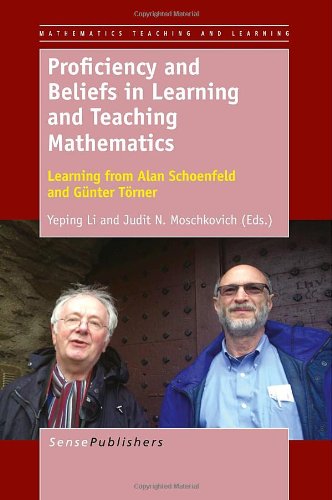
Proficiency and Beliefs in Learning and Teaching Mathematics: Learning from Alan Schoenfeld and Gunter Torner


Yeping Li e Judit N. Moschkovich

Sense Publishers | 2013 | 326 páginas | rar - pdf | 2,8 Mb

link (password: matav)

pdf | 2,3 Mb (no cover)
link

TABLE OF CONTENTS
Acknowledgements vii
Part I: Introduction
1. Proficiency and Beliefs in Learning and Teaching Mathematics – An Introduction 3
Yeping Li and Judit N. Moschkovich
2. About Alan H. Schoenfeld and His Work 9
Hugh Burkhardt and Yeping Li
3. About Günter Törner and His Work 19
Hans Heinrich Brungs and Yeping Li
Part II: Proficient Performance, Beliefs, and Metacognition in Mathematical Thinking, Problem Solving, and Learning
4. Developing Problem Solving Skills in Elementary School – The Case of Data Analysis, Statistics, and Probability 33
Kristina Reiss, Anke M. Lindmeier, Petra Barchfeld and Beate Sodian
5. Transmissive and Constructivist Beliefs of In-Service Mathematics Teachers and of Beginning University Students 51
Christine Schmeisser, Stefan Krauss, Georg Bruckmaier, Stefan Ufer and Werner Blum
6. Building on Schoenfeld’s Studies of Metacognitive Control towards Social Metacognitive Control 69
Ming Ming Chiu, Karrie A. Jones and Jennifer L. Jones
Part III: Proficient Performance, Beliefs, and Practices in Mathematics Teaching, andWays to Facilitate Them
7. The CAMTE Framework – A Tool for Developing Proficient Mathematics Teaching in Preschool 89
Pessia Tsamir, Dina Tirosh, Esther Levenson, Ruthi Barkai and Michal Tabach
8. Integrating Noticing into the Modeling Equation 111
Miriam Gamoran Sherin, Rosemary S. Russ and Bruce L. Sherin
9. Teaching as Problem Solving – Collaborative Conversations as Found Talk-Aloud Protocols 125
Ilana Seidel Horn
10. Researching the Sustainable Impact of Professional Development Programmes on Participating Teachers’ Beliefs 139
Stefan Zehetmeier and Konrad Krainer
11. Capturing Mathematics Teachers’ Professional Development in Terms of Beliefs 157
Bettina Roesken-Winter
12. Mathematicians and Elementary School Mathematics Teachers – Meetings and Bridges 179
Jason Cooper and Abraham Arcavi
Part IV: Issues and Perspectives on Research and Practice
13. Methodological Issues in Research and Development 203
Hugh Burkhardt
14. A Mathematical Perspective on Educational Research 237
Cathy Kessel
15. Issues Regarding the Concept of Mathematical Practices 259
Judit N. Moschkovich
Part V: Reflections and Future Research Development
16. Looking Back and Ahead – Some Very Subjective Remarks on Research in Mathematics Education 279
Günter Törner
17. Encore 287
Alan H. Schoenfeld
Author Biographies 303

Index 313

Being Alongside: For the Teaching and Learning of Mathematics

Alf Coles

Sense Publishers | 2013 | 186 páginas | pdf | 920 kb

link

How do you establish a classroom culture in which students routinely conjecture and think mathematically? How do you establish a way of working with teachers, using video, in which discussion supports professional development? The present book offers answers to these questions through an in depth (enactivist) study of one exceptional teacher in one innovative mathematics department in the UK. The book reveals some striking parallels between working to support students' mathematical thinking and working to support teacher learning. A case is made for the importance of metacommunication in both contexts - communication about the communications that are occurring. For example, there is compelling evidence from a classroom that metacommunication, linked to the words 'conjecture' and 'becoming a mathematician', supports student metacognition and mathematical thinking. In working with teachers or students, offering these powerful metacommunications seems to require a heightened listening. With a heightened listening, attention is placed not just in what is said, but in what kind of a thing is said, with the teacher or facilitator being alongside the individuals in the wider group. "Read this book if you're a teacher for insights into how one teacher establishes a classroom culture where her children are doing mathematics, 'being mathematicians' and reflect on what you want in your own classroom. Read this book if you're a teacher educator to reflect on parallels between teaching and running professional development sessions, particularly using video. If you do not fit in either of these categories, read this book and use stories in your life." - Laurinda Brown, University of Bristol.

TABLE OF CONTENTS
Preface ix
Timeline of Teaching and Research Activity xi
Acknowledgements xiii
Part One
1. Introduction 3
2. Enactivism 11
3. A Cyclical Enquiry 25
Part Two
4. On Using Video 37
5. On Teacher Learning 53
6. Re-looking at Teacher Discussions 65
Part Three
7. On Metacognition 79
8. The Story of Teacher A 89
9. Heightened Listening 101
Part Four
10. Conclusion 115
Appendix 1 121
Appendix 2 129
Appendix 3 147
Appendix 4 149
References 163

Jumpstart! Numeracy: Maths Activities and Games for Ages 5-14


John Taylor


David Fulton Publishers | 2004 | 94 páginas | rar - pdf | 8,9 Mb

password: matav

These fun sessions will jumpstart pupils’ enthusiasm for mathematical learning. Suitable for all abilities across Key Stages 1, 2 and 3; activities match the strands of the National Numeracy Strategy. The ‘jumpstarts’ cover:
  • brain bending quizzes - get pupils thinking
  • oral games – warm up pupils’ mathematical vocabulary
  • differentiated games and quizzes
  • activities for interactive whiteboards, flipcharts PCs
  • ICT handy hints.

Contents
Acknowledgements vi
Introduction viii
Table of games x
1 Number i
Number Snap 1
Number Lotto 2
How Many? 3
The Matchstick Game 4
Order Them 6
Beanbag Count 7
Animal Count 8
Town/Country/Team Count 9
Number Bond Countdown 9
Odds and Evens 10
Stand Up and Be Counted (1) 11
Stand Up and Be Counted (2) 12
Make a Number 13
Join Up (1) 14
Multiple Snap 15
Prime Time 16
Number Volleyball 17
Fizz Buzz 18
Hostage Round Up 19
Rounding Around 20
Percent Snap 21
Decimal Snap 23
2 Calculations 25
Team Promotion 25
Swap Over 27
First Team Home 28
League Table (1) 29
League Table (2) 30
Join Up (2) 31
Target Totals (1) 32
Target Totals (2) 33
Halves and Doubles 33
Number Cricket (1) 34
Number Cricket (2) 35
Number Rounders 36
Double Up 37
Eights and Nines 38
Eighties and Nineties 39
Number Bond Tennis 39
Fibonacci Count 40
3 Measurement 42
Time Jump (1) 42
Time Jump (2) 43
Time Volleyball (1) 44
Time Volleyball (2) 45
Crossing the River 46
Brainstorming Mass 47
Brainstorming Length 48
Brainstorming Volume 48
Rapid Conversion (1) 49
Rapid Conversion (2) 51
4 Shape and Space 53
Shape Lotto 53
Shape Snap 54
Triangle Lotto 55
Treasure Hunt (1) 55
Treasure Hunt (2) 56
Treasure Hunt (3) 57
Pipeline (1) 57
Don't Lose Your Bearings 58
Pipeline (2) 59
Pipeline (3) 60
Chicken Pen 61
Shape Up 62
5 Data Handling 63
Name a... (1) 63
Name a... (2) 64
Shape Sort 65
Data Relay 65
Probability Brainstorm 67
6 ICT Tips and Hints 69
Microsoft 69
Excel 71

Mathematics in Historical Context


(Spectrum)

Jeff Suzuki

Mathematical Association of America | 2009 | 409 páginas | pdf (4.7 mb)

link

What would Newton see if he looked out his bedroom window? Mathematics in Historical Context describes the world around the important mathematicians of the past, and explores the complex interaction between mathematics, mathematicians, and society. It takes the reader on a grand tour of history from the ancient Egyptians to the twentieth century to show how mathematicians and mathematics were affected by the outside world, and at the same time how the outside world was affected by mathematics and mathematicians. Part biography, part mathematics, and part history, this book provides the interested layperson the background to understand mathematics and the history of mathematics, and is suitable for supplemental reading in any history of mathematics course.

Mathematics in Historical Context provides the historical background to the development of mathematics. It can be used as a supplemental text to a history of mathematics course, or even as a stand-alone history text.

Contents
Introduction vii
1 The Ancient World 1
1.1 Prehistory . . . . . . . . . . . . . . . . . . . . . . . . . . . . . . . . . . . 1
1.2 Egypt . . . . . . . . . . . . . . . . . . . . . . . . . . . . . . . . . . . . . 2
1.3 Mesopotamia . . . . . . . . . . . . . . . . . . . . . . . . . . . . . . . . . 7
2 The ClassicalWorld 15
2.1 The Greeks . . . . . . . . . . . . . . . . . . . . . . . . . . . . . . . . . . 15
2.2 The Romans . . . . . . . . . . . . . . . . . . . . . . . . . . . . . . . . . . 34
3 China and India 55
3.1 China . . . . . . . . . . . . . . . . . . . . . . . . . . . . . . . . . . . . . 55
3.2 India . . . . . . . . . . . . . . . . . . . . . . . . . . . . . . . . . . . . . . 69
3.3 The Importance of Proof . . . . . . . . . . . . . . . . . . . . . . . . . . . 81
4 The IslamicWorld 83
4.1 Early Islam . . . . . . . . . . . . . . . . . . . . . . . . . . . . . . . . . . 83
4.2 The Rise and Fall of Dynasties . . . . . . . . . . . . . . . . . . . . . . . . 89
4.3 The Age of Invasion . . . . . . . . . . . . . . . . . . . . . . . . . . . . . 103
4.4 Andalusia . . . . . . . . . . . . . . . . . . . . . . . . . . . . . . . . . . . 110
5 The Middle Ages 119
5.1 Norman Sicily . . . . . . . . . . . . . . . . . . . . . . . . . . . . . . . . . 119
5.2 Early Medieval France . . . . . . . . . . . . . . . . . . . . . . . . . . . . 125
5.3 High Medieval France . . . . . . . . . . . . . . . . . . . . . . . . . . . . 145
6 Renaissance and Reformation 157
6.1 The Italian Peninsula . . . . . . . . . . . . . . . . . . . . . . . . . . . . . 157
6.2 Central Europe . . . . . . . . . . . . . . . . . . . . . . . . . . . . . . . . 169
7 Early Modern Europe 185
7.1 France . . . . . . . . . . . . . . . . . . . . . . . . . . . . . . . . . . . . . 185
7.2 The Low Countries . . . . . . . . . . . . . . . . . . . . . . . . . . . . . . 195
7.3 Great Britain . . . . . . . . . . . . . . . . . . . . . . . . . . . . . . . . . 212
8 The Eighteenth Century 231
8.1 Great Britain . . . . . . . . . . . . . . . . . . . . . . . . . . . . . . . . . 231
8.2 Central and Eastern Europe . . . . . . . . . . . . . . . . . . . . . . . . . . 242
8.3 France . . . . . . . . . . . . . . . . . . . . . . . . . . . . . . . . . . . . . 251
9 The Nineteenth Century 277
9.1 France . . . . . . . . . . . . . . . . . . . . . . . . . . . . . . . . . . . . . 277
9.2 Great Britain . . . . . . . . . . . . . . . . . . . . . . . . . . . . . . . . . 288
9.3 Italy . . . . . . . . . . . . . . . . . . . . . . . . . . . . . . . . . . . . . . 293
9.4 Germany . . . . . . . . . . . . . . . . . . . . . . . . . . . . . . . . . . . 296
10 The United States 311
10.1 From Colony to Country . . . . . . . . . . . . . . . . . . . . . . . . . . . 311
10.2 The Gilded Age . . . . . . . . . . . . . . . . . . . . . . . . . . . . . . . . 326
11 The Modern World 337
11.1 Before the Great War . . . . . . . . . . . . . . . . . . . . . . . . . . . . . 337
11.2 The Era of the Great War . . . . . . . . . . . . . . . . . . . . . . . . . . . 347
11.3 The Depression Era . . . . . . . . . . . . . . . . . . . . . . . . . . . . . . 357
11.4 WorldWar Two . . . . . . . . . . . . . . . . . . . . . . . . . . . . . . . . 369
Epilog 385
Bibliography 387
Figure Citations 395
Index 397
About the Author 409

Book of Curves

E. H. Lockwood

Cambridge University Press | 2007 | 212 páginas | pdf (11.9 mb) // DjVu (2.1 mb)

link (pdf)
link (DjVu)

This book opens up an important field of mathematics at an elementary level, one in which the element of aesthetic pleasure, both in the shapes of the curves and in their mathematical relationships, is dominant. This book describes methods of drawing plane curves, beginning with conic sections (parabola, ellipse and hyperbola), and going on to cycloidal curves, spirals, glissettes, pedal curves, strophoids and so on. In general, 'envelope methods' are used. There are twenty-five full-page plates and over ninety smaller diagrams in the text. The book can be used in schools, but will also be a reference for draughtsmen and mechanical engineers. As a text on advanced plane geometry it should appeal to pure mathematicians with an interest in geometry, and to students for whom Euclidean geometry is not a principal study.
CONTENTS
Frontispiece. Section of the shell of a Pearly Nautilus fossil. (Reproduced by permission of
Dr A. M. Winchester of Stetson University, Florida.)
preface page vii
HISTORICAL INTRODUCTION ix
NOTATION Xi
PART I. SPECIAL CURVES
1 The Parabola . . . page 2
2 The Ellipse 12
3 The Hyperbola 24
4 The Cardioid 34
5 The Limagon 44
6 TheAstroid 52
7 The Nephroid 62
8 The Deltoid 72
9 The Cycloid 80
10 The Right Strophoid ... 90
11 The Equiangular Spiral . . 98
12 The Lemniscate of
Bernoulli 110
13 The Tractrix and
Catenary 118
PART II. WAYS OF FINDING NEW CURVES
14 Conchoids 126
15 Cissoids 130
16 Strophoids 134
17 Roulettes 138
18 Pedal Curves 152
19 Negative Pedals 156
20 Glissettes 160
21 Evolutes and Involutes . . 166
22 Spirals 172
23 Inversion 176
24 Caustic Curves 182
25 Bipolar Coordinates . ... 186
FURTHER READING 191
GLOSSARY 192
INDEX OF NAMES 196
INDEX OF SUBJECTS 198

Circles: A Mathematical View


(Spectrum)

Dan Pedoe

The Mathematical Association of America | 1997 | 138 páginas | pdf (5.7 mb)

link

This revised edition of a mathematical classic originally published in 1957 will bring to a new generation of students the enjoyment of investigating that simplest of mathematical figures, the circle. The author has supplemented this new edition with a special chapter designed to introduce readers to the vocabulary of circle concepts with which the readers of two generations ago were familiar. Readers of Circles need only be armed with paper, pencil, compass, and straight edge to find great pleasure in following the constructions and theorems. Those who think that geometry using Euclidean tools died out with the ancient Greeks will be pleasantly surprised to learn many interesting results which were only discovered in modern times. Novices and experts alike will find much to enlighten them in chapters dealing with the representation of a circle by a point in three-space, a model for non-Euclidean geometry, and the isoperimetric property of the circle.

 CONTENTS
Preface ............................................. vii
CHAPTER O ......................................... xi
CHAPTER I
1. The nine-point circle ................................. 1
2. Inversion .......................................... 4
3. Feuerbach's theorem ................................. 9
4. Extension of Ptolemy's theorem ................................. 10
5. Fermat's problem ................................... 11
6. The centres of similitude of two circles .......................... 12
7. Coaxal systems of circles .............................. 14
8. Canonical form for coaxal system ....................... 16
9. Further properties .................................. 19
10. Problem of Apollonius ............................... 21
11. Compass geometry .................................. 23
CHAPTER II
1. Representation of a circle ................................. 26
2. Euclidean three-space, E3 . . . . . . . . . . . . . . . . . . . . . . . . . . . . . . . 26
3. First properties of the representation .................... 28
4. Coaxal systems .................................... 29
5. Deductions from the representation ............................. 30
6. Conjugacy relations ................................. 32
7. Circles cutting at a given angle ........................ 35
8. Representation of inversion ............................ 36
9. The envelope of a system ................................ 37
10. Some further applications ................................ 39
11. Some anallagmatic curves ................................ 43
 CHAPTER III
1. Complex numbers .................................. 44
2. The Argand diagram ................................. 44
3. Modulus and argument ............................... 45
4. Circles as level curves ....................................... 46
5. The cross-ratio of four complex numbers ........................ 47
6. Mobius transformations of the a-plane .................... 50
7. A Mobius transformation dissected ...................... 51
8. The group property ....................................... 53
9. Special transformations ............................... 55
10. The fundamental theorem ...................................... 55
11. The Poincar6 model .................................. 58
12. The parallel axiom .................................. 61
13. Non-Euclidean distance ............................... 61
CHAPTER TV
1. Steiner's enlarging process .............................. 64
2. Existence of a solution . .............................. 65
3. Method of solution ....................................... 66
4. Area of a polygon ....................................... 67
5. Regular polygons .................................... 69
6. Rectifiable curves ....................................... 71
7. Approximation by polygons ............................. 73
8. Area enclosed by a curve ............................. 76
Exercises ............................................ 79
Solutions ....................................... 84
Appendix: Karl Wilhelm Feuerbach, Mathematician
by Laura Guggenbuhl ....................................... 89
Index .............................................. 101