quinta-feira, 23 de janeiro de 2014

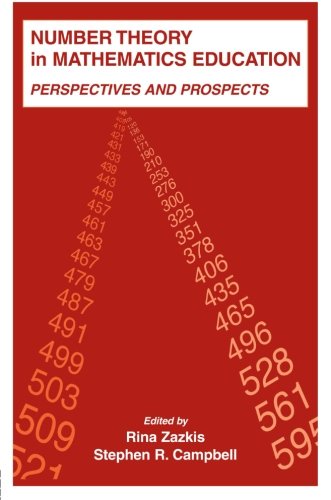
Number Theory in Mathematics Education: Perspectives and Prospects


(Studies in Mathematical Thinking and Learning)

Rina Zazkis, Stephen R. Campbell

Lawrence Erlbaum Associates | 2006 | 304 páginas | pdf | 2,8 Mb

link (password: matav)

This book offers multiple interconnected perspectives on the largely untapped potential of elementary number theory for mathematics education: its formal and cognitive nature, its relation to arithmetic and algebra, its accessibility, its utility and intrinsic merits, to name just a few. Its purpose is to promote explication and critical dialogue about these issues within the international mathematics education community. The studies comprise a variety of pedagogical and research orientations by an international group of researchers that, collectively, make a compelling case for the relevance and importance of number theory in mathematics education in both pre K-16 settings and mathematics teacher education. Topics variously engaged include: • understanding particular concepts related to numerical structure and number theory; • elaborating on the historical and psychological relevance of number theory in concept development; • attaining a smooth transition and extension from pattern recognition to formative principles; • appreciating the aesthetics of number structure; • exploring its suitability in terms of making connections leading to aha! insights and reaching toward the learner's affective domain; • reexamining previously constructed knowledge from a novel angle; • investigating connections between technique and theory; • utilizing computers and calculators as pedagogical tools; and • generally illuminating the role number theory concepts could play in developing mathematical knowledge and reasoning in students and teachers. Overall, the chapters of this book highlight number theory-related topics as a stepping-stone from arithmetic toward generalization and algebraic formalism, and as a means for providing intuitively grounded meanings of numbers, variables, functions, and proofs. Number Theory in Mathematics Education: Perspectives and Prospects is of interest to researchers, teacher educators, and students in the field of mathematics education, and is well suited as a text for upper-level mathematics education courses.

Contents
List of Contributors vii
Preface ix
1 Number Theory in Mathematics Education Research: Perspectives and Prospects
Rina Zazkis and Stephen R. Campbell
2 Understanding Elementary Number Theory in Relation to Arithmetic and Algebra
Stephen R. Campbell
3 What Makes an Example Exemplary: Pedagogical and Didactical Issues in Appreciating Multiplicative Structures
John Mason
4 For the Beauty of Number Theory 69
Nathalie Sinclair
5 On the Path to Number Theory: Repeating Patterns as a Gateway
Rina Zazkis and Peter Liljedahl
6 Learning by Teaching: The Case of Sieve of Eratosthenes and One Elementary School Teacher
Roza Leikin
7 Learning Elementary Number Theory Through a Chain of Discovery: Preservice Teachers’ Encounter with Pentominoes
Peter Liljedahl
8 The Number-Theoretic Experience of 12- to 15-Year-Olds in a Calculator Environment: The Intertwining Coemergence of Technique and Theory
Carolyn Kieran and José Guzmán
9 Learning Number Theory Concepts Via Geometrical Interactive Computerized Setting
Ilana Lavy
10 Overlooking Number Patterns in Algorithmic Problem Solving
David Ginat
11 Revisiting Algebra in a Number Theoretical Setting 249
Jennifer Christian Smith


Outros livros da mesma autora, disponíveis no blog:


- Campbell. S. R., & Zazkis, R. (Eds.) (2002). Learning and teaching number theory: Research in cognition and instruction. Westport, CT: Ablex Publishing 
- Leikin, R. & Zazkis, R. (Eds.) (2010). Learning through Teaching Mathematics:  Developing teachers’ knowledge and expertise in practice. Springer.

- Zazkis, R. (2011). Relearning mathematics: A challenge for prospective elementary school teachers. Information Age Publishing. Charlotte, NC.

Capítulos em livros, da mesma autora, disponíveis no blog:

- Zazkis, R. & Gadowsky, K. (2001). Attending to transparent features of opaque representations of natural numbers. In A. Cuoco (Ed.), NCTM 2001 Yearbook: The roles of representation in school mathematics (pp. 41-52). Reston, VA: NCTM. 
-  Zazkis, R. (2008). Divisibility and transparency of number representations. In M. P. Carlson & C. Rasmussen (Eds.), Making the Connection: Research and practice in undergraduate mathematics (pp. 81-92). MAA notes. 

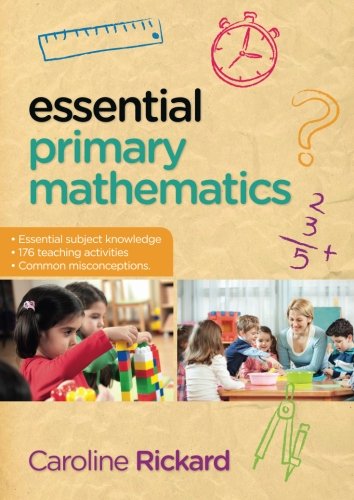
Essential Primary Mathematics


Caroline Rickard
Open University Press | 2013 | 339 páginas | rar-pdf | 12,1 Mb

link (password: matav)

If you are teaching or learning to teach primary mathematics, this is the toolkit to support you! Not only does it cover the essential knowledge and understanding that you and your pupils need to know, it also offers 176 great ideas for teaching primary mathematics - adaptable for use within different areas of mathematics and for different ages and abilities. Tackling children's misconceptions in each topic area and differentiation through open-ended tasks and elements of choice, the book encourages you to think deeply about the teaching of the primary mathematics curriculum. The classroom activities, which are simple to resource and use, support you in meeting the Teachers' Standards securely and encourage children to: think deeply about mathematics and to challenge themselves; develop mathematical independence; engage in mathematical talk; and work collaboratively with others to further understanding. Whether you are just getting started in your teaching career or more experienced you will find a wealth of innovative activities to support you in teaching primary mathematics in effective and creative ways. "This book is an absolute must for every primary teacher. The perfect blend of subject knowledge, common misconceptions, pupil activities and self-assessment questions will support all those who are feeling slightly less than confident about teaching a mathematical topic. It will also be invaluable to experienced teachers and subject leaders who wish to think more deeply about how to teach mathematics effectively." (Sue Davis, Primary PGCE Course Leader and Lecturer in Mathematics Education, University of Leicester, UK). "This book has the conversational style of an excellent mentor and/or tutor of primary mathematics. It offers advice and guidance on how to be an effective teacher of mathematics whilst still drawing the reader's attention to the importance of developing good subject knowledge, and how this can be addressed. Mathematical concepts are explained with reference to their theoretical underpinning and are then set in the context of real learning opportunities that illustrate good pedagogy. There is a real emphasis on teaching for learning, and this is most evident in the introductory chapter which provides a brief discussion of the big issues currently being debated in the field of primary mathematics. The consistent format of the subject chapters supports the reader's ability to plan and teach a wide range of appropriate activities based on rich mathematics. These are all neatly illustrated by children's drawings which bring the book to life. This is an all encompassing text for any student or teacher of mathematics and will feature on my highly recommended reading list." (Paula Stone, Senior Lecturer Primary Education (Mathematics), Canterbury Christ Church University, UK). "This book is ideal for student and practicing teachers alike. The user-friendly format such as the overview of contents at the beginning of each chapter and the highlighting of key misconceptions in each area, make it easy to locate relevant information. Each chapter evolves logically through subject knowledge and progression in learning for children. This book stands out from other texts I have used as there is an extremely helpful section at the end of each chapter which provides suggested classroom activities with associated learning objectives for each area of mathematics. As a final year student, I only wish this book had been available to me at the beginning of my course!" (Shelley Rogers, Student Teacher, University of Chichester, UK). "This book approaches the teaching of primary mathematics with a clear ethos, which is explained in the first chapter and then pervades all the suggestions and discussions which follow. The author deals with issues such as turning children's misconceptions and 'mistakes' into learning opportunities, provoking the children into communicating their reasoning and differentiating lessons in ways that empower rather than categorise children. The author's experience of having taught and observed hundreds of mathematics lessons is distilled into the essence of primary mathematics teaching." (Dr Marcus Witt, Senior Lecturer in Primary and Early Years Mathematics Education, University of the West of England, UK). "The theory sections of the book are really detailed which helps to provide a secure knowledge base for teaching primary mathematics. I especially like the way that the book is laid out; it is really easy to navigate. I love how the common misconceptions are outlined and explained in boxes separate to the body of the text but are also re-listed at the end of a chapter so that you could revise the potential issues which may arise before you start to teach a particular topic. The activities are well organised and adaptable but it is useful to see which age range each activity is suggested for at a glance, alongside the learning objective." (Natalie Ridler, NQT).

Contents

Acknowledgements ix
1 Introduction 1
2 Counting and the number system 12
3 Addition and subtraction 47
4 Multiplication 85
5 Division 120
6 Algebra 151
7 Measures 175
8 Data 200
9 Probability 240
10 Shape 263
11 Space 290
12 Conclusion 313
References 315
Index 317

Fractals, Googols, and Other Mathematical Tales


Theoni Pappas

Wide World Publishing, Tetra | 1993 | 72 Páginas | rar - pdf| 3 Mb


link (novo ficheiro)

password: matav

A new treasure trove of stories that make mathematical ideas come to life with an unusual cast of characters. This book explores mathematical concepts and topics such as real numbers, exponents, dimensions, and geometry in both serious and humorous ways.


Outros livros da mesma autora, disponíveis no blog:


The Magic Of Mathematics - Discovering The Spell Of Mathematics (1994)
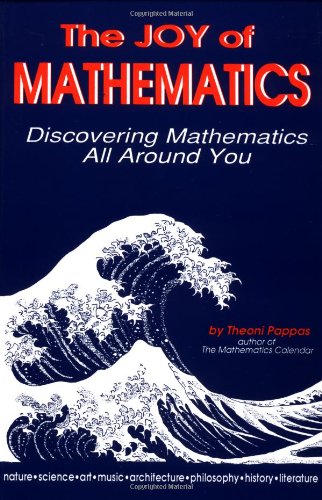
The Joy of Mathematics: Discovering Mathematics All Around You  (1993)

quarta-feira, 22 de janeiro de 2014

Primary Mathematics: Audit and Test: Assesing Your Knowledge And Understanding


Claire Mooney, Mike Fletcher
Learning Matters; Third Edition  | 2007 | 51 páginas | pdf | 447 kb


link


This book supports trainees on primary initial teacher training courses where a secure knowledge and understanding of mathematics is required for the award of Qualified Teacher Status (QTS). A rigorous test enables trainees to identify their strengths and weaknesses in mathematics and this can be revisited in order to monitor and evaluate progress towards QTS. Trainees are able to direct their studies more usefully and quickly develop confidence in topics they find difficult. This edition is fully up to date with the 2007 QTS Standards.

Contents
Introduction 1
Part 1 Mathematics background 5
Part 2 Interest in mathematics 6
Part 3 Perceived competence and confidence in mathematics 7
Competence 7
Making sense of your perceived competence 9
Confidence 10
Making sense of your perceived confidence 11
Part 4 Mathematics test 12
Number 12
Algebra – patterns and relationships 15
Shape and space 17
Statistics 23
Probability 23
Measures 24
Equations and graphs 25
Reasoning and proof 27
Making sense of your test results 27
Part 5 Answers to test questions 29
Part 6 Targets for further development 42
Part 7 Revision and further reading 43

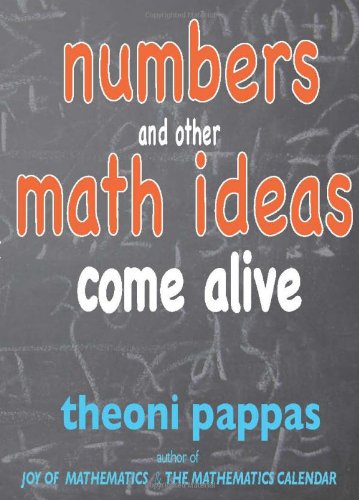
Numbers and Other Math Ideas Come Alive

Theoni Pappas


Wide World Publishing | 2012 | 160 páginas | rar - pdf | 1,2Mb

link (ficheiro novo)
password: matav

EPUB  | 1,75 Mb 

lib.freescienceengineering.org

MOBI - 2,5 Mb

lib.freescienceengineering.org

Most people don’t think about numbers, or take them for granted. For the average person numbers are looked upon as cold, clinical, inanimate objects. Math ideas are viewed as something to get a job done or a problem solved. Get ready for a big surprise with Numbers and Other Math Ideas Come Alive. Pappas explores mathematical ideas by looking behind the scenes of what numbers, points, lines, and other concepts are saying and thinking. In each story, properties and characteristics of math ideas are entertainingly uncovered and explained through the dialogues and actions of its math characters. In fact, you forget that you are actually learning mathematics as you get caught up in the characters’ private lives, secrets and how they interact with one another. You may even forget that these math actors come from the imaginary worlds of mathematics. They seem so real! This is the crux of Numbers and Other Math Ideas Come Alive — number and math ideas tell their own stories in their own words. As you read these stories you will be amazed at how math ideas come to life and develop their own personalities. We learn about their foibles and strengths, and see why mathematicians had to develop new concepts when the old ones were not sufficient for the problems at hand. You’ll see how mathematics is constantly evolving. How new numbers appeared, and old ones were reticent to accept the newcomers. How certain math ideas lay hidden for centuries, until they were resurrected or discovered by a mathematician. Love, hate, jealousy, excitement—all emotions we associate with human behavior are taken on by these math characters. You will come away learning how indispensable these math ideas and their roles are in our world today.

Outros livros da mesma autora, disponíveis no blog:


The Magic Of Mathematics - Discovering The Spell Of Mathematics (1994)
The Joy of Mathematics: Discovering Mathematics All Around You  (1993)
Fractals, Googols, and Other Mathematical Tales (1993)

Embracing reason : egalitarian ideals and the teaching of high school mathematics

(Studies in Mathematical Thinking and Learning

Daniel Chazan; Sandra Callis; Michael Lehman

Routledge | 2007 | 396 páginas | rar - pdf | 1,2 Mb

link (password: matav)

This book tells a single story, in many voices, about a serious and sustained set of changes in mathematics teaching practice in a high school and how those efforts influenced and were influenced by a local university. It includes the writings and perspectives of high school students, high school teachers, preservice teacher candidates, doctoral students in mathematics education and other fields, mathematics teacher educators, and other education faculty. As a whole, this case study provides an opportunity to reflect on reform visions of mathematics for all students and the challenges inherent in the implementation of these visions in US schools. It challenges us to rethink boundaries between theory and practice and the relative roles of teachers and university faculty in educational endeavors.


Contents
Preface: Mathematics and Egalitarian Ideals
School Mathematics and Egalitarian Ideals: A Focus on Reason(s)
Acknowledgements
1 Introduction to Our Case Study
Our Goals and Our Own Voices
The Importance of Teacher Development
A School-University PDS Two-Way Relationship
The Structure of this Case Study and Its Included Texts
Part I Changes in Classroom Teaching Practice
2 Assessment
Mathematics Performance Assessment
Alternative Formats and A Taxonomy of Tasks
3 Curriculum and Instructional Models
Starting a Functions-Based Approach to Algebra
Perspectives on Holt Algebra 1 from the Department Chair and a Newer Teacher
4 Planning
Teacher as Course-Level Planner
Must Teachers’ Create Curriculum? For Every Class?
5 Interlude A: On-campus Preservice Assignments
TE 804 Reflection and Inquiry in Teaching Practice II
Preservice Teachers as Curriculum Makers
Should Preservice Teachers be Encouraged to Create Curriculum?
6 Instructional Tasks
Finding Mathematics in the World Around Us
Getting Past Lame Justifications!
7 Classroom Roles
One Teacher’s Transformation in Teaching
What Teachers Think is Important!
Part II Student Experience of the Curriculum
8 Lower Track Classes
From an E to an A with the Help of a Graphing Calculator
How Important are Calculators?
9 Standard Track Classes
Students’ views of mathematical conversation
CURRICULUM
PATTERN OF TEACHING/LEARNING
CONCEPTION OF MATHEMATICS
Managing Students’ Participation in Classroom Conversation
10 Advanced Coursework
Developing an Interest in Mathematics
What is "mathematical power"? Related dilemmas of teaching
11 Interlude B: Observation in Classrooms
Field Experience really was the Best Teacher!
Our Contrasting Preservice Field Experiences
12 Interlude C: Student Teaching/Internship
What Kind of Teacher Will I Be?
How Do We Talk with Other Teachers about Our "Holt" Experiences?
Part III Professional Growth and Development
13 Time and Respect
Being Treated (and Treating Ourselves) as Professionals
Thoughts from Latecomers
14 Restructuring Teacher Work
Shared Teaching Assignments
What Do Shared Teaching Assignments Tell Us about Learning while Teaching?
15 Departmental Culture
One Transformed Teacher’s Viewpoint
Elementary Mathematics can be Complex and Interesting!
16 Changing the Math Curriculum
Teaching a Technologically-Supported Approach to School Algebra
Thoughts on Where to Start
17 Learning from Students and Colleagues
Questioning Ourselves and the Authorities
Should We Ever Tell Mathematical White Lies to Our Students?
18 Interlude D: Learning Math from Coursework Conversation
Lines and points
Comments from Some Former "Students"
19 Participation in Teacher Education
Becoming a Professional Teacher; Being a Mentor Teacher
Being a Mentor Teacher is Hard Work!
20 Graduate Study
Theory is Practical!
The Role of Views of Mathematics in Teaching
Part IV Stepping back: The perspective of a local "outsider"
21 A Quiet Revolution? Reflecting on Mathematics Reform at Holt High School

Mathematical Fallacies, Flaws and Flimflam

Edward J. Barbeau

The Mathematical Association of America | 2000 | 167 páginas | rar - pdf | 1,3 Mb

link (novo ficheiro)
(password: matav)

Djvu | 3,1 Mb 
link
depositfiles.com
rapidgator.net


Through hard experience mathematicians have learned to subject even the most 'evident' assertions to rigorous scrutiny, as intuition and facile reasoning can often be misleading. However, errors can slip past the most watchful eye, they are often subtle and difficult to detect; but when found they can teach us a lot and can present a real challenge to straighten out. This book collects together a mass of such errors, drawn from the work of students, textbooks, and the media, as well as from professional mathematicians themselves. Each of these items is carefully analysed and the source of the error is exposed. All serious students of mathematics will find this book both enlightening and entertaining.


Outros livros do mesmo autor, disponíveis no blog:


Five Hundred Mathematical Challenges (1997). The Mathematical Association of America

Challenging Mathematics In and Beyond the Classroom: The 16th ICMI Study (2008). Springer