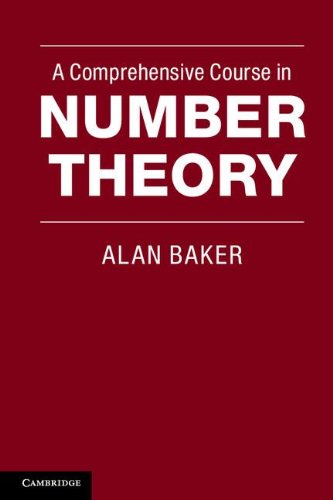
Alan Baker
Cambridge University Press | 2012 | 270 páginas | pdf | 1,7 Mb
link
RAR - PDF | 1,1 Mb
uploading.com (password : matav)
20121018ccnt
Developed from the author's popular text, A Concise Introduction to the Theory of Numbers, this book provides a comprehensive initiation to all the major branches of number theory. Beginning with the rudiments of the subject, the author proceeds to more advanced topics, including elements of cryptography and primality testing, an account of number fields in the classical vein including properties of their units, ideals and ideal classes, aspects of analytic number theory including studies of the Riemann zeta-function, the prime-number theorem and primes in arithmetical progressions, a description of the Hardy-Littlewood and sieve methods from respectively additive and multiplicative number theory and an exposition of the arithmetic of elliptic curves. The book includes many worked examples, exercises and further reading. Its wider coverage and versatility make this book suitable for courses extending from the elementary to beginning graduate studies.
Contents
Preface xi
Introduction xiii
1
Divisibility 1
1.1 Foundations 1
1.2 Division algorithm 1
1.3 Greatest common divisor 2
1.4 Euclid’s algorithm 2
1.5 Fundamental theorem 4
1.6 Properties of the primes 4
1.7 Further reading 6
1.8 Exercises 7
2 Arithmetical functions 8
2.1
The function [x] 8
2.2
Multiplicative functions 9
2.3
Euler’s (totient) function φ(n) 9
2.4 The Möbius function μ(n) 10
2.5 The functions τ(n) and σ(n) 12
2.6 Average orders 13
2.7 Perfect numbers 14
2.8 The Riemann zeta-function 15
2.9 Further reading 17
2.10 Exercises 17
3 Congruences 19
3.1 Definitions 19
3.2 Chinese remainder theorem 19
3.3 The theorems of Fermat and Euler 21
3.4 Wilson’s theorem 21
3.5 Lagrange’s theorem 22
3.6 Primitive roots 23
3.7 Indices 26
3.8 Further reading 26
3.9 Exercises 26
4 Quadratic residues 28
4.1 Legendre’s symbol 28
4.2 Euler’s criterion 28
4.3 Gauss’ lemma 29
4.4 Law of quadratic reciprocity 30
4.5 Jacobi’s symbol 32
4.6 Further reading 33
4.7 Exercises 34
5 Quadratic forms 36
5.1 Equivalence 36
5.2 Reduction 37
5.3 Representations by binary forms 38
5.4 Sums of two squares 39
5.5 Sums of four squares 40
5.6 Further reading 41
5.7 Exercises 42
6 Diophantine approximation 43
6.1 Dirichlet’s theorem 43
6.2 Continued fractions 44
6.3 Rational approximations 46
6.4 Quadratic irrationals 48
6.5 Liouville’s theorem 51
6.6 Transcendental numbers 53
6.7 Minkowski’s theorem 55
6.8 Further reading 58
6.9 Exercises 59
7 Quadratic fields 61
7.1 Algebraic number fields 61
7.2 The quadratic field 62
7.3 Units 63
7.4 Primes and factorization 65
7.5 Euclidean fields 66
7.6 The Gaussian field 68
7.7 Further reading 69
7.8 Exercises 70
8 Diophantine equations 71
8.1 The Pell equation 71
8.2 The Thue equation 74
8.3 The Mordell equation 76
8.4 The Fermat equation 80
8.5 The Catalan equation 83
8.6 The abc-conjecture 85
8.7 Further reading 87
8.8 Exercises 88
9 Factorization and primality testing 90
9.1 Fermat pseudoprimes 90
9.2 Euler pseudoprimes 91
9.3 Fermat factorization 93
9.4 Fermat bases 93
9.5 The continued-fraction method 94
9.6 Pollard’s method 96
9.7 Cryptography 97
9.8 Further reading 97
9.9 Exercises 98
10 Number fields 99
10.1 Introduction 99
10.2 Algebraic numbers 100
10.3 Algebraic number fields 100
10.4 Dimension theorem 101
10.5 Norm and trace 102
10.6 Algebraic integers 103
10.7 Basis and discriminant 104
10.8 Calculation of bases 106
10.9 Further reading 109
10.10 Exercises 109
11 Ideals 111
11.1 Origins 111
11.2 Definitions 111
11.3 Principal ideals 112
11.4 Prime ideals 113
11.5 Norm of an ideal 114
11.6 Formula for the norm 115
11.7 The different 117
11.8 Further reading 120
11.9 Exercises 120
12 Units and ideal classes 122
12.1 Units 122
12.2 Dirichlet’s unit theorem 123
12.3 Ideal classes 126
12.4 Minkowski’s constant 128
12.5 Dedekind’s theorem 129
12.6 The cyclotomic field 131
12.7 Calculation of class numbers 136
12.8 Local fields 139
12.9 Further reading 144
12.10 Exercises 145
13 Analytic number theory 147
13.1 Introduction 147
13.2 Dirichlet series 148
13.3 Tchebychev’s estimates 151
13.4 Partial summation formula 153
13.5 Mertens’ results 154
13.6 The Tchebychev functions 156
13.7 The irrationality of ζ(3) 157
13.8 Further reading 159
13.9 Exercises 160
14 On the zeros of the zeta-function 162
14.1 Introduction 162
14.2 The functional equation 163
14.3 The Euler product 166
14.4 On the logarithmic derivative of ζ(s) 167
14.5 The Riemann hypothesis 170
14.6 Explicit formula for ζ (s)/ζ(s) 171
14.7 On certain sums 173
14.8 The Riemann–von Mangoldt formula 174
14.9 Further reading 177
14.10 Exercises 177
15 On the distribution of the primes 179
15.1 The prime-number theorem 179
15.2 Refinements and developments 182
15.3 Dirichlet characters 184
15.4 Dirichlet L-functions 186
15.5 Primes in arithmetical progressions 187
15.6 The class number formulae 189
15.7 Siegel’s theorem 191
15.8 Further reading 194
15.9 Exercises 194
16 The sieve and circle methods 197
16.1 The Eratosthenes sieve 197
16.2 The Selberg upper-bound sieve 198
16.3 Applications of the Selberg sieve 202
16.4 The large sieve 204
16.5 The circle method 207
16.6 Additive prime number theory 210
16.7 Further reading 213
16.8 Exercises 214
17 Elliptic curves 215
17.1 Introduction 215
17.2 The Weierstrass ℘-function 216
17.3 The Mordell–Weil group 220
17.4 Heights on elliptic curves 222
17.5 The Mordell–Weil theorem 225
17.6 Computing the torsion subgroup 228
17.7 Conjectures on the rank 230
17.8 Isogenies and endomorphisms 232
17.9 Further reading 237
17.10 Exercises 238
Bibliography 240
Index 246