quinta-feira, 18 de outubro de 2012

Mathematics Curriculum in Pacific Rim Countries— China, Japan, Korea, and Singapore


Zalman Usiskin, Edwin Willmore (Editores)

Information Age Publishing | 2008 | 377 páginas | RAR - PDF | 9,8 Mb

link (password : matav)
uploading.com (password : matav)
20121018mcpc

A volume in Research in Mathematics Education Series Editor Barbara J. Dougherty, University of Mississippi This volume contains the proceedings of the First International Curriculum Conference sponsored by the Center for the Study of Mathematics Curriculum (CSMC). The CSMC is one of the National Science Foundation Centers for Learning and Teaching (Award No. ESI-0333879). The countries-China, Japan, Korea, and Singapore (in alphabetical order, which also happens to be the order of their populations)-have each been in the news because of their performance on international tests and/or their economic performance and potential. They also have centralized education ministries that create a single mathematics curriculum framework followed in the entire country.


CONTENTS
Preface ix
1. Introductions 1
PART I:
EDUCATION MINISTRY PERSPECTIVES ON K–12 MATHEMATICS CURRICULUM
2. Education Ministry Perspectives on Mathematics Curriculum in Japan
Shigeo Yoshikawa 9
3. An Overview of Mathematics Education in Singapore
Cheow Kian Soh 23
4. Some Characteristics of the Korean National Curriculum and Its Revision Process
Hee-Chan Lew 37
5. Mathematics Curriculum Standards of China: Its Process, Strategies, Outcomes and Difficulties
Xiaotian Sun 79
PART II: DESIGN AND IMPLEMENTATION PERSPECTIVES ON K–12 MATHEMATICS CURRICULUM
6. Sixty Years of Mathematics Syllabi and Textbooks in Singapore (1945-2005)
Peng Yee Lee 85
7. Design and Implementation of Korean Mathematics Textbooks
JeongSuk Pang 95

8. Curriculum Development in China: Perspectives From Curriculum Design and Implementation
Jun Li 127
9. Innovations Bringing Degeneration: A Lesson From Historical Analysis of the Revisions of the National Curriculum Standards for Upper Secondary School Math in Japan After World War II
Ryosuke Nagaoka 141
PART III: U.S. PERSPECTIVES ON THE CURRICULA OF ASIAN PACIFIC RIM COUNTRIES
10. Some Highlights of the Similarities and Differences in Intended, Planned/Implemented, and Achieved Curricula
Between China and the United States
Jinfa Cai 157
11. Transforming Curriculum from Intended to Implemented: What Teachers Need to Do and What They Learned in the United States and China
Yeping Li 183
12. Translating Elementary School Mathematics Curriculum: Isn’t School Mathematics Universal?
Tad Watanabe 197
13. A Look at Japanese Junior High School Mathematics Textbooks
Blake E. Peterson 209
14. Exploring Korean Primary Mathematics
Janice Grow-Maienza and Susan Beal 233
15. Comparing Elementary Mathematics Curricula of Korea and the United States
Insook Chung 255
16. Singapore Math: Can It Help Close the U.S. Mathematics Learning Gap?
Alan Ginsburg and Steven Leinwand 265
17. Singapore Math: Perspectives and Experiences of a College Professor
Richard Bisk 283

PART IV: STATUS OF CALCULATOR AND COMPUTER TECHNOLOGY IN THE K–12 CURRICULUM
18. Calculator and Computer Technology in the K–12 Curriculum: Some Observations From a U.S. Perspective
M. Kathleen Heid 293
19. The Status of Calculator Technology in United States K–8 Mathematics Curriculum: It Depends On How You Look At It
Kathryn B. Chval 305
PART V: ROLE OF TESTING IN THE K–12 CURRICULUM
20. Mathematics Assessments: Do They Tell Us the Same Thing
William H. Schmidt 319
21. Some Impacts of Testing on Mathematics Curriculum From K–12: Perspectives
Chris Cox 327
PART VI: REFLECTIONS BY CONFERENCE ATTENDEES
22. Moving Beyond Myths to Foster International Collaboration: International Conference a Step in the Right Direction
Diane L. Moore, Jill Newton, and Dawn Teuscher 337
23. Reflections on Assessment
Angela D. Sutter, Dana C. Cox, and Karen L. Fonkert 351
24. Afterword
Zalman Usiskin 361

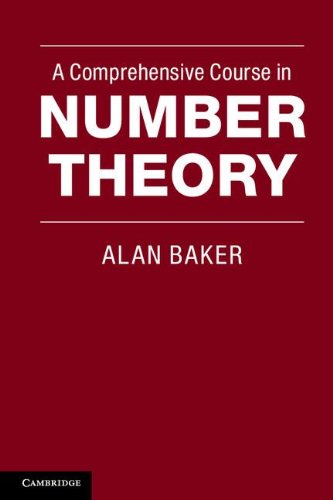
A Comprehensive Course in Number Theory


Alan Baker


Cambridge University Press | 2012 | 270 páginas | pdf | 1,7 Mb

link

RAR - PDF | 1,1 Mb
uploading.com (password : matav)
20121018ccnt

Developed from the author's popular text, A Concise Introduction to the Theory of Numbers, this book provides a comprehensive initiation to all the major branches of number theory. Beginning with the rudiments of the subject, the author proceeds to more advanced topics, including elements of cryptography and primality testing, an account of number fields in the classical vein including properties of their units, ideals and ideal classes, aspects of analytic number theory including studies of the Riemann zeta-function, the prime-number theorem and primes in arithmetical progressions, a description of the Hardy-Littlewood and sieve methods from respectively additive and multiplicative number theory and an exposition of the arithmetic of elliptic curves. The book includes many worked examples, exercises and further reading. Its wider coverage and versatility make this book suitable for courses extending from the elementary to beginning graduate studies.


Contents
Preface xi
Introduction xiii
1 Divisibility 1
1.1 Foundations 1
1.2 Division algorithm 1
1.3 Greatest common divisor 2
1.4 Euclid’s algorithm 2
1.5 Fundamental theorem 4
1.6 Properties of the primes 4
1.7 Further reading 6
1.8 Exercises 7
2 Arithmetical functions 8
2.1 The function [x] 8
2.2 Multiplicative functions 9
2.3 Euler’s (totient) function φ(n) 9
2.4 The Möbius function μ(n) 10
2.5 The functions τ(n) and σ(n) 12
2.6 Average orders 13
2.7 Perfect numbers 14
2.8 The Riemann zeta-function 15
2.9 Further reading 17
2.10 Exercises 17
3 Congruences 19
3.1 Definitions 19
3.2 Chinese remainder theorem 19
3.3 The theorems of Fermat and Euler 21
3.4 Wilson’s theorem 21
3.5 Lagrange’s theorem 22
3.6 Primitive roots 23
3.7 Indices 26
3.8 Further reading 26
3.9 Exercises 26
4 Quadratic residues 28
4.1 Legendre’s symbol 28
4.2 Euler’s criterion 28
4.3 Gauss’ lemma 29
4.4 Law of quadratic reciprocity 30
4.5 Jacobi’s symbol 32
4.6 Further reading 33
4.7 Exercises 34
5 Quadratic forms 36
5.1 Equivalence 36
5.2 Reduction 37
5.3 Representations by binary forms 38
5.4 Sums of two squares 39
5.5 Sums of four squares 40
5.6 Further reading 41
5.7 Exercises 42
6 Diophantine approximation 43
6.1 Dirichlet’s theorem 43
6.2 Continued fractions 44
6.3 Rational approximations 46
6.4 Quadratic irrationals 48
6.5 Liouville’s theorem 51
6.6 Transcendental numbers 53
6.7 Minkowski’s theorem 55
6.8 Further reading 58
6.9 Exercises 59
7 Quadratic fields 61
7.1 Algebraic number fields 61
7.2 The quadratic field 62
7.3 Units 63
7.4 Primes and factorization 65
7.5 Euclidean fields 66
7.6 The Gaussian field 68
7.7 Further reading 69
7.8 Exercises 70
8 Diophantine equations 71
8.1 The Pell equation 71
8.2 The Thue equation 74
8.3 The Mordell equation 76
8.4 The Fermat equation 80
8.5 The Catalan equation 83
8.6 The abc-conjecture 85
8.7 Further reading 87
8.8 Exercises 88
9 Factorization and primality testing 90
9.1 Fermat pseudoprimes 90
9.2 Euler pseudoprimes 91
9.3 Fermat factorization 93
9.4 Fermat bases 93
9.5 The continued-fraction method 94
9.6 Pollard’s method 96
9.7 Cryptography 97
9.8 Further reading 97
9.9 Exercises 98
10 Number fields 99
10.1 Introduction 99
10.2 Algebraic numbers 100
10.3 Algebraic number fields 100
10.4 Dimension theorem 101
10.5 Norm and trace 102
10.6 Algebraic integers 103
10.7 Basis and discriminant 104
10.8 Calculation of bases 106
10.9 Further reading 109
10.10 Exercises 109
11 Ideals 111
11.1 Origins 111
11.2 Definitions 111
11.3 Principal ideals 112
11.4 Prime ideals 113
11.5 Norm of an ideal 114
11.6 Formula for the norm 115
11.7 The different 117
11.8 Further reading 120
11.9 Exercises 120
12 Units and ideal classes 122
12.1 Units 122
12.2 Dirichlet’s unit theorem 123
12.3 Ideal classes 126
12.4 Minkowski’s constant 128
12.5 Dedekind’s theorem 129
12.6 The cyclotomic field 131
12.7 Calculation of class numbers 136
12.8 Local fields 139
12.9 Further reading 144
12.10 Exercises 145
13 Analytic number theory 147
13.1 Introduction 147
13.2 Dirichlet series 148
13.3 Tchebychev’s estimates 151
13.4 Partial summation formula 153
13.5 Mertens’ results 154
13.6 The Tchebychev functions 156
13.7 The irrationality of ζ(3) 157
13.8 Further reading 159
13.9 Exercises 160
14 On the zeros of the zeta-function 162
14.1 Introduction 162
14.2 The functional equation 163
14.3 The Euler product 166
14.4 On the logarithmic derivative of ζ(s) 167
14.5 The Riemann hypothesis 170
14.6 Explicit formula for ζ (s)/ζ(s) 171
14.7 On certain sums 173
14.8 The Riemann–von Mangoldt formula 174
14.9 Further reading 177
14.10 Exercises 177
15 On the distribution of the primes 179
15.1 The prime-number theorem 179
15.2 Refinements and developments 182
15.3 Dirichlet characters 184
15.4 Dirichlet L-functions 186
15.5 Primes in arithmetical progressions 187
15.6 The class number formulae 189
15.7 Siegel’s theorem 191
15.8 Further reading 194
15.9 Exercises 194
16 The sieve and circle methods 197
16.1 The Eratosthenes sieve 197
16.2 The Selberg upper-bound sieve 198
16.3 Applications of the Selberg sieve 202
16.4 The large sieve 204
16.5 The circle method 207
16.6 Additive prime number theory 210
16.7 Further reading 213
16.8 Exercises 214
17 Elliptic curves 215
17.1 Introduction 215
17.2 The Weierstrass ℘-function 216
17.3 The Mordell–Weil group 220
17.4 Heights on elliptic curves 222
17.5 The Mordell–Weil theorem 225
17.6 Computing the torsion subgroup 228
17.7 Conjectures on the rank 230
17.8 Isogenies and endomorphisms 232
17.9 Further reading 237
17.10 Exercises 238
Bibliography 240
Index 246

terça-feira, 16 de outubro de 2012

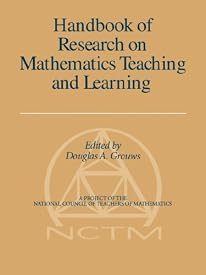
Handbook of Research on Mathematics Teaching and Learning


A Grouws Douglas (Editor)

Information Age Publishing | 1992 | 784 páginas | RAR - PDF | 122 Mb

uploading.com (password : matav)
20101610hrmte

Research in the area of mathematics education has flourished over the past two decades. The Handbook of Research on Mathematics Teaching and Learning is the most comprehensive and up-to-date survey of the best research, new developments, and critical conflicts and controversies in mathematics education. Sponsored by the National Council of Teachers of Mathematics and written by leading experts in the field of mathematics education, the Handbook is specifically designed to make important, vital scholarship accessible to mathematics education professors, graduate students, educational researchers, staff development directors, curriculum supervisors, and teachers. The Handbook provides a framework for understanding the evolution of the mathematics education research field against the backdrop of well-established conceptual, historical, theoretical, and methodological perspectives. It is an indispensable working tool for everyone interested in pursuing research in mathematics education as the references for each of the Handbook's twenty-nine chapters are complete resources for both current and past work in that particular area. The Handbook's twenty-nine chapters are organized into five major sections. Overview - presents a history of research in mathematics education, an analysis of how mathematics as a discipline has changed over time and how these shifts have influenced research, and a theoretical reconceptualization of one of the most crucial issues in mathematics education - the nature of understanding within the context of learning and teaching. Mathematics Teaching - includes articles on the culture of the classroom, effective teaching, teacher beliefs, classroom organization, andteacher education. Learning from Instruction - comprises chapters organized around mathematical domains that have been the focus of considerable research: additive structures; multiplicative structures; national numbers; problem solving; estimation; algebra, geometry, and spatial reasoning; probability and statistics; and proofs, limits, functions, and infinity. Critical Issues - considers such important issues in mathematics education as affect, evaluation, gender, ethnicity, and technology, while taking into account the evolution of these issues from teaching, learning, and research perspectives. Perspectives - offers viewpoints on international studies of achievement, international research, and reflections on the future of mathematics education.

Capítulos:

Preface
Acknowledgments
I - Overview
1-A History of Research in Mathematics Education 3
Jeremy Kilpatrick
2-The Nature of Mathematics: Its Role and Its Influence 39
John A. Dossey
3-Perspectives on Scholarship and Research Methods 49
Thomas A. Romberg
4-Learning and Teaching with Understanding 65
James Hiebert
II - Mathematics Teaching
5-The Culture of the Mathematics Classroom: An Unknown Quantity? 101
Marylin Nickson
6-Mathematics Teaching Practices and Their Effects 115
Mary Kohler e A Grouws Douglas
7-Teachers' Beliefs and Conceptions: A Synthesis of the Research 127
Alba Thompson
8-Teachers' Knowledge and Its Impact 147
Elizabeth Fennema e Megan Loef Franke
9-Grouping for Instruction in Mathematics: A Call for Programmatic Research on Small-Group Processes 165
Thomas L. Good, Catherine Mulryan e Mary McCaslin
10-Professionalization and Mathematics Teaching 197
Nel Noddings
11-Becoming a Mathematics Teacher 209
Catherine A. Brown e Hilda Borko
III - Learning from Instruction
12-Research on Whole Number Addition and Subtraction 243
Karen C. Fuson
13-Multiplication and Division as Models of Situations 276
Brian Greer
14-Rational Number, Ratio, and Proportion 296
Merlyn J. Behr, Guershon Harel, Thomas Post e Richard Lesh
(html |on-line: cehd.umn.edu)
15-Learning to Think Mathematically: Problem Solving, Metacognition, and Sense Making in Mathematics 334
Alan H. Schoenfeld
16-Estimation and Number Sense 371 
Judith Sowder
17-The Learning and Teaching of School Algebra 390 
Carolyn Kieran
18-Geometry and Spatial Reasoning 420
Douglas H. Clements e Michael T. Battista
19-Research in Probability and Statistics: Reflections and Directions 465 (falta)
J. Michael Shaughnessy
20-The Transition to Advanced Mathematical Thinking: Functions, Limits, Infinity and Proof 495
David Tall
IV - Critical Issues
21-Technology and Mathematics Education 515 
James J. Kaput
22-Ethnomathematics and Everyday Cognition 557 
Terezinha Nunes
23-Research on Affect in Mathematics Education: A Reconceptualization 575 (falta)
Douglas B. McLeod
24-Mathematics and Gender: Changing Perspectives 597
Gilah C. Leder
25-Race, Ethnicity, Social Class, Language, and Achievement in Mathematics 623
Walter G. Secada
26-Assessment of Students' Knowledge of Mathematics: Steps Toward a Theory 661 
Norman L. Webb
V - Perspectives
27-International Studies of Achievement in Mathematics 687
David F. Robitalle e Kenneth J. Travers
28-International Perspectives on Research in Mathematics Education 710 
Alan J. Bishop
29-Reflections on Where Mathematics Education Now Stands and on Where It May Be Going 724
Robert B. Davis
About the Contributors 735
Name Index 741
Subject Index 761

Basic Maths Practice Problems For Dummies


Colin Beveridge

For Dummies | 2012 | 386 páginas | RAR - PDF | 4,6 Mb

link
password: matav

In his popular Basic Maths For Dummies, professional maths tutor Colin Beveridge proved that he could turn anyone – even the most maths-phobic person – into a natural-born number cruncher. In this book he supplies more of his unique brand of maths-made- easy coaching, plus 2,000 practice problems to help you master what you learn. Whether you're prepping for a numeracy test or an employability exam, thinking of returning to school, or you'd just like to be one of those know-it-alls who says, 'Oh, that's easy!' about any maths problem that comes your way, this book is for you.
  • Master basic arithmetic, fast – in no time, solving addition, subtraction, multiplication and division problems will seem as easy as tying your shoes
  • Face down fractions – you'll never again feel shy around fractions, decimals, percentages and ratios
  • Juggle weights and measures like a pro – whether it's a question of how much it weighs, how long (or far) it is, or how much it costs, you'll never be at a loss for an answer
  • Make shapes your playthings – circles, squares, triangles and rectangles – you'll measure them, draw them and manipulate them with ease
Open the book and find:
  • 2,000 pencil-and-paper practice problems
  • The keys to mastering addition, subtraction, multiplication and division
  • The lowdown on fractions, decimals and percentages
  • Basic geometry made easy
  • How to handle weights, measures and money problems
  • How to read charts, tables and graphs at a glance
Learn to:
  • Master maths with more than 2,000 practice questions
  • Add, subtract, multiply and divide with confidence
  • Work with decimals, fractions and percentages
  • Size up weights and measures

domingo, 14 de outubro de 2012

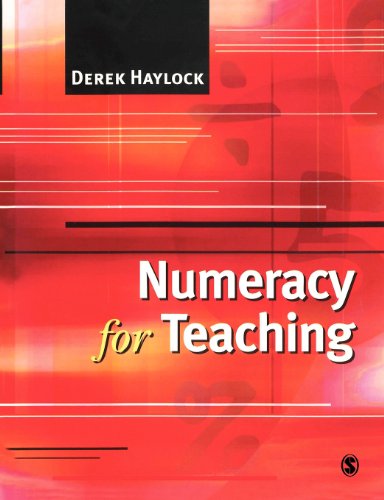
Numeracy for Teaching


Derek W Haylock

 Sage Publications Ltd | 2001 |283 páginas | PDF | 730 kb

link
link1 uploading.com


`The book is excellent. I think it will present students and others with a valuable resource, not only to help with the QTS test, but also for teaching. I could see myself using it on "dip-in-as-necessary" basis'.
`The practice questions were really helpful for checking and consolidating learning. The material was useful for the QTS test, particularly the mental calculations. Many thanks for letting me work through your sample material. I cannot begin to tell you how much more I have learnt! This has definitely made me feel more confident about passing the QTS numeracy skills test! I have definitely demonstrated to myself from this material that my ability to complete calculations mentally has increased. I can calculate faster and with some accuracy now!'
`Comprises a very helpful resource for students who are obliged to succeed in passing the QTS numeracy test in order to gain QTS. It should provide a valuable resource for students to increase their confidence as well as their competence' - Mathemtics in Schools


This book is designed to help teacher-trainees prepare for the Qualified Teaching Standards numeracy test that must now be passed by all entrants to the teaching profession. The author focuses especially on weaknesses in numeracy often observed in adults, and in teacher-trainees in particular. As far as possible, this mathematics is set in the professional context of teaching, drawing on statistics and other data from individual schools, the DfEE and the Qualifications and Curriculum Agency (QCA).

Contents
Read this first ix
Check-up 1: Mental calculations, changing proportions to percentages 1
Check-up 2: Mental calculations, changing more proportions to percentages 5
Check-up 3: Decimals and percentages 9
Check-up 4: Understanding data presented in tables 13
Check-up 5: Two-way tables for comparing two sets of data 17
Check-up 6: Bar charts and frequency tables for discrete data 21
Check-up 7: Bar charts for grouped discrete data 25
Check-up 8: Bar charts for continuous data 29
Check-up 9: Finding a fraction of a quantity 33
Check-up 10: Fractions to decimals and vice versa 37
Check-up 11: Expressing a percentage in fraction notation 41
Check-up 12: The commutative laws 45
Check-up 13: The associative laws 49
Check-up 14: The distributive laws 53
Check-up 15: Using a four-function calculator, precedence of operators 57
Check-up 16: Using a four-function calculator for money calculations 61
Check-up 17: Using the memory on a four-function calculator 65
Check-up 18: Using a calculator to express a proportion as a percentage 69
Check-up 19: Rounding answers 73
Check-up 20: Very large and very small numbers 77
Check-up 21: Mental calculations, multiplication strategies 81
Check-up 22: Mental calculations, division strategies 85
Check-up 23: Mental calculations, finding a percentage of a quantity 89
Check-up 24: Finding a percentage of a quantity using a calculator 93
Check-up 25: Adding and subtracting decimals 97
Check-up 26: Mental calculations, adding lists 101
Check-up 27: More multiplication strategies 105
Check-up 28: More division strategies 109
Check-up 29: Multiplication with decimals 113
Check-up 30: Division with decimals 117
Check-up 31: Using approximations to check your answers 121
Check-up 32: Mental calculations, time 125
Check-up 33: Knowledge of metric units of length and distance 129
Check-up 34: Knowledge of metric units of area and solid volume 133
Check-up 35: Knowledge of other metric units 137
Check-up 36: Mental calculations, money 141
Check-up 37: Simplifying ratios 145
Check-up 38: Sharing a quantity in a given ratio 149
Check-up 39: Increasing or decreasing by a percentage 153
Check-up 40: Expressing an increase or decrease as a percentage 157
Check-up 41: Finding the original value after a percentage increase or decrease 161
Check-up 42: Calculating means 165
Check-up 43: Modes 169
Check-up 44: Medians 173
Check-up 45: Upper and lower quartiles 177
Check-up 46: Measures of spread, range and inter-quartile range 181
Check-up 47: Box-and-whisker diagrams 185
Check-up 48: More box-and whisker diagrams 189
Check-up 49: Percentiles 193
Check-up 50: Reading scatter graphs 197
Check-up 51: Scatter graphs and correlation 201
Check-up 52: Conversion graphs 205
Check-up 53: Interpreting pie charts 209
Check-up 54: Substituting into formulas 213
Check-up 55: Weighted means 217
Check-up 56: Combining means or percentages from two or more sets of data 221
Check-up 57: Understanding cumulative frequency graphs 225
Check-up 58: Cumulative frequency graphs, finding the median and quartiles 229
Check-up 59: Line graphs for representing data over time 233
Check-up 60: Bar charts for comparing two sets of data 237
Check-up 61: The notion of value-added 241
Check-up 62: Interpreting value-added graphs 245
Answers to Further Practice Questions 249
Sources of Data 267


Site com material semelhante ao livro:


Outro livro de Derek Haylock, disponível no blog


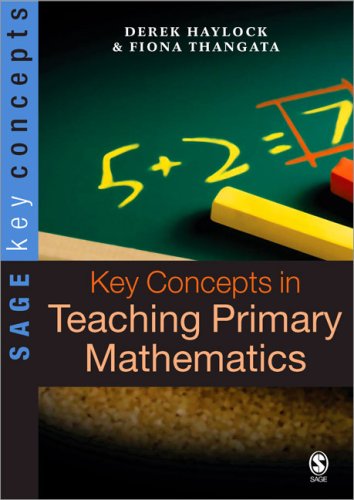
Key Concepts in Teaching Primary Mathematics, Sage (2007)

sábado, 13 de outubro de 2012

Developing Number Knowledge: Assessment,Teaching and Intervention with 7-11 year olds


Robert J Wright, David Ellemor-Collins, Pamela D Tabor 

Sage Publications | 2011| 313 páginas | RAR - PDF | 4,6 Mb

link (password : matav)

This fourth book in the Mathematics Recovery series equips teachers with detailed pedagogical knowledge and resources for teaching number to 7 to 11-year olds. Drawing on extensive programs of research, curriculum development, and teacher development, the book offers a coherent, up-to-date approach emphasizing computational fluency and the progressive development of students’ mathematical sophistication. The book is organized in key domains of number instruction, including structuring numbers 1 to 20, knowledge of number words and numerals, conceptual place value, mental computation, written computation methods, fractions, and early algebraic reasoning.

Contents
Introduction 1
PART I 5
1 Professional Learning for Quality Instruction 5
2 Instruction in Arithmetic 10
PART II 25
3 Number Words and Numerals 25
4 Structuring Numbers 1 to 20 50
5 Conceptual Place Value 77
6 Addition and Subtraction to 100 99
7 Multiplication and Division 135
8 Written Computation 173
PART III 199
9 Early Algebraic Reasoning 199
10 Understanding Fractions Peter Gould 212
11 Connecting the Teaching and Learning of Fractions Peter Gould 225
Glossary 247
Appendix: Instructional Settings 255
References 258
Index 269

Outro livro da mesma série - Math Recovery -, disponível no blog:


Early Numeracy: Assessment for Teaching and Intervention (2006)

The Complete Idiot's Guide to Trigonometry


Izolda Fotiyeva
Dmitriy Fotiyev 


ALPHA | 2012 | 385 páginas | RAR - PDF | 5,12 Mb

uploading.com (password : matav)
20121013gt

Contents

Part 1: The Basic Tools.. 1
1 What Is Trigonometry?...3

2 Geometry Tools Needed to Study Trigonometry...9
3 Algebra Tools Needed to Study Trigonometry....23

Part 2: Triangle Trigonometry..... 37
4 Trigonometric Functions and Right Triangles..... 39
5 Relations Among Trigonometric Ratios......55
6 The Law of Sines.... 71
7 The Law of Cosines.....85

Part 3: Trigonometric Functions and the Unit Circle...... 101
8 Angles and Rotations....103
9 The Unit Circle Approach...... 121
10 Trigonometric Functions of Any Angle... 133

Part 4: Graphs of Trigonometric Functions.. 145
11 Graphs of Sine and Cosine Functions.... 147
12 Graphs of Other Trigonometric Functions... 163
13 Graphs of Inverse Trigonometric Functions.... 179

Part 5: Trigonometric Identities and Equations...193
14 Kaleidoscope of Identities...195
15 Verifying Trigonometric Identities..205
16 Solving Trigonometric Equations... 217
17 Sum and Difference Formulas... 227

18 Double-Angle and Power-Reducing Formulas... 239
19 Half-Angle and Product-to-Sum Formulas.........249

Part 6: Polar Coordinates and Complex Numbers..........259
20 Polar Coordinates.......261

21 Complex Numbers and Operations with Them.... 275
22 Trigonometry and Calculators......291