quinta-feira, 23 de agosto de 2012

Teach Yourself VISUALLY Calculus


Dale W. Johnson M.A.

Visual | 2008  | 291 páginas | PDF | 10,1 Mb 

Calculus can test the limits of even the most advanced math students. This visual, easy-to-follow book deconstructs complex mathematical concepts in a way that's infinitely easier to grasp. With clear, color-coded methods, you'll get step-by-step instructions on solving problems using limits, derivatives, differentiation, curve sketching, and integrals. Easy access to concepts means you don't have to sort through lengthy instructions text, and you can refer to the Appendix for a look at common differentiation rules, integration formulas, and trigonometric identities. 

Livro da mesma colecção, disponível no blog


Teach Yourself VISUALLY Algebra (2008)

Teach Yourself VISUALLY Algebra


David Alan Herzog

Visual |  2008 | PDF | 304 páginas | 6 Mb

link scribd.com
4shared.com

uploading.com (password se necessária : www.AvaxHome.ru)

Algebra may seem intimidating? but it doesn't have to be. With Teach Yourself VISUALLY Algebra, you can learn algebra in a fraction of the time and without ever losing your cool. This visual guide takes advantage of color and illustrations to factor out confusion and helps you easily master the subject. You'll review the various properties of numbers, as well as how to use powers and exponents, fractions, decimals and percentages, and square and cube roots. Each chapter concludes with exercises to reinforce your skills.

Livro da mesma colecção, disponível no blog


Teach Yourself VISUALLY Calculus (2008)

Algebra 2


Cuevas Luchin


Student Edition

Glencoe/McGraw-Hill |  2008 | 1100 páginas | PDF  | 57 Mb

link
link1
Site do manual:
http://glencoe.mcgraw-hill.com/sites/007873830x/student_view0/


Glencoe Algebra 2 is a key program in our vertically aligned high school mathematics series developed to help all students achieve a better understanding of mathematics and improve their mathematics scores on today’s high-stakes assessments.


Unit 1 First-Degree Equations and Inequalities
1 Equations and Inequalities
2 Linear Relations and Functions
3 Systems of Equations and Inequalities
4 Matrices
Unit 2 Quadratic, Polynomial, and Radical Equations and Inequalities
5 Quadratic Functions and Inequalities
6 Polynomial Functions
7 Radical Equations and Inequalities
Unit 3 Advanced Functions and Relations
8 Rational Expressions and Equations
9 Exponential and Logarithmic Relations
10 Conic Sections
Unit 4 Discrete Mathematics
11 Sequences and Series
12 Probability and Statistics
Unit 5 Trigonometry
13 Trigonometric Functions
14 Trigonometric Graphs and Identities

sábado, 18 de agosto de 2012

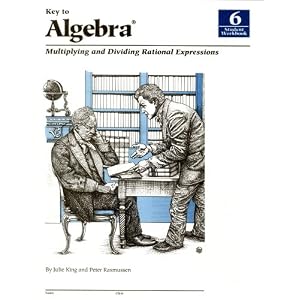
Key to Algebra: Multiplying and Dividing Rational Expressions

Book 6

Julie King, Peter Rasmussen


Key Curriculum Press | 1990  | 36 páginas | PDF | 1,58 Mb


link
link1

Too many students end their study of mathematics before ever taking an algebra course. Others attempt to study algebra, but are unprepared and cannot keep up. Key to Algebra was developed with the belief that anyone can learn basic algebra if the subject is presented in a friendly, non-threatening manner and someone is available to help when needed. Some teachers find that their students benefit by working through these books before enrolling in a regular algebra course--thus greatly enhancing their chances of success. Others use Key to Algebra as the basic text for an individualized algebra course, while still others use it as a supplement to their regular hardbound text. Allow students to work at their own pace. The Key to Algebra books are informal and self-directing. Book 6 covers Multiplying and Dividing Rational Expressions.Format: PaperbackPublisher: Key Curriculum Press

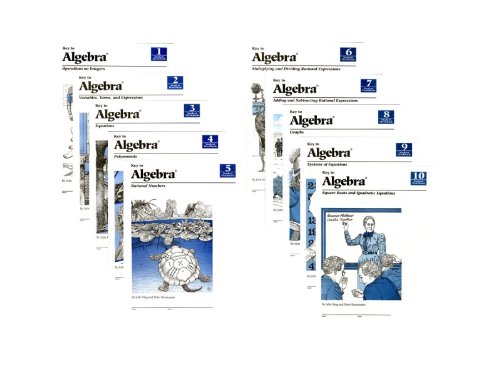
Outros livros da mesma série disponíveis no blog


Key to Algebra: Adding and Subtracting Rational Expressions. Book 7 (1991)


Limits, Limits Everywhere: The Tools of Mathematical Analysis


David Applebaum 

Oxford University Press | 2012 | 217 páginas | RAR - PDF | 1,09 Mb

link uploading.com (password : matav)
201208182

A quantity can be made smaller and smaller without it ever vanishing. This fact has profound consequences for science, technology, and even the way we think about numbers. In this book, we will explore this idea by moving at an easy pace through an account of elementary real analysis and, in particular, will focus on numbers, sequences, and series. 

Almost all textbooks on introductory analysis assume some background in calculus. This book doesn't and, instead, the emphasis is on the application of analysis to number theory. The book is split into two parts. Part 1 follows a standard university course on analysis and each chapter closes with a set of exercises. Here, numbers, inequalities, convergence of sequences, and infinite series are all covered. Part 2 contains a selection of more unusual topics that aren't usually found in books of this type. It includes proofs of the irrationality of e and ?, continued fractions, an introduction to the Riemann zeta function, Cantor's theory of the infinite, and Dedekind cuts. There is also a survey of what analysis can do for the calculus and a brief history of the subject. 

A lot of material found in a standard university course on "real analysis" is covered and most of the mathematics is written in standard theorem-proof style. However, more details are given than is usually the case to help readers who find this style daunting. Both set theory and proof by induction are avoided in the interests of making the book accessible to a wider readership, but both of these topics are the subjects of appendices for those who are interested in them. And unlike most university texts at this level, topics that have featured in popular science books, such as the Riemann hypothesis, are introduced here. As a result, this book occupies a unique position between a popular mathematics book and a first year college or university text, and offers a relaxed introduction to a fascinating and important branch of mathematics.


Contents

PART I APPROACHING LIMITS
1. A Whole Lot of Numbers 2
1.1 Natural Numbers 2
1.2 Prime Numbers 3
1.3 The Integers 9
1.4 Exercises for Chapter 1 12
2. Let’s Get Real 14
2.1 The Rational Numbers 14
2.2 Irrational Numbers 17
2.3 The Real Numbers 23
2.4 A First Look at Infinity 24
2.5 Exercises for Chapter 2 26
3. The Joy of Inequality 28
3.1 Greater or Less? 28
3.2 Intervals 33
3.3 The Modulus of a Number 34
3.4 Maxima and Minima 38
3.5 The Theorem of the Means 38
3.6 Getting Closer 41
3.7 Exercises for Chapter 3 42
4. Where Do You Go To, My Lovely? 45
4.1 Limits 45
4.2 Bounded Sequences 54
4.3 The Algebra of Limits 56
4.4 Fibonacci Numbers and the Golden Section 59
4.5 Exercises for Chapter 4 62
5. Bounds for Glory 65
5.1 Bounded Sequences Revisited 65
5.2 Monotone Sequences 69
5.3 An Old Friend Returns
5.4 Finding Square Roots 73
5.5 Exercises for Chapter 5 75
6. You Cannot be Series 78
6.1 What are Series? 78
6.2 The Sigma Notation 79
6.3 Convergence of Series 82
6.4 Nonnegative Series 84
6.5 The Comparison Test 88
6.6 Geometric Series 92
6.7 The Ratio Test 95
6.8 General Infinite Series 98
6.9 Conditional Convergence 99
6.10 Regrouping and Rearrangements 102
6.11 Real Numbers and Decimal Expansions 104
6.12 Exercises for Chapter 6 105
PART II EXPLORING LIMITS
7. Wonderful Numbers – e,π and γ 110
7.1 The Number e 110
7.2 The Number π 118
7.3 The Number γ 123
8. Infinite Products 126
8.1 Convergence of Infinite Products 126
8.2 Infinite Products and Prime Numbers 130
8.3 Diversion – Complex Numbers and the Riemann Hypothesis 134
9. Continued Fractions 138
9.1 Euclid’s Algorithm 138
9.2 Rational and Irrational Numbers as Continued Fractions 139
10. How Infinite Can You Get? 145
11. Constructing the Real Numbers 151
11.1 Dedekind Cuts 151
11.2 Cauchy Sequences 152
11.3 Completeness 153
12. Where to Next in Analysis? The Calculus 157
12.1 Functions 157
12.2 Limits and Continuity
12.3 Differentiation 163
12.4 Integration 166
13. Some Brief Remarks About the History of Analysis 171
Further Reading 175
Appendices 181
Appendix 1: The Binomial Theorem 181
Appendix 2: The Language of Set Theory 183
Appendix 3: Proof by Mathematical Induction 186
Appendix 4: The Algebra of Numbers 188
Hints and Solutions to Selected Exercise 190
Index 195

The Trouble with Maths: A Practical Guide to Helping Learners with Numeracy Difficulties


Steve Chinn

Routledge | 2011 - 
2.ª edição | 185 páginas | RAR - PDF | 1 Mb

link
password: matav

Now in a second edition, the award-winning The Trouble with Maths offers important insights into the often confusing world of numeracy. By looking at learning difficulties in maths from several perspectives, including the language of mathematics, thinking styles and the demands of individual topics, this book offers a complete overview of the most common problems associated with mathematics teaching and learning. It draws on tried-and-tested methods based on research and the author’s many years of classroom experience to provide an authoritative yet highly accessible one-stop classroom resource.
Combining advice, guidance and practical activities, this user-friendly guide will enable you to:
  • develop flexible thinking skills;
  • use alternative strategies for pupils to access basic facts;
  • understand the implications of pre-requisite skills, such as working memory, on learning;
  • implement effective preventative measures before disaffection sets in;
  • recognise maths anxiety and tackle self-esteem problems;
  • tackle the difficulties with word problems that many pupils may have;
  • select appropriate materials to enhance understanding.
With useful features such as checklists for the evaluation of books, an outline for setting up an inclusive Maths Department policy and a brand new chapter on materials, manipulatives and communication, this book will equip you with the essential skills to tackle your pupils’ maths difficulties and improve standards. This book will be useful for all teachers, classroom assistants, learning support assistants and parents who have pupils who underachieve with maths.

Contents

List of illustrations viii

Preface to the second edition x
1 Introduction: learning difficulties in maths and dyscalculia 1
2 Factors that affect learning 19
3 What the curriculum asks pupils to do and where difficulties may occur 40
4 Thinking style and mathematics 61
5 Developmental perspectives 79
6 The vocabulary and language of maths 98
7 Anxiety and attributions 110
8 The inconsistencies of maths 119
9 Manipulatives and materials: multisensory learning 125
10 The nasties: long division and fractions 142
Appendix 1 Further reading 154
Appendix 2 Checklists and resources 155
Appendix 3 ‘Jog your memory cards’ for multiplication facts 157
Appendix 4 Setting an inclusive maths department policy 161
Notes 166
Index 168


1.ª edição 

quinta-feira, 16 de agosto de 2012

Family Math Night: Middle School Math Standards in Action


Jennifer Taylor-Cox,  Christine Oberdorf

Eye On Education | 2005 | 114 páginas | PDF | 6,02 Mb

uploading.com (password : matav)


Why should your school have a Family Math Night?
- Help students learn essential math concepts
- Give parents a chance to serve as models of motivation, persistence and competence
- Promote math success in a supportive setting
With its step-by-step directions and suggestions for both teachers and parents, this book takes the worry out of planning and conducting a Family Math Night at your school.
How does Family Math Night work?
- Invite parents to accompany their children to school for an evening event.
- Arrange a series of tables (“stations”) in a large room or in several classrooms.
- As shown in this book, prepare materials – easy-to-find and inexpensive -- and set up an activity at each station.
- Parents and students visit some or all stations and engage in the activities together.
- Teachers encourage participation, offer assistance, and promote “math talk”.
This book contains 40 engaging and inspiring activities, organized by grade level, along with –
For the teacher – 
- list of materials
- helpful hints
- connections to math standards
- For the parent and student –
- description of activity and directions
- questions parents can ask
- challenges
The activities in this book align with the NCTM content and process standards for pre-kindergarten through grade 5.

Table of contents
Chapter One: Introduction .1
Why Should Our School Have Family Math Night? .1
How is Family Math Night: Middle School Math Standards in Action Organized?.2
How are the Activities Connected to Math Standards? .3
Why Should We Use Manipulatives in Mathematics? .5
Why is “Questions Parents Can Ask” Included? .6
Why is There a Challenge for Each Activity? .6
What are Some Additional Tips for a Successful Family Math Night? .7
What is the Teacher’s Role During Family Math Night? .8
Chapter Two: Number and Operations .9
The Baseball Card Collection .10
How Low Can You Go? . 12
Digits in a Row .14
Salary Selections .16
Fraction Designs .18
Establishing Order .20
Chapter Three: Algebra .23
Spiders and Ants . .24
Birds Migrating to Florida .26
Box Dilemma .28
ABCs and 123s .30
Pascal’s Patterns .32
Produce Equations .34
Chapter Four: Geometry ..37
All Squared Up..38
Party with Pentominoes..40
Line Up the Attribute Blocks ..42
Nets Under Construction..44
Newspaper Networks ..46
Pythagorean Triples..48

Chapter Five: Measurement ..51
Big Bubbles..52
Try Angles ...54
Mystery Figure ..56
Triangular Teasers ..58
This Room on That Paper ..60
Cookie Constructions ..62
Chapter Six: Data Analysis and Probability ..65
Deep-Sea Diving ..66
Lollipops in the Bag..68
Pendulum Swing Experiment..70
A Day in My Life..72
Chance for Freebies ..74
Spinner Maker ..76
Chapter Seven: Additional Tools ..79
Family Math Night Invitation to Parents ..80
Family Math Night Journal Cover ..81
Family Math Night Evaluation Form..82
How Low Can You Go? ..83
Digits in a Row ..85
Salary Selections ..86
Establishing Order..87
Spiders and Ants..89
ABCs and 123s..91
Pascal’s Patterns ..92
All Squared Up...93
Party with Pentominoes..94
Newspaper Networks..95
Try Angles ..96
Cookie Constructions ..97
Deep-Sea Diving ..98
Pendulum Swing Experiment ..99
Chance for Freebies ..100
Notes ..102