terça-feira, 7 de agosto de 2012

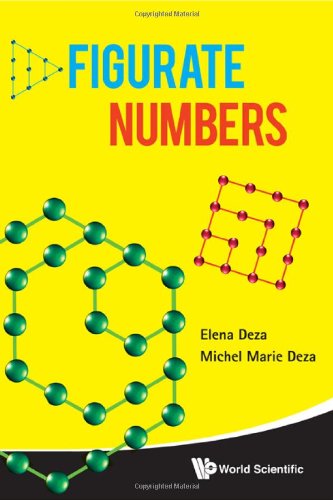
Figurate Numbers


Elena Deza (Moscow State Pedagogical University, Russia)
Michel Marie Deza (Ecole Normale Superieure, Paris, France)

World Scientific Pub Co Inc | 2012 | 476 páginas | PDF | 2,45 Mb

uploading.com (password : matav)


Figurate numbers have a rich history with many applications. The main purpose of this book is to provide a thorough and complete presentation of the theory of figurate numbers, giving much of their properties, facts and theorems with full proofs. This book is the first of this topic written in unified systematic way. It also contains many exercises with solutions.

Contents:
  • Plane Figurate Numbers
  • Space Figurate Numbers
  • Multidimensional Figurate Numbers
  • Areas of Number Theory including Figurate Numbers
  • Fermat's Polygonal Number Theorem
  • Zoo of Figurate-related Numbers


Types of Functions in Mathematics


Gabriella Durand

World Technologies | 2012 | 105 páginas | PDF | 1,29 Mb

link
uploading.com (password : matav)

This book explains different types of Functions in Mathematics.


Table of Contents
Chapter 1 - Additive Function
Chapter 2 - Algebraic Function
Chapter 3 - Analytic Function
Chapter 4 - Completely Multiplicative Function and Concave Function
Chapter 5 - Convex Function
Chapter 6 - Differentiable Function
Chapter 7 - Elementary Function and Entire Function
Chapter 8 - Even and Odd Functions
Chapter 9 - Harmonic Function
Chapter 10 - Holomorphic Function
Chapter 11 - Homogeneous Function
Chapter 12 - Indicator Function
Chapter 13 - Injective Function
Chapter 14 - Measurable Function
Chapter 15 - Meromorphic Function
Chapter 16 - Multiplicative Function and Multivalued Function
Chapter 17 - Periodic Function
Chapter 18 - Pseudoconvex Function and Quasiconvex Function
Chapter 19 - Rational Function
Chapter 20 - Ring of Symmetric Functions

Reasoning, Communication And Connections In Mathematics


Yearbook 2012, Association of Mathematics Educators


Berinderjeet Kaur (National Institute of Education, Singapore), 

Tin Lam Toh (National Institute of Education, Singapore)

World Scientific Publishing Company | 2012 | 332 páginas | rar - PDF | 3,6 Mb

link 

password: matav

Contents:
Reasoning, Communication and Connections in Mathematics: An Introduction (Berinderjeet KAUR and TOH Tin Lam)
The Epistemic Framing of Mathematical Tasks in Secondary Three Mathematics Lessons in Singapore (Ridzuan Abdul RAHIM, David HOGAN and Melvin CHAN)
Modifying Textbook Exercises to Incorporate Reasoning and Communication into the Primary Mathematics Classroom(Denisse R THOMPSON)
Some “What” Strategies that Advance Reasoning and Communication in Primary Mathematics Classrooms (Berinderjeet KAUR)
Reasoning and Justification in the Secondary Mathematics Classroom (Denisse R THOMPSON)
LOGO Project-Based Mathematics Learning for Communication, Reasoning and Connection (Hee-Chan LEW and In-Ok JANG)
Reasoning, Communication and Connections in A-Level Mathematics (TOH Tin Lam)
Visual and Spatial Reasoning: The Changing Form of Mathematics Representation and Communication (Tom LOWRIE)
Understanding Classroom Talk in Secondary Three Mathematics Classes in Singapore (David HOGAN, Ridzuan Abdul RAHIM, Melvin CHAN, Dennis KWEK and Philip TOWNDROW)
Mathematics Classroom Discourse Through Analogical Reasoning (Kyeong-Hwa LEE)
Students' Reasoning Errors in Writing Proof by Mathematical Induction (Alwyn Wai-Kit PANG and Jaguthsing DINDYAL)
Presenting Mathematics as Connected in the Secondary Classroom (LEONG Yew Hoong)
Numeracy: Connecting Mathematics (Barry KISSANE)
Making Connections Between School Mathematics and the Everyday World: The Example of Health (Marian KEMP)
Mathematics, Astronomy and Culture: Helping Students See Connections (Helmer ASLAKSEN)

sábado, 4 de agosto de 2012

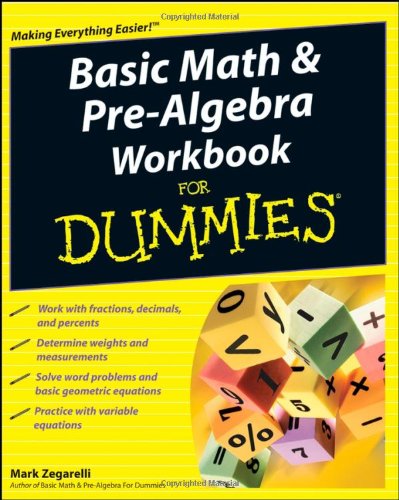
Basic Math & Pre-Algebra For Dummies


Mark Zegarelli

John Wiley & Sons | 2012 | 146 Páginas | PDF | 5,2 Mb

uploading.com (password : matav)


The fun and easy way® to understand the basic concepts and problems of pre-algebra
Whether you're a student preparing to take algebra or a parent who needs a handy reference to help kids study, this easy-to-understand guide has the tools you need to get in gear. From exponents, square roots, and absolute value to fractions, decimals, and percents, you'll build the skills needed to tackle more advanced topics, such as order of operations, variables, and algebraic equations.
Open the book and find:
  • How to find the greatest common factor and least common multiple
  • Tips for adding, subtracting, dividing, and multiplying fractions
  • How to change decimals to fractions (and vice versa)
  • Hints for solving word problems


    Mark Zegarelli

    John Wiley & Sons | 2007 | 384 páginas |  PDF | 4,8 Mb


    When you have the right math teacher, learning math can be painless and even fun! Let Basic Math and Pre-Algebra Workbook For Dummies teach you how to overcome your fear of math and approach the subject correctly and directly. A lot of the topics that probably inspired fear before will seem simple when you realize that you can solve math problems, from basic addition to algebraic equations. Lots of students feel they got lost somewhere between learning to count to ten and their first day in an algebra class, but help is here! 

    Begin with basic topics like interpreting patterns, navigating the number line, rounding numbers, and estimating answers. You will learn and review the basics of addition, subtraction, multiplication, and division. Do remainders make you nervous? You’ll find an easy and painless way to understand long division. Discover how to apply the commutative, associative, and distributive properties, and finally understand basic geometry and algebra. Find out how to: 
    Properly use negative numbers, units, inequalities, exponents, square roots, and absolute value 
    Round numbers and estimate answers 
    Solve problems with fractions, decimals, and percentages 
    Navigate basic geometry 
    Complete algebraic expressions and equations 
    Understand statistics and sets 
    Uncover the mystery of FOILing 
    Answer sample questions and check your answers 

    Complete with lists of ten alternative numeral and number systems, ten curious types of numbers, and ten geometric solids to cut and fold, Basic Math and Pre-Algebra Workbook For Dummies will demystify math and help you start solving problems in no time! 

    From the Back Cover
    Get the confidence and the math skills you need to get started with algebra! 

    Are you about to jump into algebra? This easy-to-follow, hands-on workbook helps you brush up on your general math skills and practice the types of problems you'll encounter in your coursework. You get plenty of work space, step-by-step solutions to every problem, and expert tips on making the leap from arithmetic to algebra. 

    100s of Problems! 

    Detailed, fully worked-out solutions to problems 

    The inside scoop on converting fractions, decimals, and percents 

    The tips and tricks you need to solve basic algebra problems

quarta-feira, 1 de agosto de 2012

The Art of Mathematics: Coffee Time in Memphis

Bela Bollobás

Cambridge University Press  | 2006 | 374 Páginas  | PDF | 8,2 Mb

link
link1
scribd.com
rapidgator.net

Can a Christian escape from a lion? How quickly can a rumor spread? Can you fool an airline into accepting oversize baggage? Recreational mathematics is full of frivolous questions where the mathematician's art can be brought to bear. But play often has a purpose. In mathematics, it can sharpen skills, provide amusement, or simply surprise, and books of problems have been the stock-in-trade of mathematicians for centuries. This collection is designed to be sipped from, rather than consumed in one sitting. The questions range in difficulty: the most challenging offer a glimpse of deep results that engage mathematicians today; even the easiest prompt readers to think about mathematics. All come with solutions, many with hints, and most with illustrations. Whether you are an expert, or a beginner or an amateur mathematician, this book will delight for a lifetime.

Revisão: plus.maths.org

sábado, 28 de julho de 2012

The Mathematical Collage


Ronald Staszkow, Robert Bradshaw 

Custom Publishing | 2006 | 

Versão draft

online: ohlone.edu (capítulos)

PDF
ohlone.edu (link direto)

The Mathematical Collage has been written to meet an Associate Degree general education requirement of a mathematics course with a Beginning Algebra prerequisite. The text shows that mathematics is alive in today's world and helps students see the beauty and power of mathematics. Its contents consists of chapters on the lore of numbers, finance matters, measurement geometry and trigonometry, probability and statistics, and math in sports, It also includes Mathematical Excursions, short trips into various areas where mathematics is used, such as math and the tourist, math and the internet, math and voting, math and nursing, math and the automobile, math and cooking, math and the angler, math and the World Series of Poker.

sexta-feira, 27 de julho de 2012

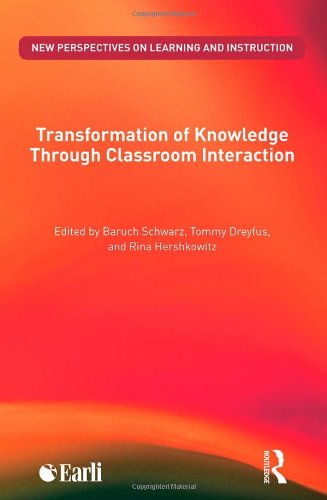
Transformation of Knowledge Through Classroom Interaction


(New Perspectives on Learning and Instruction)

Baruch Schwarz, Tommy Dreyfus, Rina Hershkowitz

Routledge | 2009 | 336 páginas | PDF | 3,7 Mb


Classrooms provide extremely varied settings in which learning may take place, including teacher-led conversations, small group unguided discussions, individual problem solving or computer supported collaborative learning (CSCL).
Transformation of Knowledge through Classroom Interaction examines and evaluates different ways which have been used to support students learning in classrooms, using mathematics and science as a model to examine how different types of interactions contribute to students’ participation in classroom activity, and their understanding of concepts and their practical applications. The contributions in this book offer rich descriptions and ways of understanding how learning occurs in both traditional and non-traditional settings. Combining theoretical perspectives with practical applications, the book includes discussions of:
  • the roles of dialogue and argumentation in constructing knowledge
  • the role of guidance in constructing knowledge
  • abstracting processes in mathematics and science classrooms
  • the effect of environment, media and technology on learning processes
  • methodologies for tracing transformation of knowledge in classroom interaction.
Bringing together a broad range of contributions from leading international researchers, this book makes an important contribution to the field of classroom learning, and will appeal to all those engaged in academic research in education.

Contents
Introduction 
Part 1: Construction of knowledge in classroom interactions 
1.1 The nested epistemic actions model of abstraction in context
Baruch Schwarz, Hebrew University of Jerusalem, Israel, Tommy Dreyfus, Tel Aviv University, Israel and Rina Hershkowitz, Weizmann Institute of Science, Rehovot, Israel 
1.2 Construction of physics knowledge in the classroom from different perspectives: the classroom as a community and the students as individuals,
Andrée Tiberghien, CNRS Université de Lyon, France and Layal Malkoun 
1.3 Technology based algebra learning: epistemological discontinuities and curricular implications
Michal Yerushalmy, University of Haifa, Israel 
1.4 Toward trialogical approach to learning,
Kai Hakkarainen, University of Joensuu, Finland and Sami Paavola, University of Helsinki, Finland 
1.5 Commentary on the chapters on the construction of knowledge,
Ivy Kidron, Jerusalem College of Technology and John Monaghan, University of Leeds, UK 
Part 2: The role of the teacher in the transformation of knowledge in classroom interactions 
2.1 Expert Support for Group Work in Elementary Science: The Role of Consensus,
Christine Howe, University of Cambridge, UK 
2.2 Guidance in Construction of Knowledge in the Classroom: the troika of talk, tasks and tools,
Sarah Michaels, Clark University, USA, M.C. O’Connor, Boston University, USA, Richard Sohmer, The Investigators Club, USA and Lauren Resnick, University of Pittsburgh, USA 
2.3 Implementing technology-facilitated collaboration and awareness in the classroom - roles for teachers, educational researchers and technology experts,
Ulrich Hoppe, University of Duisburg-Essen, Germany, Reuma De-Groot, Hebrew University of Jerusalem, Israel and Rakheli Hever, The Hebrew Univesity Jerusalem 
Part 3: The role of argumentation and dialogue in the transformation of knowledge 
3.1 Intersubjective and intrasubjective rationalities in pedagogical debates: realising what one thinks,
Michael Baker, CNRS & Université Paris X, France 
3.2 Transformation of robust misconceptions through peer argumentation
Christa S. C. Asterhan and Baruch B. Schwarz, The Hebrew University of Jerusalem, Israel 
3.3 Commentary on the chapters by Baker, and Asterhan and Schwarz through the lenses of commognition,
Anna Sfard, University of Haifa, Israel 
3.4 A dialogue on dialogue and its place within education,
Rupert Wegerif, Exeter University, UK, Jerry Andriessen, University of Utrecht, Paolo Boero, University of Genova, Italy and Ellice Forman, Universty of Pittsburgh, USA 
Part 4: Methodologies for studying transformation of knowledge in classroom interaction 
4.1 A methodological framework and empirisal techniques for studying the travel of ideas in classroom communities,
Geoffrey B. Saxe, Meghan Shaughnessy, Darrell Earnest, Sarah Cremer, Linda Platas and Adena Young, University of California, Berkeley, USA 
4.2 A Design Research Perspective on the Identities that Students are Developing in Mathematics Classrooms,
Paul Cobb, Vanderbilt University, Nashville, TN, USA, Melissa Gresalfi, University of Indiana, USA and Lynn Liao Hodge, University of Tennessee, USA 
4.3 Methodological Considerations in the Study of Intersubjectivity Among Participants of a Dialogic Mathematics Classroom ,
Mitchell J. Nathan, University of Wisconsin-Madison, USA, Billie Eilam, University of Haifa, Israel and Suyeon Kim, University of Wisconsin-Madison, USA 
4.4 Comparing and contrasting methodologies: a commentary, Angelika Bikner-Ahsbahs, University of Bremen, Germany and Gaye Williams, Deakin University, Australia 
Part 5: General reflections on transformations of knowledge in classroom interactions 
5.1 Contour lines between a model as a theoretical framework and the same model as methodological tool,
Rina Hershkowitz, Wiezmann Institute of Science, Rehovot, Israel 
5.2 Learning in schools: a dialectical materialistic, cultural-historical activity theoretic perspective,
Wolff-Michael Roth, University of Victoria 
5.3 Sociogenesis and cognition: the struggle between social and cognitive activities,
Sten Ludvigsen, University of Oslo.