sexta-feira, 27 de julho de 2012

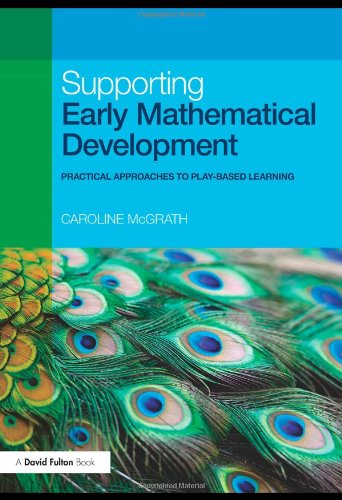
Supporting Early Mathematical Development Practical Approaches to Play-Based Learning

Caroline McGrath

Routledge | 2010 | 264 páginas | PDF | 3,25 Mb

link

Supporting Early Mathematical Development is an essential text for current Early Years practitioners and students, offering an excellent blend of theory and practice that will enable you to provide successful mathematical education for children from birth to eight years old. Charting the delivery of mathematical development in Playgroups, Children's Centres, Nurseries and Primary Schools, it forges links between current practice and fundamental Early Years principles and makes suggestions for creating effective pedagogies in maths teaching.
Promoting mathematical development through play-based learning, this book presents:
  • a wealth of practical multi-sensory teaching strategies
  • instructional methodologies
  • activity ideas incorporating play, books, songs, cookery and the outdoors
  • examples of children's work
  • advice on translating theory into practice
  • questions for reflective practice.
Throughout the book, Caroline McGrath breaks down the complexity of teaching and learning mathematics into simple steps and guides readers through possible gaps in their knowledge, bringing fresh enthusiasm to teaching mathematics. This is an invaluable resource for practitioners and trainee teachers wishing to strengthen their mathematical teaching and professional practice, or for students on a wide range of Early Years courses.
Contents
List of tables Introduction 1. Fear, anxiety and other emotions 2. General Principals 3. Specific Principles 4. Connecting Curricula 5. Early Years Foundation Stage Mathematics 6. Understanding Number 7. Understanding number operations: addition and subtraction 8. Understanding number operations: multiplication and division 9. Problem Solving Conclusion Reflecting on your Learning References Index

Learning to Read the Numbers: Integrating Critical Literacy and Critical Numeracy in K-8 Classrooms


A Co-Publication of The National Council of Teachers of English and Routledge

Phyllis Whitin, David Whitin

Routledge | 2010 | 144 páginas | PDF | 3,45 Mb

uploading.com (matav)
link
link1

Being a critical reader of numerical information is an integral part of being literate in today’s data-drenched world. Uniquely addressing both mathematics and language issues, this text shows how critical readers dig beneath the surface of data to better evaluate their usefulness and to understand how numbers are constructed by authors to portray a certain version of reality.

Engaging, concise, and rich with examples and clear connections to classroom practice, it provides a framework of critical questions that children and teachers can pose to crack open authors’ intentions, expose their decisions, and make clear who are the winners and losers—questions that are essential for building democratic classrooms.

Explaining and illustrating how K-8 teachers can engage students in developing the ability to be both critical composers and critical readers of texts, Learning to Read the Numbers is designed for teacher education courses across the areas of language arts, mathematics, and curriculum studies, and for elementary teachers, administrators, and literacy and mathematics coaches. A copublication of Routledge and NCTE.

quinta-feira, 26 de julho de 2012

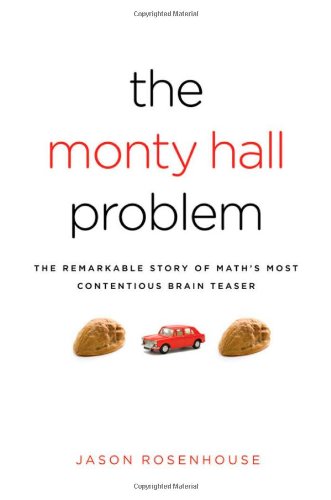
The Monty Hall Problem The Remarkable Story of Math's Most Contentious Brain Tease


Jason Rosenhouse

Oxford University Press | 2009 | 208 páginas | PDF | 1,8 Mb

Mathematicians call it the Monty Hall Problem, and it is one of the most interesting mathematical brain teasers of recent times. Imagine that you face three doors, behind one of which is a prize. You choose one but do not open it. The host--call him Monty Hall--opens a different door, always choosing one he knows to be empty. Left with two doors, will you do better by sticking with your first choice, or by switching to the other remaining door? In this light-hearted yet ultimately serious book, Jason Rosenhouse explores the history of this fascinating puzzle. Using a minimum of mathematics (and none at all for much of the book), he shows how the problem has fascinated philosophers, psychologists, and many others, and examines the many variations that have appeared over the years. As Rosenhouse demonstrates, the Monty Hall Problem illuminates fundamental mathematical issues and has abiding philosophical implications. Perhaps most important, he writes, the problem opens a window on our cognitive difficulties in reasoning about uncertainty

Contents
Preface
Acknowledgments
1: Ancestral Monty
2: Classical Monty
3: Bayesian Monty
4: Progressive Monty
5: Miscellaneous Monty
6: Cognitive Monty
7: Philosophical Monty
8: Final Monty
Appendix: A Gallery of Variations
Bibliography
Index

Complex Numbers and Geometry


Liang-shin Hahn

(Mathematical Association of America Textbooks)

The Mathematical Association of America | 1994 | 203 Páginas | 2,72Mb

depositfiles.com

djvu - 1,2 Mb
link direto
link
link1

The purpose of this book is to demonstrate that complex numbers and geometry can be blended together beautifully. This results in easy proofs and natural generalizations of many theorems in plane geometry, such as the Napoleon theorem, the Ptolemy-Euler theorem, the Simson theorem, and the Morley theorem. The book is self-contained - no background in complex numbers is assumed - and can be covered at a leisurely pace in a one-semester course. Many of the chapters can be read independently. Over 100 exercises are included. The book would be suitable as a text for a geometry course, or for a problem solving seminar, or as enrichment for the student who wants to know more.


Contents

1. Complex numbers; 2. Applications of geometry; 3. Möbius transformations; 4. Epilogu

Complex Numbers from A to ...Z

Titu Andreescu , Dorin Andrica

Birkhäuser Boston | 2006 | 321 páginas | PDF - 3 Mb

f3.tiera.ru (link direto)
It is impossible to imagine modern mathematics without complex numbers. Complex Numbers from A to . . . Z introduces the reader to this fascinating subject that, from the time of L. Euler, has become one of the most utilized ideas in mathematics.

Complex Numbers in Geometry

I. M. Yaglom

Academic Press | 243 Páginas | DjVu | 1,9 Mb

This book is intended for pupils in the top classes in high schools and for students in mathematics departments of universities and teachers' colleges. It may also be useful in the work of mathematical societies and may be of interest to teachers of mathematics in junior high and high schools.
The subject matter is concerned with both algebra and geometry. There are many useful connections between these two disciplines. Many applications of algebra to geometry and of geometry to algebra were known in antiquity; nearer to our time there appeared the important subject of analytical geometry, which led to algebraic geometry, a vast and rapidly developing science, concerned equally with algebra and geometry. Algebraic methods are now used in projective geometry, so that it is uncertain whether projective geometry should be called a branch of geometry or algebra. In the same way the study of complex numbers, which arises primarily within the bounds of algebra,
proved to be very closely connected with geometry; this can be seen if only from the fact that geometers, perhaps, made a greater contribution to the development of the theory than algebrais

Mathematical Omnibus: Thirty Lectures on Classic Mathematics


Dmitry Fuchs, Serge Tabachnikov

American Mathematical Society | 465 páginas | PDF | 7 Mb

links diretos:


The book consists of thirty lectures on diverse topics, covering much of the mathematical landscape rather than focusing on one area. The reader will learn numerous results that often belong to neither the standard undergraduate nor graduate curriculum and will discover connections between classical and contemporary ideas in algebra, combinatorics, geometry, and topology. The reader's effort will be rewarded in seeing the harmony of each subject. The common thread in the selected subjects is their illustration of the unity and beauty of mathematics. Most lectures contain exercises, and solutions or answers are given to selected exercises. A special feature of the book is an abundance of drawings (more than four hundred), artwork by an award-winning artist, and about a hundred portraits of mathematicians. Almost every lecture contains surprises for even the seasoned researcher.