quinta-feira, 26 de julho de 2012

Mathematical Omnibus: Thirty Lectures on Classic Mathematics


Dmitry Fuchs, Serge Tabachnikov

American Mathematical Society | 465 páginas | PDF | 7 Mb

links diretos:


The book consists of thirty lectures on diverse topics, covering much of the mathematical landscape rather than focusing on one area. The reader will learn numerous results that often belong to neither the standard undergraduate nor graduate curriculum and will discover connections between classical and contemporary ideas in algebra, combinatorics, geometry, and topology. The reader's effort will be rewarded in seeing the harmony of each subject. The common thread in the selected subjects is their illustration of the unity and beauty of mathematics. Most lectures contain exercises, and solutions or answers are given to selected exercises. A special feature of the book is an abundance of drawings (more than four hundred), artwork by an award-winning artist, and about a hundred portraits of mathematicians. Almost every lecture contains surprises for even the seasoned researcher.

terça-feira, 24 de julho de 2012

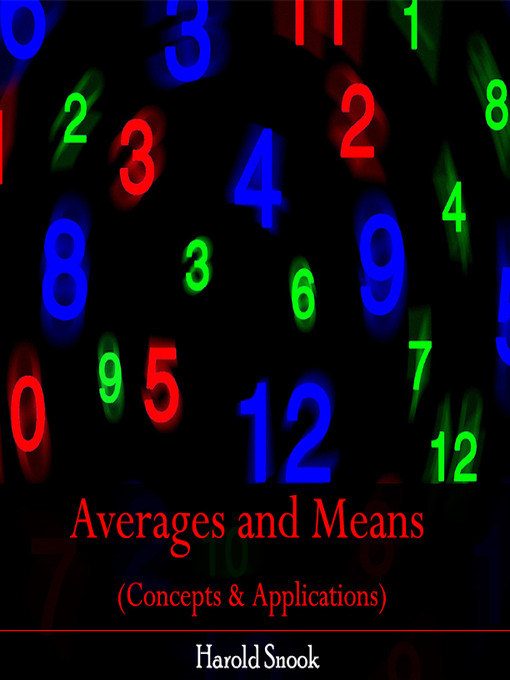
Averages and Means Concepts & Applications

Harold Snook

World Technologies |  2012 | 85 páginas | rar - PDF | 1,12 Mb

link (password: matav)

This book deals with concepts and applications of Averages and Means.

Table of Contents
Chapter 1 - Average
Chapter 2 - Calculation and Basic Concepts of Means
Chapter 3 - Fundamental Concepts of Averages and Means
Chapter 4 - Moving Average


segunda-feira, 23 de julho de 2012

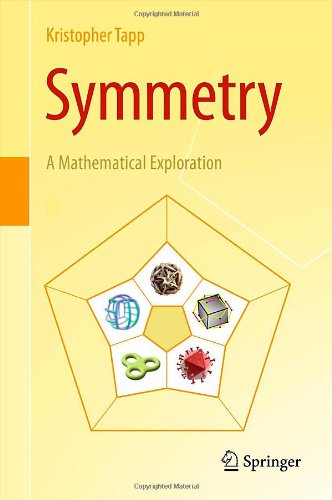
Symmetry: A Mathematical Exploration

Kristopher Tapp

Springer | 2011 | 225 páginas | PDF | 13 Mb

This textbook is perfect for a math course for non-math majors, with the goal of encouraging effective analytical thinking and exposing students to elegant mathematical ideas. It includes many topics commonly found in sampler courses, like Platonic solids, Euler’s formula, irrational numbers, countable sets, permutations, and a proof of the Pythagorean Theorem. All of these topics serve a single compelling goal: understanding the mathematical patterns underlying the symmetry that we observe in the physical world around us. The exposition is engaging, precise and rigorous. The theorems are visually motivated with intuitive proofs appropriate for the intended audience. Students from all majors will enjoy the many beautiful topics herein, and will come to better appreciate the powerful cumulative nature of mathematics as these topics are woven together into a single fascinating story about the ways in which objects can be symmetric.

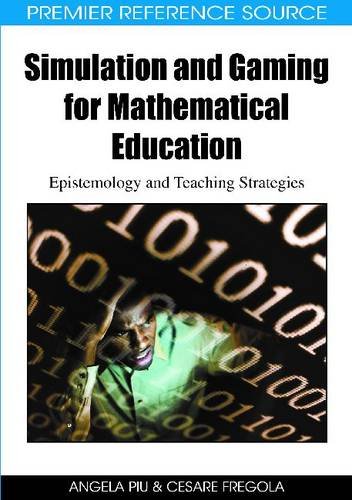
Simulation and Gaming for Mathematical Education: Epistemology and Teaching Strategies


Angela Piu

IG I Global | 2010 | 356 páginas | PDF | 4,4 Mb

Technologic and virtual development is growing, creating an environment of online gaming that can be used as an effective and motivational instrument for math didactics in education. Simulation and Gaming for Mathematical Education: Epistemology and Teaching Strategies provides leading research on ways for various learning environments to becreated referring to math didactics through redefinition and reassessment of teaching experiences. A defining collection of field advancements, this publication gradually leads readers through the steps of planning innovative strategies in math education.

Pangeometry


Nikolai I. Lobachevsky, Athanase Papadopoulos

(Heritage of European Mathematics)

European Mathematical Society | 2010 | 332 páginas | PDF | 12,5 Mb


Lobachevsky wrote his Pangeometry in 1855, the year before his death. This memoir is a résumé of his work on non-Euclidean geometry and its applications, and it can be considered as his clearest account on the subject. It is also the conclusion of his lifework, and the last attempt he made to acquire recognition. The treatise contains basic ideas of hyperbolic geometry, including the trigonometric formulae, the techniques of computation of arc length, of area and of volume, with concrete examples. It also deals with the applications of hyperbolic geometry to the computation of new definite integrals. The techniques are different from those found in most modern books on hyperbolic geometry since they do not use models.

Besides its historical importance, Lobachevsky’s Pangeometry is a beautiful work, written in a simple and condensed style. The material that it contains is still very alive, and reading this book will be most useful for researchers and for students in geometry and in the history of science. It can be used as a textbook, as a source book and as a repository of inspiration.

The present edition provides the first complete English translation of thePangeometry that appears in print. It contains facsimiles of both the Russian and the French original versions. The translation is accompanied by notes, followed by a biography of Lobachevky and an extensive commentary.

Contents
On the present edition xi
I. Pangeometry 1
English translation 3
French original from 1856 79
Russian original from 1855 145
II. Lobachevsky’s biography 203
Preface to Lobachevsky’s 1886 biography 205
Lobachevsky’s biography (1886) 217
III. A commentary on Lobachevsky’s Pangeometry 227
Introduction 229
1. On the content of Lobachevsky’s Pangeometry 235
2. On hyperbolic geometry and its reception 260
3. On models, and on model-free hyperbolic geometry 280
4. A short list of references 285
5. Some milestones for Lobachevsky’s works on geometry 290
Bibliography 299

Review in Zentralblatt MATH 1208.51013

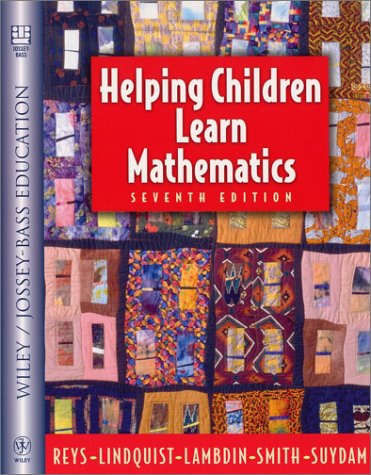
Helping Children Learn Mathematics


Robert Reys, Mary Lindquist, Diana V. Lambdin, Nancy L. Smith

9.ª edição

Wiley, John & Sons | 2009 | 531 páginas | PDF | 28 Mb

link
link1

The ninth edition of this best-selling elementary math methods textbook continues the rich history of this book with a dash of new breath and a new contemporary design. It has been updated to reflect current recommendations, readings, and practices while maintaining the characteristics and features that have made it a popular choice of instructors. This new edition remains an invaluable text for students who are being introduced to teaching elementary mathematics. In addition, its depth also makes it appropriate for teachers to use as they continue to learn about teaching mathematics.


Contents
1. School Mathematics in a Changing World
2. Helping Children Learn Mathematics with Understanding
3. Planning and Teaching
4. Assessment: Enhanced Learning and Teaching
5. Processes of Doing Mathematics
6. Helping Children with Problem Solving
7. Counting and Number Sense in Early Childhood and Primary Grades
8.  Extending Number Sense: Place Value
9. Operations: Meaning and Basic Facts
10. Computation Methods: Calculators, Mental Computation, and Estimation
11. Standard and Alternative Computational Algorithms
12. Fractions and Decimals: Meanings and Operations
13. Ratio, Proportion, and Percent: Meanings and Applications
14. Algebraic Thinking
15. Geometry
16. Measurement
17. Data Analysis, Statistics, and Probability
18. Number Theory


capítulos on-line - 7.ª edição (2003)

CHAPTER 7 -  


CHAPTER 9 - Operations: Meanings and Basic Facts

domingo, 22 de julho de 2012

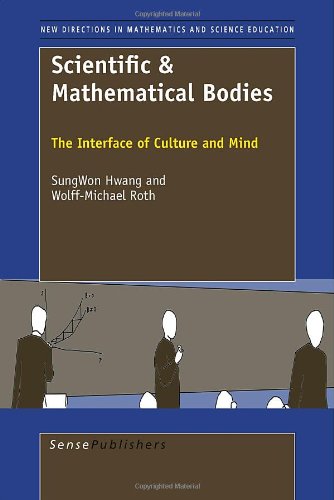
Scientific & Mathematical Bodies: The Interface of Culture and Mind


SungWon Hwang, Wolff-Michael Roth

Sense Publishers | 2011 | 192 páginas | PDF | 3,3 Mb


This book is about the sensuous, living body without which individual knowing and learning is impossible. It is the interface between the individual and culture. Recent scholarship has moved from investigated knowing and learning as something in the mind or brain to understanding these phenomena in terms of the body (embodiment literature) orculture (social constructivism). These two literatures have expanded the understanding of cognition to include the role of the body in shaping the mind and to recognize the tight relation between mind and culture. However, there are numerous problems arising from ways in which the body and culture are thought in these separate research domains. In this book, the authors present an interdisciplinary, scientific initiative that brings together the concerns for body and for culture to develop a single theory of cognition centered on the living and lived body. This book thereby contributes to bridging the gap that currently exists between theory (knowing that) and praxis (knowing how) that is apparent in the existing science and mathematics education literatures.

CONTENTS
Preface vii
PART A: FROM THE SENSE OF THE BODY TO THE BODY OF SENSE 19
PART B: THE ROLE OF THE BODY IN SENSE MAKING 57
3  Literacy as Bodily Performance 63
4  The Body in/of Mathematical Concepts 77
5  Mathematical Inscriptions and Cultural Development 93
6  Heterogeneous Performances and Linguistic Hybridity 105
PART C: THE BODY IN A STRANGE WORLD 115
7  Learning – From the Perspective of the Unknown 119
8  The Body in/of Research Ethics 145
Epilogue: Knowing in the Flesh 165
References 175
Index 179
About the Authors 183