sexta-feira, 6 de julho de 2012

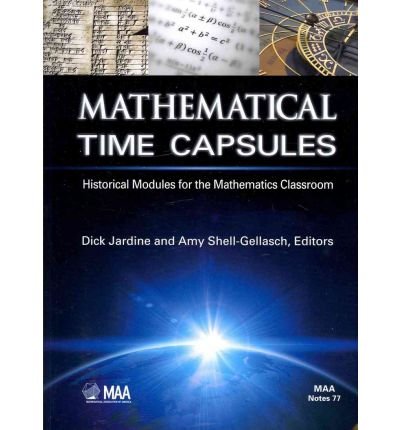
Mathematical Time Capsules: Historical Modules for the Mathematics Classroom


Dick Jardine e Amy Shell-Gellasch

The Mathematical Association of America | 2011| 304 páginas | rar - PDF | 7,4 Mb

link
password: matav

Offers teachers historical modules for immediate use in the mathematics classroom. Readers will find articles and activities from mathematics history that enhance the learning of topics covered in the undergraduate or secondary mathematics curricula. Each capsule presents at least one topic or a historical thread that can be used throughout a course. The capsules were written by experienced practitioners to provide teachers with historical background and classroom activities designed for immediate use in the classroom, along with further references and resources on the chapter subject.

quinta-feira, 5 de julho de 2012

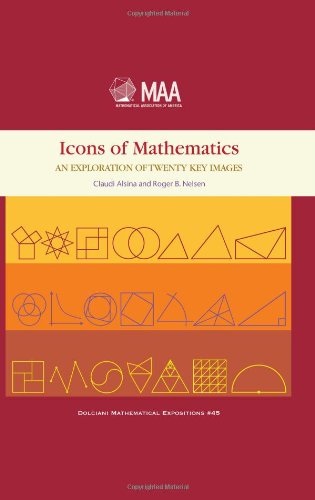
Icons of Mathematics: An Exploration of Twenty Key Images


(Dolciani Mathematical Expositions)

Claudi Alsina e Roger B. Nelsen

Mathematical Association of America | 2011| 327 páginas | rar - PDF | 7,31 Mb

link
Password: matav

This book explores 20 geometric diagrams that play crucial roles in visualizing mathematical proofs. Alsina and Nelsen examine the mathematics within these diagrams and the mathematics that can be created from them. Those who teach undergraduate mathematics will find their book useful for problem-solving sessions, and will have in their hands enrichment material for courses on proofs and mathematical reasoning.
Each of the book's icons is covered in a separate chapter, illustrating its presence in life, its primary mathematical characteristics, and how it plays essential roles in visual proofs of a wide range of mathematical facts. Included are classical results from plane geometry; properties of the integers; means and inequalities; trigonometric identities; theorems from calculus; and puzzles from recreational mathematics. Every chapter contains selections of challenges that readers can explore for further properties and applications of the icons.

Table of Contents

Preface. Twenty Key Icons of Mathematics 1. The Bride's Chair; 2. Zhou Bi Suan Jing 3. Garfield's Trapezoid 4. The semicircle; 5. Similar Figures 6. Cevians 7. The Right Triangle 8. Napoleon's Triangles 9. Arcs and Angles 10. Polygons with Circles 11. Two Circles 12. Venn Diagrams 13. Overlapping Figures 14. Yin and Yang 15. Polygonal Lines; 16. Star Polygons 17. Self-similar Figures 18. Tatami 19. The Rectangular Hyperbola 20. Tiling. Solutions to the Challenges References. Index.

Problemas elementales de máximo y mínimo, Suma de cantidades infinitamente pequeñas

I. P. Natanson

Ed MIR | 1977 | 112 páginas | PDF | 16,6 Mb

link
4shared.com
4shared.com
scribd.com

Se exponen algunos procedimientos elementales para solución, de problemas de máximo y mínimo. La obra está destinada a los alumnos de los grados superiores de la escuela secundaria que deseen adquirir algunas nociones respecto al carácter de los problemas que se examinan en las matemáticas superiores. El material que se expone puede utilizarse en el trabajo de los círculos matemáticos escolares

quarta-feira, 4 de julho de 2012

Mathematical Handbook Elementary Mathematics


M. Vygodsky 

Mir Publishers | 1984 | 422 Páginas | PDF | 9 Mb

link
uploading.com
However, it is well to bear in mind that neither handbook, nor textbook alone suffices  to give the reader a knowledge of the subject: he must use pencil and paper and work through the examples and problems for himself.
This is how the the preface of the Mathematical Handbook – Elementary Mathematics by M. Vygodsky ends. The book has about 420 pages and was first published in 1979 by Mir Publishers.
The book has following sections
Tables, Arithmetic, Algebra, Geometry (Plane and Solid), Trigonometry, Functions and Graphs

segunda-feira, 2 de julho de 2012

Fun with Maths and Physics: Brain Teasers Tricks Illusions


Ya. I. Perelman

MIR Publishers | 1988 | 380 páginas | PDF | 12 Mb
ifile.it (password: mirtitles)

djvu - 6,5 Mb
link
link1
link2
ifile.it (password: mirtitles)


In 1913, in Russian bookshops, appeared a book by the outstanding educationist Yakov Isidorovich Perelman entitled Physics for Entertainment. It struck the fancy of the young who found in it the answers to many of the questions that interested them. Physics for Entertainment not only had an interesting layout, it was also immensely instructive.
In the preface to the 11th Russian edition Perelman wrote: "The main objective of Physics for Entertainment is to arouse the activity of scientific imagination, to teach the reader to think in the spirit of the science of physics and to create in his mind a wide variety of associations of physical knowledge with the widely differing facts of life, with all that he normally comes in contact with." Physics for Entertainment was a best seller.

Probability Theory (First Steps)


E.S. Wentzel

MIR | 1982 | 87 páginas | PDF | 2 Mb

link
link1
rapidgator.net

The author of this booklet describes in popular language how probability theory was developed and found wide application in all fields of modern science. This book can be considered as an introduction towards a more thorough study of probability theory and is intended for a wide circle of readers.

Contents
Probability Theory and Its Problems 6
Probability and Frequency 24
Basic Rules of Probability Theory 40
Random Variables 57
Literature 87

Images of Geometric Solids / Representación de figuras espaciales


N. M. Beskin


Mir Publishers, Moscow | 1985 | 78 páginas | djvu | 663 kb

link
link1
link2
ifile.it (password: mirtitles)


Drawing a plane figure is not geometrically difficult because the image drawn is either an exact copy of the original or a similar figure, e.g. the drawing of a circle looks like the original circle. Drawing geometric solids is quite a different matter. Unfortunately, there are no “spatial pencils” which can trace an object in the air. Such a pencil would “draw” a cube by tracing along its edges. Hence, we have to sketch a cube on paper with an ordinary pencil. A plane image will never be an exact copy of a solid and, therefore, a certain routine ought to be followed in drawing a solid that would create an image of the original in the best way.
What is the book about. Descriptive geometry embraces so
many methods that even a brief account would make up a rather thick volume. Therefore, we shall discuss just one of these methods, so as to enable the reader to make stereometric drawings and solve the respective problems…
This book presents a geometric theory of constructing
stereometric drawings. Having mastered this theory, a reader will be able to make the drawings himself rather than have to stick to the few sample ones.
The first chapter presents the theory, the second one is devoted
to its applications (drawing of a cube, a cone, a cylinder, etc.),
and the third one describes a method of plotting the points of an
image if their coordinates are known.
It is these strategies and routine that this book discusses. Though many things are possible with modern computer programs, but the logic may not be known to people who are using them.
The book was translated from the Russian by Valery Barvashov and was first published by Mir in 1985. 
Contents
Chapter 1. Theory
1. The subject matter of the Theory of images .7
2. Requirements of an image. 7
3. What is the book about .8
4. The method of parallel projection …8
5. A comment on notation .10
6. Properties of parallel projections . 11
7. Free images .13
8. Constructing the images of plane figures ..14
9. Some examples of representing polygons .15
10. The image of a circle .16
11. Another viewpoint of constructing the images of plane figures  .17
12. Pohlke-Schwartz theorem.20
13. Representing geometric solids…26
14. Reversibility of an image .28
15. Specified images .30
Chapter 2. Practical Exercises
16. Cross sections of polyhedrons .32
17. Metric problems  ..35
18. Solids of revolution…37
19. The image of a plane..42
20. Inscribed and circumscribed solids.…43
21. Some drawing conventions..46
22. Drawing obvious images…47
Chapter 3. A computation method
23. Theory… 50
24. Application of the computation method …53
Appendix 1. Expression of the Coordinates of the Image Points Using the Coordinates of the Original Points
25. A characteristic property of a linear homogeneous function .62
26. Formulas for the coordinates of the points of an image .64
Appendix 2. The Ellipse
27. Uniform compression  .67
28. The definition of an ellipse ..70
29. Some properties of ellipse …70
30. The ellipse as the projection of a circle .73
31. The cross sections of a circular cylinder …75
3;2. Some constructions connected with the ellipse .76

Representación de figuras espaciales

88 páginas | PDF | 15,7 Mb
Al representar una figura plana no aparece ninguna dificultad geométrica. El dibujo resulta una copia exacta del original o bien representa una figura semejante al mismo. Cuando consideramos el dibujo de un círculo, nuestra percepción visual es la misma que al considerar el círculo original. La situación es otra por completo cuando se trata de la representación de figuras espaciales. Desgraciadamente, no existe un "lápiz espacial" cuya punta deje huella en el aire. Tal lápiz permitiría "dibujar" un cubo auténtico trazando sus aristas. Pero como no existe, nos vemos obligados a dibujar el cubo desplazando sobre el papel la punta de un lápiz corriente. La imagen plana no puede ser copia exacta de una figura espacial. Esta discordancia plantea el problema: ¿a qué normas atenerse para construir la representación a fin de que ésta dé la imagen más adecuada del original?.