segunda-feira, 2 de julho de 2012

Problems in Geometry


A. Kutepov, A. Rubanov

Mir Publishers, Moscow | 1978| 208 páginas | PDF | 21,1 Mb


djvu - 2 Mb- link direto

1.ª edição 1975, 2.ª edição 1978.

The book contains a collection of 1351 problems (with answers) in plane and solid geometry for technical schools and colleges. The problems are of varied content, involving calculations, proof, construction of diagrams, and determination of the spatial location of geometrical points. It gives sufficient problems to meet the needs of students for practical work in geometry, and the requirements of the teacher for varied material for tests, etc


Contents
CHAPTER I. REVIEW PROBLEMS
1. The Ratio and Proportionality of Line Segments,
Similarity of Triangles 7
2. Metric Relationships in a Right-Angled Triangle 10
3. Regular Polygons, the Length of the Circumference
and the Arc 15
4. Areas of Plane Figures 17
CHAPTER II. SOLVING TRIANGLES
5. Solving Right-Angled Triangles 22
6. Solving Oblique Triangles 29
Law of Cosines 29
Law of Sines 31
Areas of Triangles, Parallelograms and
Quadrilaterals 32
Basic Cases of Solving Oblique Triangles 34
Particular Cases of Solving Oblique Triangles 34
Heron’s Formula 35
Radii r and R of Inscribed and Circumscribed Circles and the Area S of a Triangle 36
Miscellaneous Problems 37
CHAPTER III. STRAIGHT LINES AND PLANES IN SPACE
7. Basic Concepts and Axioms. Two Straight Lines in Space 43
8. Straight Lines Perpendicular and Inclined to a Plane 46
9. Angles Formed by a Straight Line and a Plane  52
10. Parallelism of a Straight Line and a Plane 55
11. Parallel Planes  59
12. Dihedral Angles. Perpendicular Planes 63
13. Areas of Projections of Plane Figures 67
14 Polyhedral Angles 69
CHAPTER IV. POLYHEDRONS AND ROUND SOLIDS
15. Prisms and Parallelepipeds 71
16. The Pyramid 77
17. The Truncated Pyramid 81
18. Regular Polyhedrons 84
19. The Right Circular Cylinder 86
20. The Right Circular Cone 89
21. The Truncated Cone 93
CHAPTER V. AREAS OF POLYHEDRONS AND ROUND SOLIDS
22. Areas of Parallelepipeds and Prisms 97
23. Areas of Pyramids 102
24. Areas of Truncated Pyramids 105
25. Areas of Cylinders 108
26. Areas of Cones Ill
27. Areas of Truncated Cones 115
CHAPTER VI. VOLUMES OF POLYHEDRONS AND ROUND SOLIDS
28. Volumes of Parallelepipeds 118
29. Volumes of Prisms 122
30. Volumes of Pyramids 127
31. Volumes of Truncated Pyramids 133
32. Volumes of Cylinders 137
33. Volumes of Cones 141
34. Volumes of Truncated Cones 145
CHAPTER VII. THE SPHERE
35. Spheres 149
36. Areas of Spheres and Their Parts 152
37. Volumes of Spheres and Their Parts 155
38. Inscribed and Circumscribed Spheres 159
CHAPTER VIII. APPLYING TRIGONOMETRY TO SOLVING GEOMETRIC PROBLEMS
39. Polyhedrons 164
40. Round Solids 168
41. Areas and Volumes of Prisms 172
42. Areas and Volumes of Pyramids  176
43. Areas and Volumes of Round Solids . 181
Answers 187

domingo, 1 de julho de 2012

Math in Society


David Lippman


DL, LuLu | 2011 | 215 páginas | PDF | 5 Mb

online :  dlippman.imathas.com

A survey of math for liberal arts majors. This book is a survey of contemporary mathematical topics: voting theory, weighted voting, fair division, graph theory, scheduling, growth models, finance math, statistics, and historical counting systems. Core material for each topic is covered in the main text, with additional depth available through exploration exercises appropriate for in-class, group, or individual investigation.

The text is designed so that most chapters are independent, allowing the instructor to choose a selection of topics to be covered. 
Emphasis is placed on the applicability of the mathematics. 

Contents
Voting Theory
Weighted Voting
Fair Division
Graph Theory
Scheduling 
Growth Models
Finance 
Statistics
Describing Data by David Lippman, Jeff Eldridge
Historical Counting Systems by Lawrence Morales
Solutions to Selected Exercises

How We Think: A Theory of Goal-Oriented Decision Making and its Educational Applications

Alan H. Schoenfeld

Routledge | 2010 | 264 páginas | PDF | 2,72 Mb

uploading.com


EPUB | 1,2 Mb - link

Teachers try to help their students learn. But why do they make the particular teaching choices they do? What resources do they draw upon? What accounts for the success or failure of their efforts? In How We Think, esteemed scholar and mathematician, Alan H. Schoenfeld, proposes a groundbreaking theory and model for how we think and act in the classroom and beyond. Based on thirty years of research on problem solving and teaching, Schoenfeld provides compelling evidence for a concrete approach that describes how teachers, and individuals more generally, navigate their way through in-the-moment decision-making in well-practiced domains. Applying his theoretical model to detailed representations and analyses of teachers at work as well as of professionals outside education, Schoenfeld argues that understanding and recognizing the goal-oriented patterns of our day to day decisions can help identify what makes effective or ineffective behavior in the classroom and beyond.

sexta-feira, 29 de junho de 2012

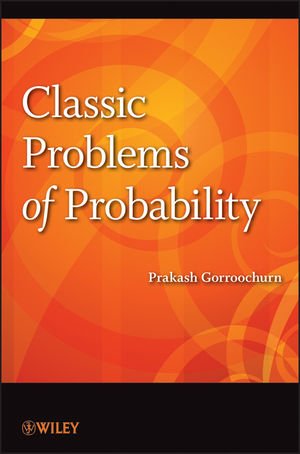
Classic Problems of Probability


Prakash Gorroochurn

Wiley | 2012 | 320 páginas | PDF | 6,5 Mb


link
uploading.com

"A great book, one that I will certainly add to my personal library."
--Paul J. Nahin, Professor Emeritus of Electrical Engineering, University of New Hampshire

Classic Problems of Probability presents a lively account of the most intriguing aspects of statistics. The book features a large collection of more than thirty classic probability problems which have been carefully selected for their interesting history, the way they have shaped the field, and their counterintuitive nature.

From Cardano's 1564 Games of Chance to Jacob Bernoulli's 1713 Golden Theorem to Parrondo's 1996 Perplexing Paradox, the book clearly outlines the puzzles and problems of probability, interweaving the discussion with rich historical detail and the story of how the mathematicians involved arrived at their solutions. Each problem is given an in-depth treatment, including detailed and rigorous mathematical proofs as needed. Some of the fascinating topics discussed by the author include:
  • Buffon's Needle problem and its ingenious treatment by Joseph Barbier, culminating into a discussion of invariance
  • Various paradoxes raised by Joseph Bertrand
  • Classic problems in decision theory, including Pascal's Wager, Kraitchik's Neckties, and Newcomb's problem
  • The Bayesian paradigm and various philosophies of probability
  • Coverage of both elementary and more complex problems, including the Chevalier de Méré problems, Fisher and the lady testing tea, the birthday problem and its various extensions, and the Borel-Kolmogorov paradox
Classic Problems of Probability is an eye-opening, one-of-a-kind reference for researchers and professionals interested in the history of probability and the varied problem-solving strategies employed throughout the ages. The book also serves as an insightful supplement for courses on mathematical probability and introductory probability and statistics at the undergraduate level.

Preface 3
Problem 1. Cardano and Games of Chance (1564) 8
Problem 2. Gailieo and a Discovery Concerning Dice (1620) 15
Problem 3. The Chevalier de Méré Problem I: The Problem of Dice (1654) 17
Problem 4. The Chevalier de Méré Problem II: The Problem of Points (1654) 22
Problem 5. Huygens and the Gambler’s Ruin (1657) 39
Problem 6. The Pepys-Newton Connection (1693) 47
Problem 7. Rencontres with Montmort (1708) 50
Problem 8. Jacob Bernoulli and his Golden Theorem (1713) 54
Problem 9. De Moivre’s Problem (1730) 71
Problem 10. De Moivre, Gauss, and the Normal Curve (1730, 1809) 79
Problem 11. Daniel Bernoulli and the St Petersburg Problem (1738) 94
Problem 12. D’Alembert and the “Croix ou Pile” Article (1754) 102
Problem 13. D’Alembert and the Gambler’s Fallacy (1761) 105
Problem 14. Bayes, Laplace, and Philosophies of Probability (1764, 1774) 109
Problem 15. Leibniz’s Error (1768) 132
Problem 16. The Buffon Needle Problem (1777) 134
Problem 17. Bertrand’s Ballot Problem (1887) 143
Problem 18. Bertrand’s Strange Three Boxes (1889) 147
Problem 19. Bertrand’s Chords (1889) 151
Problem 20. Three Coins and a Puzzle from Galton (1894) 156
Problem 21. Lewis Carroll’s Pillow Problem No. 72 (1894) 157
Problem 22. Borel and A Different Kind of Normality (1909) 161
Problem 23. Borel’s Paradox and Kolmogorov’s Axioms (1909, 1933) 165
Problem 24. Of Borel, Monkeys, and the New Creationism (1913) 173
Problem 25. Kraitchik’s Neckties and Newcomb’s Problem (1930, 1960)
Problem 26. Fisher and the lady Tasting Tea (1935) 188
Problem 27. Benford and the Peculiar Behavior of the First Significant Digit (1938) 195
Problem 28. Coinciding Birthdays (1939) 200
Problem 29. Lévy and the Arc Sine Law (1939) 206
Problem 30. Simpson’s Paradox (1951) 210
Problem 31. Gamow, Stern, and Elevators (1958) 215
Problem 32. Monty-Hall, Cars, and Goats (1975) 218
Problem 33. Parrondo’s Perplexing Paradox (1996) 224
Bibliography 230
Photo Credits 254

quinta-feira, 28 de junho de 2012

Geometric Exercises in Paper Folding


Sundara T. Row 

Chicago, The Open Court pub. co | 1917

online: archive.org

online: chestofbooks.com (html)

PDF - 13 Mb

arvindguptatoys.com (link direto)

djvu - 2,7 Mb

The idea of this book was suggested to me by Kindergarten Gift No. VIII. - Paper-folding. The gift consists of two hundred variously colored squares of paper, a folder, and diagrams and instructions for folding. The paper is colored and glazed on one side. The paper may, however, be of self-color, alike on both sides. In fact, any paper of moderate thickness will answer the purpose, but colored paper shows the creases better, and is more attractive. The kindergarten gift is sold by any dealers in school supplies ; but colored paper of both sorts can be had from stationery dealers. Any sheet of paper can be cut into a square as explained in the opening articles of this book, but it is neat and convenient to have the squares ready cut.

quarta-feira, 27 de junho de 2012

The Contest Problem Book V: American High School Mathematics Examinations (AHSME) / American Invitational Mathematics Examinations (AIME) 1983-1988


George Berzsenyi,  Stephen B. Maurer 

The Mathematical Association of America | 1997 | 308 páginas | PDF | 7,41 Mb

link

Berzsenyi and Maurer raised the level of The Contest Problem Book series to new highs by including A guide to the Problem Literature, dropped problems of AHSME and AIME and a thematic index of the problems. Their book is a valuable addition to personal libraries of all enthusiasts of problem solving in general and mathematics competitions in particular. —Zentrallblatt für Mathematik
We are all in the debt of the authors...not only for their role in unearthing some of the gems, but also for polishing and mounting them so attractively. —The Mathematical Gazette
...it is a great resource for mathematics teachers because it furnishes the complete exams and detailed solutions. The solutions are very useful because many of the questions are quite challenging ... Mathematics teachers and students at both high school and college levels will find this collection a useful resource and a welcome addition to the ongoing series. Also of great use to teachers are the indexed classification of problems by type and the excellent bibliography of problem-solving resources. General readers; lower-division undergraduates; faculty. —CHOICE
Over the years perhaps the most popular of the MAA problem books have been the high school contest books, covering the yearly American High Mathematics Examinations (AHSME) that began in 1950, co-sponsored from the start by the MAA. Book V also includes the first six years of the American Invitational Mathematics Examination (AIME) which was developed as an intermediate step between the AHSME and the USA Mathematical Olympiad (USAMO). The AIME has a unique answer format—all answers are integers between 0 and 999.
The editors of this volume, George Berzsenyi and Stephen B. Maurer, were respectively the chair of the AIME and the AHSME during this period. In addition to a thorough index, they have added much material not included in Contest Books I–IV:
  • a comprehensive guide to other problem materials world wide
  • additional solutions,
  • dropped problems,
  • statistical information
  • information on test development and history
This is a must volume for avid fans of elementary problems, young and old.

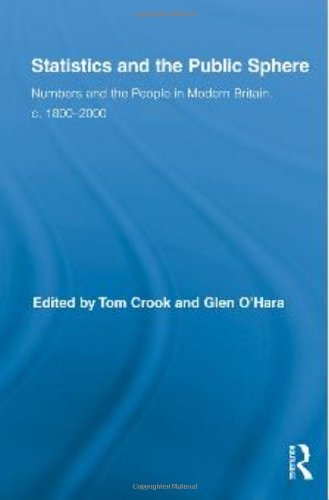
Statistics and the Public Sphere: Numbers and the People in Modern Britain, c. 1800-2000


(Routledge Studies in Modern British History)

Tom Crook, Glen O'Hara 

Routledge | 2011 | 290 páginas | rar - PDF | 2,2 Mb

link (password: matav)

Contemporary public life in Britain would be unthinkable without the use of statistics and statistical reasoning. Numbers dominate political discussion, facilitating debate while also attracting criticism on the grounds of their veracity and utility. However, the historical role and place of statistics within Britain’s public sphere has yet to receive the attention it deserves. There exist numerous histories of both modern statistical reasoning and the modern public sphere; but to date, there are no works which, quite pointedly, aim to analyse the historical entanglement of the two. Statistics and the Public Sphere: Numbers and the People in Modern Britain, c.1800-2000 directly addresses this neglected area of historiography, and in so doing places the present in some much needed historical perspective.