quarta-feira, 11 de abril de 2012

Practical Poker Math: Basic Odds & Probabilities for Hold'Em and Omaha


Pat Dittmar

ECW Press | 2008 | 256 páginas | PDF | 3,76Mb


PDF | 5 Mb


A study in probability, strategy, and game theory, this handy companion explores all the mathematical methods of mastering the game of poker. Using an original concept called "Total Odds," the book presents a complete odds work-up for both Texas Hold'Em and the high and low hands of Omaha. These principles are accessible to any poker player at any skill level, and the calculations are color-coded, making them easy to follow. Serving as a convenient primer for the beginner and a reference text for more experienced players, this guide is a safe bet for anyone looking to win.

The Search for Certainty: On the Clash of Science and Philosophy of Probability

Krzysztof Burdzy

World Scientific Publishing Company | 2009 | 272 páginas | PDF | 1,9 Mb

This volume represents a radical departure from the current philosophical duopoly in the area of foundations of probability, that is, the frequency and subjective theories. One of the main new ideas is a set of scientific laws of probability. The new laws are simple, intuitive and, last but not least, they agree well with the contents of current textbooks on probability. Another major new claim is that the "frequency statistics" has nothing in common with the "frequency philosophy of probability," contrary to popular belief. Similarly, contrary to the general perception, the "Bayesian statistics" shares nothing in common with the "subjective philosophy of probability."
The book is non-partisan on the scientific side -- it is supportive of both frequency statistics and Bayesian statistics. On the other hand, it contains well-documented and thoroughly-explained criticisms of the frequency and subjective philosophies of probability. Short reviews of other philosophical theories of probability and basic mathematical methods of probability and statistics are incorporated. The book includes substantial chapters on decision theory and teaching probability, and it is easily accessible to the general audience.
Contents:
  • Main Philosophies of Probability
  • The Science of Probability
  • Decision Making
  • The Frequency Philosophy of Probability
  • Classical Statistics
  • The Subjective Philosophy of Probability
  • Bayesian Statistics
  • Teaching Probability
  • Abuse of Language
  • What is Science?
  • What is Philosophy?
  • Concluding Remarks
  • Mathematical Methods of Probability and Statistics
  • Literature Review

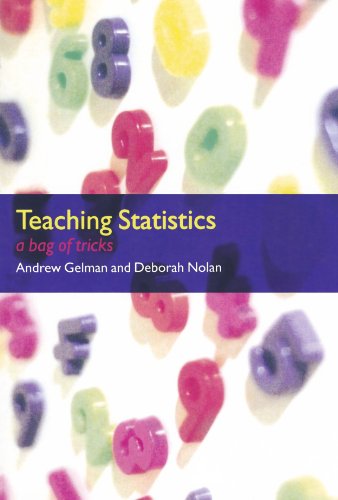
Teaching Statistics: A Bag of Tricks


Andrew Gelman,  Deborah Nolan

Oxford University Press | 2002 | PDF | 320 páginas | 3,7 Mb


This exciting new volume takes a positive spin on the field of statistics. Statistics is seen by students as difficult and boring, however, the authors of this book have eliminated that theory. Teaching Statistics: A Bag Of Tricks, brings together a complete set of examples, demonstrations and projects that not only will increase class participation but will help to eliminate any negative feelings toward the area of statistics.


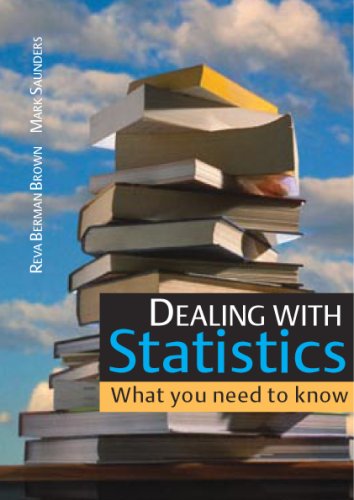
Dealing with Statistics: What you need to know

Mark Saunders

Open University Press | 2007 | 152 páginas | PDF | 2 Mb

link
link1

This is a highly accessible, yet an adequately sophisticated text, which can be enjoyed by students across the skills spectrum. I am confident that it will help students who suffer from maths phobia as it offers to teach statistics with anxiety-busting clarity. The book benefits from easy to follow demonstrations and illustrations of statistical methods and techniques, which are highly relevant for business and management research at the undergraduate and masters level courses
 Professor Mustafa F. Ozbilgin, University of East Anglia, UK

Are you confused about which statistical tests to use, when you should be using them and why you should be using them? This book is about helping you to choose and use the right statistical technique to analyse your data and write about your results and findings convincingly. It provides a concise and accessible guide to the essential statistical skills needed for success in your assignment, project or dissertation.Berman Brown and Saunders concentrate on particular statistical tests and their three Ws  what, why, and when. They provide you with the tools to choose the graphs and statistics that are suitable for your data, and to understand what the statistical results actually mean.In addition, the book: Explains why it is impossible to avoid using statistics in analysing data Describes the language of statistics to make it easier to understand the various terms used for statistical techniques Deals with using tables and charts to present data so that they are easy to understand Explains the statistics used to describe data used to infer differences and relationships.The book also includes a handy alphabet of statistics as well as a glossary of key statistical terms.Dealing with Statistics is key reading for students undertaking a social science or business and management assignment, project or dissertation as part of an undergraduate or Masters qualification.

Chance And Choice By Card Pack And ChessBoard Vol I

 Hogben Lancelot M.A


Max Parrish And Co | 1950 


online: archive.org

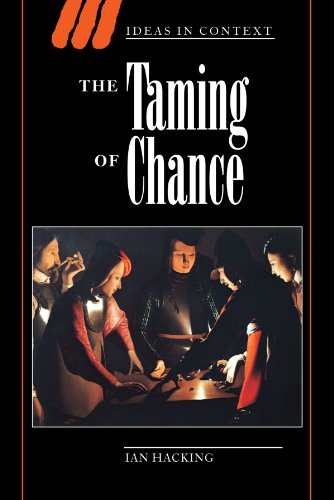
The Taming of Chance

Ian Hacking

CUP | 2002 | 284 Páginas | DJVU | 2,59 Mb

In this important new study Ian Hacking continues the enquiry into the origins and development of certain characteristic modes of contemporary thought undertaken in such previous works as his best selling Emergence of Probability. Professor Hacking shows how by the late nineteenth century it became possible to think of statistical patterns as explanatory in themselves, and to regard the world as not necessarily deterministic in character. Combining detailed scientific historical research with characteristic philosophic breath and verve, The Taming of Chance brings out the relations among philosophy, the physical sciences, mathematics and the development of social institutions, and provides a unique and authoritative analysis of the "probabilization" of the Western world.

Lady Luck: The Theory of Probability

Warren Weaver

Dover Publications | 1982 | 384 páginas | Djvu | 3,13 Mb


Everyday questions such as "Should I take my umbrella?" involve probability — a topic important in daily life and in science. This witty, nontechnical introduction to the subject elucidates such concepts as permutations, independent events, mathematical expectation, the law of averages and more. No advanced math required. 49 drawings.