sexta-feira, 30 de março de 2012

Abraham De Moivre: Setting the Stage for Classical Probability and Its Applications

David R. Bellhouse

A K Peters/CRC Press | 2011 | 266 páginas | PDF | 3,55 Mb

link direto
link

Extensively researched, this book traces the life and work of Abraham De Moivre as well as the state of probability and statistics in eighteenth-century Britain. It is the first extensive biography of De Moivre and is based on recently discovered material and translations, including some of De Moivre’s letters.
The book begins with discussions on De Moivre’s early life in France and his initial work in pure mathematics with some excursions into celestial mechanics. It then describes his fundamental contributions to probability theory and applications, including those in finance and actuarial science. The author explores how De Moivre’s wide network of personal and professional connections often motivated his research. The book also covers De Moivre’s contemporaries and his impact on the field. Written in a clear, approachable style, this biography will appeal to historians and practitioners of the art of probability and statistics in a wide range of applications, including finance and actuarial science.


Review

This is a very scholarly piece of work, with many references to original documents … Bellhouse’s book should fascinate most academics in that, beside going with the uttermost detail into De Moivre’s contributions to probability, it uncovers the way (mathematical) research was done in the 17th and 18th century England … Another fascinating aspect of the book is the way English (incl. De Moivre) and Continental mathematicians fought and bickered on the priority of discoveries. … this is a highly pleasant and easily readable [book] on the career of a major mathematician and one of the founding fathers of probability theory. David Bellhouse is to be congratulated on the scholarship exhibited by this book and on the painstaking pursuit of all historical documents related with De Moivre’s life.
—Christian Robert on his blog, March 2012

About the Author

David Bellhouse is a professor in the Department of Statistical and Actuarial Sciences at the University of Western Ontario. His research interests include statistical theory and methods as well as the history of probability, statistics, actuarial science, and mathematics.


Table of Contents
Preface ix
Acknowledgments xiii
Chapter 1: Early Life in France 15
Chapter 2: Points of Connection 25
Chapter 3: Getting Established in England 39
Chapter 4: Scotica Mathematica 51
Chapter 5: The Breakthrough: De Mensura Sortis 63
Chapter 6: A Newtonian Intermezzo 87
Chapter 7: Miscellanea Mathematica 101
Chapter 8: The Doctrine of Chances and the Doctrine Disputed 111
Chapter 9: Doctrinal Dissemination and Further Development 133
Chapter 10: De Moivre as Teacher 145
Chapter 11: Life Annuities 153
Chapter 12: The Decade of the Doctrine Enhanced 173
Chapter 13: The Two Thomases 191
Chapter 14: Old Age 205
Endnotes 217
Bibliography 239

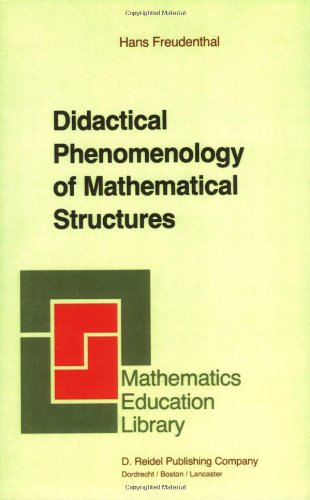
Didactical Phenomenology of Mathematical Structures

(Mathematics Education Library)

Hans Freudenthal

Springer | 1999 | 606 páginas| PDF | 4,6 Mb


Our mathematical concepts, structures, ideas have been invented as tools to organise the phenomena of the physical, social and mental world. Phenomenology of a mathematical concept, structure, or idea means describing it in its relation to the phenomena for which it was created, and to which it has been extended in the learning process of mankind, and, as far as this description is concerned with the learning process of the young generation, it is didactical phenomenology, a way to show the teacher the places where the learner might step into the learning process of mankind. Not in its history but in its learning process that still continues, which means dead ends must be cut and living roots spared and reinforced.

quinta-feira, 29 de março de 2012

Gottfried Wilhelm Leibniz: The Polymath Who Brought Us Calculus

M. . W. Tent

A K Peters/CRC Press | 2011 | 260 páginas | PDF | 2,4 Mb


Gottfried Wilhelm Leibniz: The Polymath Who Brought Us Calculus focuses on the life and accomplishments of one of the seventeenth century’s most influential mathematicians and philosophers. The book, which draws on Leibniz’s written works and translations, and reconstructs dialogues Leibniz may have had based on the historical record of his life experiences, portrays Leibniz as both a phenomenal genius and a real person.
Suitable for middle school age readers, the book traces Leibniz’s life from his early years as a young boy and student to his later work as a court historian. It discusses the intellectual and social climate in which he fought for his ideas, including his rather contentious relationship with Newton (both claimed to have invented calculus). The text describes how Leibniz developed the first mechanical calculator that could handle addition, subtraction, multiplication, and division. It also examines his passionate advocacy of rational arguments in all controversial matters, including the law, expressed in his famous exclamation calculemus: let us calculate to see who is right.
Leibniz made groundbreaking contributions to mathematics and philosophy that have shaped our modern views of these fields.

Ancient Puzzles: Classic Brainteasers and Other Timeless Mathematical Games of the Last Ten Centuries

Dominic Olivastro

Bantam | 1993 | 288 Páginas |  PDF | 12,6 Mb

scribd.com

djvu - 2,7 Mb
link
link1

Olivastro's combination of history and puzzles-to-solve may intimidate or simply put off some readers who are strictly of the "let's play" school. Others will be enthralled to learn of the antiquity of some of today's still-popular numeric puzzles. Along the way, the author delivers some fascinating information, such as the origin of the word stockholder and of a magic square devised by Benjamin Franklin. Here are some great ideas for enlivening a math classroom or blending math with history or social studies.

Mathematical Amazements and Surprises: Fascinating Figures and Noteworthy Numbers


Alfred S. Posamentier e Ingmar Lehmann

Prometheus Books | 2009 |  269 Páginas | DjVu | 6,3 Mb


What are the odds of finding two people who share the same birth date in a room of thirty-five? Most people would guess they’re pretty low. In actuality, the probability is better than 80 percent. This is just one of many entertaining examples of mathematical curiosities presented in this book. If you have been waiting for a book that will evoke the delight and intrigue that mathematics has to offer, this is the book for you. Mathematics educators Alfred S Posamentier and Ingmar Lehmann have created the perfect introduction to the wonders of mathematics for the general reader, requiring only a high school background in the subject. Among the entertaining and useful tricks they teach are shortcuts in arithmetic, such as ways to determine at a glance the exact divisors of any given number. They also demonstrate how the properties of certain numbers can lead to infinite loops. What is particularly exciting is how many correct answers turn out to be counterintuitive. Exploring all these features will instill insights into the nature of numbers, improve your ability to manipulate them, and give you an appreciation for the inherent elegance of mathematics. Posamentier and Lehmann evoke the beauty of mathematics through the visual aspect of geometry. Enjoy with them the riches of the aesthetic and surprising properties to be found in triangles, quadrilaterals, and circles. As you marvel at the many unusual relationships and novelties revealed in this ingenious and delightful presentation, you will be learning more maths than you ever thought possible – and will be relishing every moment of it!

Amazing "Aha!" Puzzles

Lloyd King
Lulu.com | 2006 | 180 páginas | PDF | 2,4 Mb


DO YOU WANT TO IMPROVE YOUR ABILITY TO THINK 'OUTSIDE THE BOX' AND BOOST YOUR CREATIVITY?

This truly mind-altering and inspirational book of more than 300 brand new lateral puzzles provides a fantastic opportunity for anyone to improve their creativity and mental flexibility. It is packed with all kinds of fun and imaginative problems of varying degrees of difficulty that encourage you to break out of familiar thought patterns and to think creatively and ‘outside the box’. In addition, the puzzles have extremely rewarding and addictive "Aha!" answers absolutely guaranteed to make you both groan and smile at the same time. This book will keep you perplexed and entertained for many enjoyable hours, days and weeks to come.

Mathematics: Marvels and Milestones


A. Audichya

Oxford Book Company | 2010 | : 224 páginas | PDF | 7,8 Mb


To transport the reader to the highest level of mathematical awareness and to acquaint him with outstanding mathematical achievements. The foremost of them all is the pluralization of mathematics, i.e.,where we had geometry, we now have geometries, and algebras rather than algebra, and number systems rather than number system. It is intended for the intelligent layman who is in search of short and pointed answers to his queries but is little inclined to undertake detai led study of mathematical ideas and concepts.