terça-feira, 13 de março de 2012

Dissections: Plane and Fancy

Greg N. Frederickson

Cambridge University Press | 1997 | 322 páginas | djvu | 2,73 Mb

link
link1

páginas i a ix: assets.cambridge.orgpáginas 1 a 10: assets.cambridge.org

Página do livro: cs.purdue.edu


Can you cut an octagon into five pieces and rearrange them into a square? How about turning a star into a pentagon? These are just two of the infinite challenges of geometric dissections, the mathematical art of cutting figures into pieces that can be rearranged to form other figures, using as few pieces as possible. Through the ages, geometric dissections have fascinated puzzle fans and great mathematicians alike. Here are dissections known to Plato and exciting new discoveries alike. Greg Frederickson explains solution methods carefully, assuming only a basic knowledge of high school geometry. This beautifully illustrated book provides hours of enjoyment for every mathematical puzzle enthusiast.

Figures for Fun: Stories and Conundrums

Yakov I. Perelman

Central Books Ltd | 1973 | 153 páginas | djvu | 4,72 Mb

link
link1
ifile.it (password: mirtitles)

um blog com alguns problemas retirados deste livro: figforfun


To read and enjoy this book it suffice to possess a modest knowledge of mathomatics, i.e., knowledge of arithmetical rules  and elementary geometry. Very few problem' require the ability of forming and solving equations-and the simplest at that.
The subjects range from a mostley collection of conundrums and mathe-matical stunts to useful practical problems on counting

Matematicas Recreativas


Yakov Perelman
(em castelhano)

Martinez Roca S a Ediciones | 2002 | PDF | 1 Mb

Esta obra expone más de cien instructivos problemas de cálculo de probabilidades, geometría, configuraciones numéricas, cuadrados mágicos. . . Todos ellos ilustrados y resueltos con rigor. Un libro para jugar aprendiendo y aprender jugando.

Geometria Recreativa


Yakov Perelman
(em castelhano)

on-line: librosmaravillosos.com

pdf - 2 Mb
link direto
link
link1

PDF | 9,75 Mb
depositfiles.com (Password: www.intercambiosvirtuales.org)
scribd.com
scribd.com


Ante Uds. uno de los mejores clásicos de la geometría práctica. Su lenguaje sencillo y directo facilita la lectura del libro: problemas poco comunes, captura de situaciones históricas y curiosos ejemplos de la vida diaria, harán las delicias de los jóvenes lectores y talvez de otros no tanto.

Esta publicación tiene como objetivo principal inculcar en los jóvenes el gusto por el estudio de la geometría, promoviendo en ellos el interés por su aprendizaje independiente y entregándoles conocimientos suplementarios a los programas escolares.


  • Presentación
  • Geometría en el bosque
  • Geometría junto al río
  • Geometría a campo raso
  • Geometría de viaje
  • Sin tablas ni fórmulas
  • Donde la Tierra se junta con el Cielo
  • Geometría de los robinsones
  • Geometría a ciegas
  • Lo antiguo y nuevo sobre el círculo
  • Geometría sin mediciones ni cálculos
  • Grande y pequeño en geometría
  • Economía Geométrica

Aritmética Recreativa


Yakov Perelman
(em castelhano)

On-line: librosmaravillosos.com
f3.tiera.ru(link direto)
perueduca.edu.pe (link direto)
link
link1
mediafire.com
scribd.com
ziddu.com
scribd.com


domingo, 11 de março de 2012

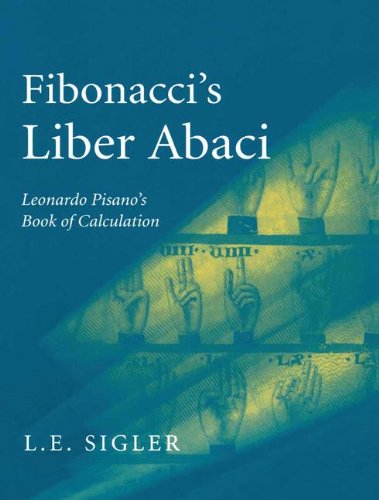
Fibonacci's Liber Abaci

Laurence Sigler

Springer | 2003 | 634 páginas | pdf | 21 Mb

link

 "Leonardo of Pisa's Liber Abaci (Book of Calculation) is one of the most important books in the history of European mathematics. Leonardo learned his mathematics from the Islamic mathematical tradition (some have even argued that he should be considered part of that tradition), but he wrote his books in Latin. As a result, he became one of the most important mediators of that tradition to European readers. The Liber Abaci focused on "calculation." From our point of view, most of the contents are either arithmetic or algebra. It starts off with an extensive and detailed discussion of the use of "the nine Indian figures" to represent numbers and to perform arithmetical operations with them. The "nine figures" are, of course, 1, 2, 3, 4, 5, 6, 7, 8, and 9, with 0 being treated as a separate sign. The book then goes on to deal with a large number of problems that we would describe as algebraic. Most of these reduce to linear equations (this includes systems of linear equations and also linear diophantine equations). The final chapter discusses quadratic equations. All of this is done, of course, without any sort of algebraic symbolism. As Heinz Lueneberg has pointed out in a recent issue of FOCUS, this is an amazing book, and it is somewhat frustrating that we had to wait for the 800th anniversary of its original publication to see an English translation. But here it is at last, the Liber Abaci in English. It is now possible for mathematicians who are interested in history to read it, and for students to read portions of it in their history courses. One final comment: attentive readers will note that the name "Fibonacci" does not occur in this brief review. That is because Leonardo never used that name: it is a nickname given to him by a 19th century historian of mathematics. I'm enough of a purist to want to refer to Leonardo as he referred to himself: Leonardo of Pisa, of the Bonacci family. He was a great mathematician, and here is an accessible and readable edition of his most famous book. Don't miss the opportunity to get a copy." MAA Online, March 2003 "The Liber abaci of Leonardo Pisano (today commonly called Fibonacci) is one of the fundamental works of European mathematics. No other book did more to establish the basic framework of arithmetic and algebra as they developed in the Western world. …its position as the only modern text of this fundamental work will make this translation an essential part of any collection in the history of mathematics." MathSciNet " . . . Even the Latin original has been hard to find outside the rare book room . . . But now this cornerstone of mathematical culture has finally become widely available with the appearance of Fibonacci’s ‘Liber Abaci’: A Translation into Modern English of Leonardo Pisano’s Book of Calculation." AMERICAN SCIENTIST "This book is the translation of Baldassarre Boncompagni’s Latin edition published in Rome in 1857. This is the first and so far the only translation to a modern language of an important rarity. … The titles of the chapters describe the topics quite well. … this important book should be on the shelves of anyone interested in history, culture, mathematics and the interaction of these basic human values." (Peter Hajnal, Acta Scientiarum Mathematicarum, Vol. 70, 2004)

sábado, 10 de março de 2012

The Colorado Mathematical Olympiad and Further Explorations

Alexander Soifer

Springer | 2011 | 447 páginas | PDF | 8 Mb

lyhourhuon.files.wordpress.com (link direto)
f3.tiera.ru (link direto)
link

This book dramatically (by a factor of 2.5) expands its predecessor, the 1994 Colorado Mathematical Olympiad: The First Ten Years and Further Explorations. It conveys the spirit and the exciting history of the competition as well as an outline of all original problems and solutions that have been created for the contest over 20 years mostly by the author. Some of the problems were inspired by Russian mathematical folklore; for example, the 1989 Sugar Cubed problem was written in a pleasant Lewis Carroll-like story. Other entertaining problems involve Olde Victorian Map Colourings, King Authur and the Knights of the Round Table, Crawford Cowboy Had a Farm, Santa Claus and his elves painting the plane, etc. The twenty "Further Explorations" form a unique feature, not found in any other Olympiad book: each exploration takes off a solved Olympiad problem and leads the reader to the forefront of mathematics. These bridges allow young mathematicians to engage in mathematical research all of their own. Part V of the book gives the microphone to the winners, who describe the role of this Olympiad in their lives and share their successful careers.