sexta-feira, 17 de setembro de 2010

Mathematics and Humor: A Study of the Logic of Humor


John Allen Paulos

University Of Chicago Press | 1982 | 124 páginas | PDF | 1,45 MB

link
link1

"Jokes, paradoxes, riddles, and the art of non-sequitur are revealed with great perception and insight in this illuminating account of the relationship between humor and mathematics."--Joseph Williams, New York Times"'Leave your mind alone,' said a Thurber cartoon, and a really complete and convincing analysis of what humour is might spoil all jokes forever. This book avoids that danger. What it does. . .is describe broadly several kinds of mathematical theory and apply them to throw sidelights on how many kinds of jokes work."--New Scientist"Many scholars nowadays write seriously about the ludicrous. Some merely manage to be dull. A few--like Paulos--are brilliant in an odd endeavor."--Los Angeles Times Book Review

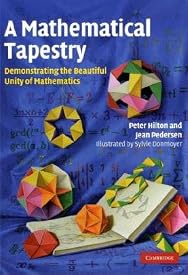
A Mathematical Tapestry: Demonstrating the Beautiful Unity of Mathematics


Peter Hilton, Jean Pedersen

Cambridge University Press | 2010 | 306 páginas | pdf | 6,1 Mb

link direto
link
link1

This easy-to-read book demonstrates how a simple geometric idea reveals fascinating connections and results in number theory, the mathematics of polyhedra, combinatorial geometry, and group theory. Using a systematic paper-folding procedure it is possible to construct a regular polygon with any number of sides. This remarkable algorithm has led to interesting proofs of certain results in number theory, has been used to answer combinatorial questions involving partitions of space, and has enabled the authors to obtain the formula for the volume of a regular tetrahedron in around three steps, using nothing more complicated than basic arithmetic and the most elementary plane geometry. All of these ideas, and more, reveal the beauty of mathematics and the interconnectedness of its various branches. Detailed instructions, including clear illustrations, enable the reader to gain hands-on experience constructing these models and to discover for themselves the patterns and relationships they unearth.

quinta-feira, 5 de agosto de 2010

Understanding and Teaching Primary Mathematics


Tony Cotton
Longman | 2010 | 272 páginas | pdf | 6 Mb


link

Understanding and Teaching Primary Mathematics is a full colour, core textbook for anyone training to teach Maths at primary level. A self-audit is provided at the outset to assess your prior knowledge and highlight areas for your personal development. The book will then help you to develop your mathematical understanding by encouraging you to think mathematically. You will be asked to create an action plan to aid your development and this will also allow you to build up a portfolio of evidence to help you achieve QTS (Qualified Teacher Status). Rather than treating subject knowledge and pedagogy as two separate entities, the book sets maths subject knowledge in context, showing you how to apply it in the classroom, through models and cases of best practice. Misconception boxes appear throughout each chapter to highlight common misconceptions children have in maths and help you to make connections between different areas of mathematics so that your pupils will see mathematics as a whole rather than a series of separate and often disparate ideas. Case studies in each chapter also provide you with an exemplar lesson plan annotated by a new teacher which shows you how to deal with a common misconception. This book will help you to deliver Maths at primary level in a clear and confident manner.

Contents
Teaching and Learning Primary Mathematics
What Should I Know? What Do I Know?
Using and Applying Mathematics
Counting and Understanding Number
Knowing and Using Number Facts
Calculating
Understanding Shape
Measuring
Handling Data
Teaching and Learning Mathematics in the Early Years
Issues of Inclusion
ICT and Teaching and Learning Mathematics
The QTS Skills Test
Defending Hypatia: Ramus, Savile, and the Renaissance Rediscovery of Mathematical History

(Archimedes)
Robert Goulding

Springer | 2010 | 201 páginas

pdf - 1,6 Mb

link


Why should mathematics, the purest of sciences, have a history? Medieval mathematicians took little interest in the history of their discipline. Yet in the Renaissance the history of mathematics flourished. This book explores how Renaissance scholars recovered and reconstructed the origins of mathematics by tracing its invention in prehistoric Antiquity, its development by the Greeks, and its transmission to modern Europe via the works of Euclid, Theon and Proclus. The principal architects of this story -- the French philosopher and University of Paris reformer Peter Ramus, and his critic, the young Oxford astronomy lecturer Henry Savile – worked out diametrically opposed models for the development of the mathematical arts, models of historical progress and decline which mirrored each scholar’s larger convictions about the nature of mathematical thinking, the purpose of the modern university, and the potential of the human mind. In their hands, the obscure story of mathematical history became a site of contention over some of the most pressing philosophical and pedagogical debates of the sixteenth century.

Test Your Logic


George J. Summers

Dover Publications | 1972 | 100 páginas | djvu | 560 kb

link
link1
link2

George J. Summers creates 50 new puzzles for fans eager to test their logic. The puzzles range in difficulty from the relatively simple examples at the beginning of the book to others that are tricky, complex and subtle enough to the test the expert.

Essays on the Foundations of Mathematics by Moritz Pasch


(The Western Ontario Series in Philosophy of Science)
Stephen Pollard

Springer | 2010 | 245 páginas | PDF | 2,15 Mb

link direto
link
link1
ishare.iask

Moritz Pasch (1843-1930) is justly celebrated as a key figure in the history of axiomatic geometry. Less well known are his contributions to other areas of foundational research. This volume features English translations of 14 papers Pasch published in the decade 1917-1926. In them, Pasch argues that geometry and, more surprisingly, number theory are branches of empirical science; he provides axioms for the combinatorial reasoning essential to Hilbert’s program of consistency proofs; he explores "implicit definition" (a generalization of definition by abstraction) and indicates how this technique yields an "empiricist" reconstruction of set theory; he argues that we cannot fully understand the logical structure of mathematics without clearly distinguishing between decidable and undecidable properties; he offers a rare glimpse into the mind of a master of axiomatics, surveying in detail the thought experiments he employed as he struggled to identify fundamental mathematical principles; and much more. This volume will: Give English speakers access to an important body of work from a turbulent and pivotal period in the history of mathematics, help us look beyond the familiar triad of formalism, intuitionism, and logicism, show how deeply we can see with the help of a guide determined to present fundamental mathematical ideas in ways that match our human capacities, will be of interest to graduate students and researchers in logic and the foundations of mathematics.

Math and Nonfiction, Grades 6-8


Jennifer M. Bay-Williams, Sherri L. Martinie

Math Solutions | 2008 | 224 páginas | PDF | 1,9 MB

link
link1
uploading.com
This new addition to the Math, Literature, and Nonfiction series helps teachers build on their students' natural passion for knowledge as they engage in real-world mathematical problem solving. The lessons in this book use nonfiction as a springboard to explore mathematical concepts key to the middle school curriculum. The lessons inspire students to collect and analyze data, use proportional reasoning, and explore probability, relationships between two-and three-dimensional objects, pi, and more. Each lesson includes an overview of the nonfiction title; a discussion of the lesson s mathematical focus; and a detailed narrative description of how the activity unfolds.