quinta-feira, 5 de agosto de 2010

Test Your Logic


George J. Summers

Dover Publications | 1972 | 100 páginas | djvu | 560 kb

link
link1
link2

George J. Summers creates 50 new puzzles for fans eager to test their logic. The puzzles range in difficulty from the relatively simple examples at the beginning of the book to others that are tricky, complex and subtle enough to the test the expert.

Essays on the Foundations of Mathematics by Moritz Pasch


(The Western Ontario Series in Philosophy of Science)
Stephen Pollard

Springer | 2010 | 245 páginas | PDF | 2,15 Mb

link direto
link
link1
ishare.iask

Moritz Pasch (1843-1930) is justly celebrated as a key figure in the history of axiomatic geometry. Less well known are his contributions to other areas of foundational research. This volume features English translations of 14 papers Pasch published in the decade 1917-1926. In them, Pasch argues that geometry and, more surprisingly, number theory are branches of empirical science; he provides axioms for the combinatorial reasoning essential to Hilbert’s program of consistency proofs; he explores "implicit definition" (a generalization of definition by abstraction) and indicates how this technique yields an "empiricist" reconstruction of set theory; he argues that we cannot fully understand the logical structure of mathematics without clearly distinguishing between decidable and undecidable properties; he offers a rare glimpse into the mind of a master of axiomatics, surveying in detail the thought experiments he employed as he struggled to identify fundamental mathematical principles; and much more. This volume will: Give English speakers access to an important body of work from a turbulent and pivotal period in the history of mathematics, help us look beyond the familiar triad of formalism, intuitionism, and logicism, show how deeply we can see with the help of a guide determined to present fundamental mathematical ideas in ways that match our human capacities, will be of interest to graduate students and researchers in logic and the foundations of mathematics.

Math and Nonfiction, Grades 6-8


Jennifer M. Bay-Williams, Sherri L. Martinie

Math Solutions | 2008 | 224 páginas | PDF | 1,9 MB

link
link1
uploading.com
This new addition to the Math, Literature, and Nonfiction series helps teachers build on their students' natural passion for knowledge as they engage in real-world mathematical problem solving. The lessons in this book use nonfiction as a springboard to explore mathematical concepts key to the middle school curriculum. The lessons inspire students to collect and analyze data, use proportional reasoning, and explore probability, relationships between two-and three-dimensional objects, pi, and more. Each lesson includes an overview of the nonfiction title; a discussion of the lesson s mathematical focus; and a detailed narrative description of how the activity unfolds.

terça-feira, 13 de julho de 2010

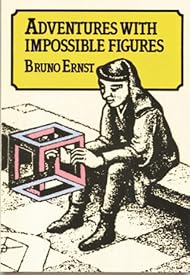
Adventures with Impossible Figures


Bruno Ernst (J.A.F de Rijk)

Tarquin | 1986 | 96 páginas | djvu | 1,9Mb

link
mediafire.com

Descrição: Describes the methods which are used to construct intriguing impossible figures which can tease the eye and baffle the imagination. Copious examples are drawn from the author's own work and the fertile imagination of Escher and Oscar Reutersvärd.

Combinatorics and Reasoning: Representing, Justifying and Building Isomorphisms


(Mathematics Education Library)
Carolyn A. Maher, Arthur B. Powell, Elizabeth B. Uptegrove

Springer | 2010 | 224 páginas |  PDF | 3,35 MB

link

Descrição: Combinatorics and Reasoning: Representing, Justifying and Building Isomorphisms is based on the accomplishments of a cohort group of learners from first grade through high school and beyond, concentrating on their work on a set of combinatorics tasks. By studying these students, the editors gain insight into the foundations of proof building, the tools and environments necessary to make connections, activities to extend and generalize combinatoric learning, and even explore implications of this learning on the undergraduate level.
This volume underscores the power of attending to basic ideas in building arguments; it shows the importance of providing opportunities for the co-construction of knowledge by groups of learners; and it demonstrates the value of careful construction of appropriate tasks. Moreover, it documents how reasoning that takes the form of proof evolves with young children and discusses the conditions for supporting student reasoning.
Conteúdos:
Introduction.- The Longitudinal Study.- Methodology.- Representations as a Tool for Building Arguments.- Building Towers: Justifications Leading to Proof Making.- Making Pizzas: Reasoning by Cases and recursion.- Responding to Ankur's Challenge: Co-construction of Argument Leading to Proof.- Co-construction of Proof.- The Case of Stephanie.- Representations and Connections.- Pizzas, Block Towers, and Binomials.- Generalizing from Pizzas, Towers, Binomial Expansion, and Pascal's Triangle.- Extending and Generalizing the Isomorphism: Towers, Pizzas, Pascal's Triangle, and the Taxicab Problem.- College Students Building Towers and Making Pizzas.- Comparing the Problem Solving of College Students with Longitudinal Study Students.- Conclusions and Suggestions for Practice.

sexta-feira, 2 de julho de 2010

A Focus on Fractions: Bringing Research to the Classroom


(Studies in Mathematical Thinking and Learning Series)

Marjorie M. Petit, Robert E. Laird, Edwin L. Marsden

Routledge | 2010 | 208 páginas | PDF | 8 Mb

link

A Focus on Fractions is the first book to make cognitive research on how students develop their understanding of fraction concepts readily accessible and understandable to pre- and in-service K– 8 mathematics educators. This important resource assists teachers in translating research findings into their classroom practice by conveying detailed information about how students develop fraction understandings as well as common student misconceptions, errors, preconceptions, and partial understandings that may interfere with students learning.  Using extensive annotated samples of student work, as well as vignettes characteristic of classroom teachers’ experiences, this book equips educators with knowledge and tools to reveal students’ thinking so that they can modify their teaching to improve student learning of fractions concepts. 


Special Features:

End of Chapter Questions provide teachers the opportunity to analyze student thinking and consider instructional strategies for their own students. Instructional Links help teachers relate concepts from the chapter to their own instructional materials and programs. Big Ideas and Research Reviews frame the chapters and provide a platform for meaningful exploration of the teaching of fractions. Answer Key posted online offers extensive explanations of in-chapter questions.

A Focus on Fractions bridges the gap between what mathematics education researchers have discovered about the learning of fraction concepts and what teachers need to know to make effective instructional decisions.

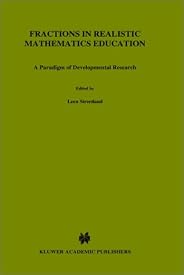
Fractions in Realistic Mathematics Education: A Paradigm of Developmental Research


(Mathematics Education Library)
Leen Streefland

Springer | 1991 | 368 páginas |  PDF | 29 MB

link

This book has a two-fold purpose. First, it was intended as a description of the development and testing of a primary school fraction program, presently in practice. This project seeks to develop a realistic alternative to the teaching and learning of fractions. The second purpose was to produce a theory on the teaching and learning of fractions that could be an example for a theory of realistic mathematics education.

The introduction gives an overview of the research and the sequential development of the course.

Chapter 1, "Description of the Fraction Problem," describes an historical background of the problem created by fractions in mathematics education.
Chapter 2, "Currents-Standpoint-Proposal," regards fractions from a variety of viewpoints from the background of the historical learning process.
Chapter 3, "The Context of the Research," offers a framework of the circumstances and conditions of the research.
Chapter 4, "The "Course in Theory and Practice", contains a general outline of the new course.
Chapter 5, "Individual Portraits of the Fraction Researchers," draws portions of the individual learning processes of those 13 students who participated throughout the entire research period.
Chapter 6, "Internal Evaluation of the Learning Process," illuminates the individual learning processes against the background of the type of instruction given.
Chapter 7, "External or Summative Evaluation", contains the research group's results on a "cross-section test" compared to a control group.
Chapter 8, "Theoretical Review", is a theoretical reflection that establishes certain links with the more general frameworks of cognitive psychology and educational psychology.