quinta-feira, 1 de julho de 2010

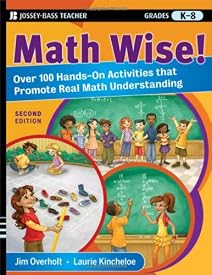
Math Wise! Over 100 Hands-On Activities that Promote Real Math Understanding, Grades K-8


(Jossey-Bass Teacher)
James L. Overholt, Laurie Kincheloe

Jossey-Bass | 2010 | 448 páginas |  PDF | 5.2 MB

link
link1

A fun, easy-to-implement collection of activities that give elementary and middle-school students a real understanding of key math concepts
Math is a difficult and abstract subject for many students, yet teachers need to make sure their students comprehend basic math concepts. This engaging activity book is a resource teachers can use to give students concrete understanding of the math behind the questions on most standardized tests, and includes information that will give students a firm grounding to work with more advanced math concepts.
  • Contains over 100 activities that address topics like number sense, geometry, computation, problem solving, and logical thinking.
  • Includes projects and activities that are correlated to National Math Education Standards
  • Activities are presented in order of difficulty and address different learning styles
Math Wise! is a key resource for teachers who want to teach their students the fundamentals that drive math problems.

Learning Through Teaching Mathematics: Development of Teachers' Knowledge and Expertise in Practice

(Mathematics Teacher Education)
Roza Leikin, Rina Zazkis

Springer | 2010 | 250 páginas | PDF | 1,59 MB

link
4shared.com

This volume explores how and when teachers' knowledge develops through teaching. The book presents international views on teachers' learning from their practice; the chapters are written by mathematicians or mathematics educators from Brazil, Canada, Israel, Mexico, UK, and USA. They address diverse content – numerical literacy, geometry, algebra, and real analysis – and a variety of levels – elementary school, secondary school, undergraduate mathematics, and teacher education courses. The authors employ different methodological tools and different theoretical perspectives as they consider teaching in different learning environments: lecturing, small group work on problems and tasks, mathematical explorations with the support of technological software, or e-learning. Despite these differences, the authors exemplify and analyze teachers’ learning that occurred and address the question: "What kinds of knowledge are developed as a result of teaching mathematics and what are the factors that support or impede such development?"Further, the chapters explore interactions and interrelationships between the enhancement of mathematical and pedagogical knowledge. The important and original contribution of this book is that it ties together the notions of teachers’ knowledge and complexity of teacher’s work, while presenting them from a relatively unexplored perspective – learning through teaching mathematics
Índice:Part I: Theoretical and Methodological Perspectives on Teachers’ Learning through Teaching
Roza Leikin and Rina Zazkis - Teachers’ opportunities to learn mathematics through teaching
John Mason - Attention and intention: Learning about teaching through teaching
Ron Tzur - What and How might mathematics teachers learn via teaching: Contributions to closing an unspoken gap
Roza Leikin - Learning through teaching though the lens of multiple solution tasks
Part II: Examples of Learning through teaching: Pedagogical mathematics
Rina Zazkis - What have I learned: Mathematical insights and pedagogical implication
Marcelo Borba and Rúbia B. A. Zulatto - Dialogical education and learning mathematics online from teachers.
Carolyn Kieran and José Guzmán - Role of task and technology in provoking teacher change: A case of proofs and proving in high school Algebra
Nick Jackiw and Nathalie Sinclair - Learning through teaching when teaching machines: Discursive interaction design in Sketchpad
Robin Marcus and Daniel Chazan - What experienced teachers have learned from helping students think about solving equations in the one-variable-first algebra curriculum
Part III: Examples of Learning through teaching: Mathematical pedagogy
Michal Yerushalmy and Shulamit Elikan - Exploring reform ideas of teaching Algebra: Analysis of videotaped episodes and conversations about them
Peter Liljedahl - On rapid professional growth: cases of learning through teaching
Lara Alcock - Interactions between teaching and research: Developing pedagogical content knowledge for Real Analysis
Helen Doerr and Stephen Lerman - Teachers learning from their teaching: The case of communicative practices
Dave Hewitt - Feedback: Expanding a repertoire and making choices


Outros livros da mesma autora, disponíveis no blog:


- Campbell. S. R., & Zazkis, R. (Eds.) (2002). Learning and teaching number theory: Research in cognition and instruction. Westport, CT: Ablex Publishing 
- Zazkis, R. & Campbell, S. R. (Eds). (2006). Number theory in mathematics education: Perspectives and prospects. Lawrence Erlbaum Press. 

- Zazkis, R. (2011). Relearning mathematics: A challenge for prospective elementary school teachers. Information Age Publishing. Charlotte, NC.

Capítulos em livros, da mesma autora, disponíveis no blog:

- Zazkis, R. & Gadowsky, K. (2001). Attending to transparent features of opaque representations of natural numbers. In A. Cuoco (Ed.), NCTM 2001 Yearbook: The roles of representation in school mathematics (pp. 41-52). Reston, VA: NCTM. 

-  Zazkis, R. (2008). Divisibility and transparency of number representations. In M. P. Carlson & C. Rasmussen (Eds.), Making the Connection: Research and practice in undergraduate mathematics (pp. 81-92). MAA notes. 

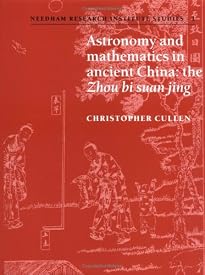
Astronomy and Mathematics in Ancient China: The 'Zhou Bi Suan Jing'


(Needham Research Institute Studies)
Christopher Cullen

Cambridge University Press | 1996 | 255 páginas |  PDF | 6,49 MB

link

This is a study and translation of the Zhou bi suan jing, a Chinese work on astronomy and mathematics that reached its final form around the first century AD. The author provides the first easily accessible introduction to the developing mathematical and observational practices of ancient Chinese astronomers and shows how the generation and validation of knowledge about the heavens in Han dynasty China related closely to developments in statecraft and politics. This book will be fascinating reading for scholars in the history of science, Chinese history, and astronomy.• First study of ancient Chinese mathematical astronomy accessible to the non-specialist • Fully annotated and lucid translation of an important Chinese astronomical text • Shows the close interplay between politics and scientific activity in ancient ChinaContentsPreface; 1. The background of the Zhou bi; 2. The Zhou bi and its contents; 3. The origins of the work; 4. The later history of the Zhou bi; Zhou bi suan jing: translation; Appendices; References and bibliography; Index.Reviews‘… Cullen provides a lucid and highly readable survey of the development of Chinese cosmography … All this and more is set forth in a jargon-free style accessible to the general reader while at the same time satisfying the demands of the specialist for comprehensive and informative references and Chinese characters.’ The Journal of Asian Studies‘The pathway for the reader is more than just academically interesting … he will find himself led through fascinating territory.’ Irish Astronomical Journal‘Christopher Cullen’s book will help immensely in enlarging our view of cultural production during the Han … [it] is a challenging and thoughtful inquiry for any reader of ancient Chinese texts.’ Andrea Eberhard, Centaurus‘… the first easily accessible introduction to the developing mathematical and observational practices of ancient Chinese astronomers … of equal interest to historians of science and those studying the history of Chinese culture.’ Europe & Astronomy

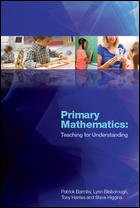
Primary Mathematics: Teaching for Understanding


Patrick Barmby, Lynn Bilsborough, Tony Harries, Steve Higgins
Open University Press | 2009 | 232 páginas | PDF | 2,61 Mb

link

"One feature of this book that sets it apart from others is the care that is taken to clarify the authors’ interpretation of the phrase 'teaching for understanding'. Each component of this interpretation – connections, representations, reasoning, communication and misconceptions – is then successfully incorporated as a theme in the subsequent chapters that develop important mathematical topics."
Ian Thompson, Visiting Professor at Edge Hill University and Northumbria University, UKThis important book aims to support and develop teachers' understanding of the key primary mathematics topics. It takes an innovative approach by defining exactly what is meant by 'understanding' and uses this model to examine and explain various mathematical topics.The authors emphasize the importance of the different representations that can be used for mathematical concepts and inform the reasoning process. By focusing on understanding, the book also draws attention to common misconceptions that teachers may encounter in the classroom.Key features:Specific focus on 'understanding' to offer new insights in to how to teach the topicsCase studies to demonstrate how to communicate mathematical topics in the classroomEnd of chapter questions to stimulate discussionThe authors integrate research and theory throughout, to highlight core issues. This theoretical background is also linked directly to classroom practice and informs suggestions for how topics can be communicated in the classroom. This offers valuable guidance to trainee teachers on how to teach the topics and presents experienced teachers with the opportunity to develop their subject and pedagogical knowledge.

Índice
ContentsList of illustrations1 Introduction2 Using numbers3 Addition and subtraction4 Multiplication and division5 Fractions6 Decimals7 Representing patterns of numbers8 Understanding shapes9 Measurement10 Data handling11 Problem solvingGlossaryReferencesIndex

Diccionario De Matematicas


(em Espanhol)

Norma S a Editorial | 2004 | 215 páginas | RAR - PDF | 123 MB

link

El Diccionario de Matemáticas de la colección “Llave de la ciencia” responde a las consultas y dudas en el estudio de esta área del conocimiento, a nivel escolar, universitario y profesional.
-Más de 1.500 conceptos definidos.
-Definiciones claras y completas.
-Explicaciones para nivel inicial y avanzado.
-Ilustraciones, diagramas y cuadros claros y completos.
-Referencias cruzadas que remiten a conceptos que aportan información adicional.
-Apéndice de símbolos, notación y fórmula

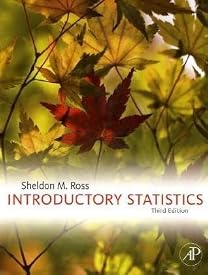
Introductory Statistics


Sheldon M. Ross

Academic Press | 2010 - 3ª edição| 848 páginas | PDF | 5,4 MB

link direto
link1

In this revised text, master expositor Sheldon Ross has produced a unique work in introductory statistics. The text's main merits are the clarity of presentation, contemporary examples and applications from diverse areas. Ross provides a clear explanation of intuition and the ideas behind the statistical methods. To quote from the preface, "It is only when a student develops a feel or intuition for statistics that she or he is really on the path toward making sense of data." Ross achieves this goal through a coherent mix of mathematical analysis, intuitive discussions and examples.
  • Unique historical perspective profiling prominent statisticians and historical events to motivate learning by providing interest and context.
  • Comprehensive ancillaries include most commonly used statistical software packages (SAS, SPSS, Minitab), ISM, SSM, and graphing calculutor manual all insures the most complete instructor support of any book
  • Use of exercises and examples helps guide the student towards indpendent learning using real issues and real data, e.g. stock price models, health issues, gender issues, sports, scientific fraud.
  • Summary/Key Terms- chapters end with detailed reviews of important concepts and formulas, key terms and definitions which are useful to students as study tools
  • Data sets from text and exercise material will be available to download from the text website, saves students time

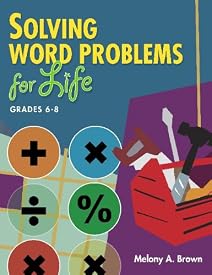
Solving Word Problems for Life, Grades 6-8


Melony A. Brown

Libraries Unlimited | 2009 | 146 páginas | PDF | 457 kb

link
link1
4shared.com

Solving Word Problems for Life, Grades 6-8 offers students who struggle with math a daily opportunity to improve their skills. The book offers 180 math word problems. The first 30 focus on 6th-grade math standards, the second 30 on 7th-grade standards, and the last 30 on 8th-grade standards. There is also a section of more difficult, extra-credit problems titled "Hard-Hat Thinking". All of the activities are designed to strengthen basic math skills and problem-solving ability. Six visual cues—a hammer for adding, a screwdriver for subtracting, gears for multiplying, a saw for dividing, a tape measure for measuring, and a level for averaging—remind the students which math process to follow and further reinforce their skills.Catering to the growing need to prepare students for gateway tests, the problems here target the areas that appear on these tests most frequently. In this era of accountability, every teacher is concerned with student achievement and adequate yearly progress. This book can help.