sábado, 8 de maio de 2010

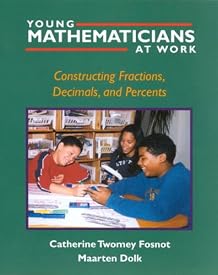
Young Mathematicians at Work, 3: Constructing Fractions, Decimals, and Percents


Catherine Twomey Fosnot, Maarten Dolk

Heinemann | 2002 | 192 páginas | pdf | 2,619 Mb

link


In our efforts to reform mathematics education, we've learned a tremendous amount about young students' strategies and the ways they construct knowledge, without fully understanding how to support such development over time. The Dutch do. So, funded by the National Science Foundation and ExxonMobil, Mathematics in the City was begun, a collaborative inservice project that pooled the best thinking from both countries. In Young Mathematicians at Work, Catherine Fosnot and Maarten Dolk reveal what they learned after several years of intensive study in numerous urban classrooms.
In this third volume in a series of three, Fosnot and Dolk focus on how children in grades 5-8 construct their knowledge of fractions, decimals, and percents. Their book:
  • describes and illustrates what it means to do and learn mathematics.
  • contrasts word problems with true problematic situations which support and enhance investigation and inquiry.
  • provides strategies to help teachers turn their classrooms into math workshops.
  • explores the cultural and historical development of fractions, decimals, and their equivalents and the ways in which children develop similar ideas and strategies.
  • defines and gives examples of modeling, noting the importance of context.
  • discusses calculation using number sense and the role of algorithms in computation instruction.
  • describes how to strengthen performance and portfolio assessment.
  • focuses on teachers as learners by encouraging them to see themselves as mathematicians.

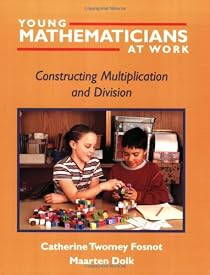
Young Mathematicians at Work, 2: Constructing Multiplication and Division


Catherine Twomey Fosnot, Maarten Dolk

Heinemann | 2001 | 192 páginas | pdf | 3,6 Mb

link
link1

In this second volume in a series of three, Fosnot and Dolk focus on how to develop an understanding of multiplication and division in grades 3-5.

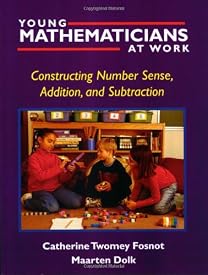
Young Mathematicians at Work, 1: Constructing Number Sense, Addition, and Subtraction


Catherine Twomey Fosnot, Maarten Dolk

Heinemann | 2001 | 224 páginas | PDF | 3 Mb

lib.freescienceengineering.org

In our efforts to reform mathematics education, we've learned a tremendous amount about young students' strategies and the ways they construct knowledge, without fully understanding how to support such development over time. The Dutch do. So, funded by the NSF and Exxon, Mathematics in the City was begun, a collaborative inservice project that pooled the best thinking from both countries. In Young Mathematicians at Work, Catherine Fosnot and Maarten Dolk reveal what they learned after several years of intensive study in numerous urban classrooms.
The first in a three-volume set, Young Mathematicians at Work focuses on young children between the ages of four and eight as they construct a deep understanding of number and the operations of addition and subtraction. Rather than offer unrelated activities, Fosnot and Dolk provide a concerted, unified description of development, with a focus on big ideas, progressive strategies, and emerging models. Drawing from the work of the Dutch mathematician Hans Freudenthal, they define mathematics as "mathematizing"—the activity of structuring, modeling, and interpreting one's "lived world" mathematically. And they describe teachers who use rich problematic situations to promote inquiry, problem solving, and construction, and children who raise and pursue their own mathematical ideas.
In contrast to other books on math reform, Young Mathematicians at Work provides a new look at the teaching of computation. It moves beyond the current debate about algorithms to argue for deep number sense and the development of a repertoire of strategies based on landmark numbers and operations. Sample minilessons on the use of the open number line model are provided to show you how to support the development of efficient computation.


Contents:

1. "Mathematics" or "Mathematizing"?
2. The Landscape of Learning
3. Number Sense on the Horizon
4. Place Value on the Horizon
5. Developing Mathematical Models
6. Addition and Subtraction Facts on the Horizon
7. Algorithms Versus Number Sense
8. Developing Efficient Computation with Minilessons
9. Assessment
10. Teachers as Mathematicians

quinta-feira, 6 de maio de 2010

Teaching and Learning Mathematical Problem Solving


Edward A. Silver (Editor)

Lawrence Erlbaum | 1984 | 469 páginas | rar - pdf  | 32,8 Mb


link (password: matav)

A provocative collection of papers containing comprehensive reviews of previous research, teaching techniques, and pointers for direction of future study. Provides both a comprehensive assessment of the latest research on mathematical problem solving, with special emphasis on its teaching, and an attempt to increase communication across the active disciplines in this area.

Contents
Part A. Problem-Solving Research: Mathematics Education Perspectives
A Retrospective Account of the Past Twenty-five Years of Research on
Teaching Mathematical Problem Solving
Jeremy Kilpatrick. . 1
Learning to Add and Subtract: An Exercise in Problem Solving
Thomas P. Carpenter .. 17
Methodological Considerations in Research on Mathematical Problem-Solving
Instruction
Frank K. Lester, Jr. .. 41
Mathematical Problem Solving: Lessons from the British Experience
Nicholas A. Branca .. 71
Part B. Problem-Solving Research: Cross-Discipline Perspectives
Implications for Mathematics Instruction of Research on Scientific Problem Solving
Joan I. Heller and Hamet N. Hungate . . 83
Thinking Scientifically and Thinking Mathematically: A Discussion of the Paper by Heller and Hungate
Gerald A. Goldin .. 113
Implications of Cognitive Psychology for Instruction in Mathematical Problem Solving
Richard E. Mayer. . 123
Cognitive Psychology and Mathematical Problem Solving: A Discussion of Mayer's Paper
La", K. Sowder. . 139
Artificial Intelligence and the Learning of Mathematics: A Tutorial Sampling
Edwina L. Rissland .. 147
Artificial Intelligence and Mathematics Education: A Discussion of Rissland's Paper
Alan H. Schoenfeld . . 177
Experience, Problem Solving, and Learning Mathematics: Considerations in Developing Mathematics Curricula
Patrick W. Thompson.. 1189
Cognitive Theory and Curriculum Design: A Discussion of Thompson's Paper
James G. Greeno . . 237
Part C. Problem-Solving Research: Themes and Directions
Research on Teaching Mathematical Problem Solving: Some Underrepresented Themes and Needed Directions
Edward A. Silver. .. 247
Affective Issues in Research on Teaching Mathematical Problem Solving
Douglas B. McLeod . . 267
Teacher's Conceptions of Mathematics and the Teaching of Problem Solving
Alba G. Thompson . . 281
The Teacher and Classroom Instruction: Neglected Themes in Problem-Solving Research
Douglas A. Grouws .. 295
Conceptual Analyses of Problem-Solving Performance
Richard A. Lesh. . 309
Individual Differences and Mathematical Problem Solving
Judith Threadgill-Sowder .. 331
Small Groups as a Setting for Research on Mathematical Problem Solving
Nel Noddings .. 345
Metacognitive and Epistemological Issues in Mathematical Understanding
Alan H. Schoenfeld .. 361
Representation and Problem Solving: Methodological Issues Related to
Modeling
James J. Kaput ... 381
Problem-Solving Derailers: The Influence of Misconceptions on Problem-
Solving Performance
J. Michael Shaughnessy . 399
Computers in Research on Mathematical Problem Solving
Patnek W. Thompson... 417
Summary
On Teaching Problem Solving and Solving the Problems of Teaching
Lee S. Shulman... 439


domingo, 2 de maio de 2010

Theories of Mathematical Learning


Leslie P. Steffe, Pearla Nesher, Paul Cobb, Gerard A. Goldin, Brian Greer

Routledge | 1996 | 544 páginas | rar - PDF | 33 Mb

link
password: matav

Descrição: Chemists, working with only mortars and pestles, could not get very far unless they had mathematical models to explain what was happening "inside" of their elements of experience -- an example of what could be termed mathematical learning.

This volume contains the proceedings of Work Group 4: Theories of Mathematics, a subgroup of the Seventh International Congress on Mathematical Education held at Université Laval in Québec. Bringing together multiple perspectives on mathematical thinking, this volume presents elaborations on principles reflecting the progress made in the field over the past 20 years and represents starting points for understanding mathematical learning today. This volume will be of importance to educational researchers, math educators, graduate students of mathematical learning, and anyone interested in the enterprise of improving mathematical learning worldwide.

Contents:
Preface. 
Part I: P. Cobb, Sociological and Anthropological Perspectives on Mathematics Learning. P. Cobb, B. Jaworski, N. Presmeg, Emergent and Sociocultural Views of Mathematical Activity. J. Voigt, Negotiation of Mathematical Meaning in Classroom Processes: Social Interaction and Learning Mathematics. G.B. Saxe, T. Bermudez, Emergent Mathematical Environments in Children's Games. J. Richards, Negotiating the Negotiation of Meaning: Comments on Voigt (1992) and Saxe and Bermudez (1992). A.D. Schliemann, D.W. Carraher, Negotiationg Mathematical Meanings In and Out of School. E. Yackel, Social Interaction and Individual Cognition. B. van Oers, Learning Mathematics as a Meaningful Activity. E.A. Forman, Learning Mathematics as Participation in Classroom Practice: Implications of Sociocultural Theory for Educational Reform. K. Crawford, Cultural Processes and Learning: Expectations, Actions, and Outcomes. J.W. Stigler, C. Fernandez, M. Yoshida,Traditions of School Mathematics in Japanese and American Elementary Classrooms. Part II: B. Greer, Cognitive Science Theories and Their Contributions to the Learning of Mathematics.B. Greer, Theories of Mathematics Education: The Role of Cognitive Analyses. G. Hatano, A Conception of Knowledge Acquisition and Its Implications for Mathematics Education. G. Vergnaud, The Theory of Conceptual Fields. D.W. Carraher, Learning About Fractions. P.W. Thompson, Imagery and the Development of Mathematical Reasoning. R.B. Davis, Cognition, Mathematics, and Education. Part III: G.A. Goldin, The Contribution of Constructivism to the Learning of Mathematics. G.A. Goldin, Theory of Mathematics Education: The Contributions of Constructivism. E. von Glasersfeld, Aspects of Radical Constructivism and Its Educational Recommendations. F. Marton, D. Neuman, Phenomenography and Children's Experience of Division. P. Ernest, Varieties of Constructivism: A Framework for Comparison. N. Herscovics,The Construction of Conceptual Schemes in Mathematics. G. Booker, Constructing Mathematical Conventions Formed by the Abstraction and Generalization of Earlier Ideas: The Development of Initial Fraction Ideas. G.A. Goldin, J.J. Kaput, A Joint Perspective on the Idea of Representation in Learning and Doing Mathematics. C.A. Maher, A.M. Martino, Young Children Invent Methods of Proof: The Gang of Four. C. Janvier, Constructivism and Its Consequences for Training Teachers. Part IV: Perspectives on the Nature of Mathematical Learning. W. Dörfler, Is the Metaphor of Mental Object Appropriate for a Theory of Learning Mathematics? L.P. Steffe, H.G. Wiegel, On the Nature of a Model of Mathematical Learning.


Math Through the Ages: A Gentle History for Teachers and Others


William P. Berlinghoff, Fernando Q. Gouvêa

The Mathematical Association of America | 2003 | 208 páginas | pdf | 7,519 Mb

link
link1
scribd.com


Where did math come from? Who thought up all those algebra symbols, and why? What's the story behind ...negative numbers? ...the metric system? ...quadratic equations? ...sine and cosine? The 25 independent sketches in "Math through the Ages" answer these questions and many others in an informal, easygoing style that's accessible to teachers, students, and anyone who is curious about the history of mathematical ideas. Each sketch contains Questions and Projects to help you learn more about its topic and to see how its main ideas fit into the bigger picture of history.
It is ideal for a broad spectrum of audiences, including students in math history courses in the late high school or early college level, pre-service or in-service teachers and casual readers who just want to know a little more about the origins of mathematics.
The 25 short stories are preceded by a 56-page bird's-eye overview of the entire panorama of mathematical history, a whirlwind tour of the most important people, events, and trends that shaped the mathematics we know today. ``What to Read Next'' and reading suggestions after each sketch provide starting points for readers who want to pursue a topic further.


Topics covered in the sketches

1. writing whole numbers
2. wherethe symbols of arithmetic came from
3. the story of zero
4. writing fractions
5. negative numbers
6. metric measurement
7. the story of pi
8. writing algebra with symbols
9. solving first degree equations
10. quadratic equations
11. solving cubic equations
12. the pythagorean theorem
13. Fermat's last theorem
14. Euclid's plane geometry
15. the platonic solids
16. coordinate geometry
17. complex numbers
18. sine and cosine
19. the non-euclidean geometries
20. projective geometry
21. the start of probability theory
22. statistics becomes a science
23. electronic computers
24. logic and boolean algebra
25. infinity and the theory of sets

Mathematics in the Time of the Pharaohs


Richard J. Gillings

Dover Publications | 1982 | 286 páginas | pdf | 6,6 Mb


Descrição: In this carefully researched study, the author examines Egyptian mathematics, demonstrating that although operations were limited in number, they were remarkably adaptable to a great many applications—solution of problems in direct and inverse proportion, linear equations of the first degree, and arithmetical and geometrical progressions.