quinta-feira, 21 de janeiro de 2010

Modeling Students' Mathematical Modeling Competencies: ICTMA 13


Richard Lesh, Peter L. Galbraith, Christopher R. Haines, Andrew Hurford

Springer | 2009 | 662 páginas | pdf | 21,42 Mb


Descrição: As we enter the 21st century, there is an urgent need for new approaches to mathematics education emphasizing its relevance in young learners’ futures. Modeling Students’ Mathematical Modeling Competencies explores the vital trend toward using real-world problems as a basis for teaching mathematics skills, competencies, and applications. Blending theoretical constructs and practical considerations, the book presents papers from the latest conference of the ICTMA, beginning with the basics (Why are models necessary? Where can we find them?) and moving through intricate concepts of how students perceive math, how instructors teach—and how both can become better learners. Dispatches as varied as classroom case studies, analyses of math in engineering work, and an in-depth review of modeling-based curricula in the Netherlands illustrate modeling activities on the job, methods of overcoming math resistance, and the movement toward replicable models and lifelong engagement.A sampling of topics covered:How students recognize the usefulness of mathematicsCreating the modeling-oriented classroomAssessing and evaluating students’ modeling capabilitiesThe relationship between modeling and problem-solvingInstructor methods for developing their own models of modelingNew technologies for modeling in the classroom Modeling Students’ Mathematical Modeling Competencies offers welcome clarity and focus to the international research and professional community in mathematics, science, and engineering education, as well as those involved in the sciences of teaching and learning these subjects.

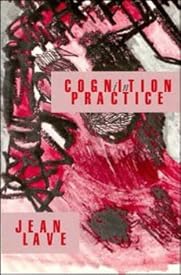
Cognition in Practice: Mind, Mathematics and Culture in Everyday Life


(Learning in Doing)
Jean Lave

Cambridge University Press | 1988 | 229 páginas | djvu | 1,1 Mb

link
uploading.com

pdf - link

Descrição: In this innovative study, Jean Lave moves the analysis of one particular form of cognitive activity--arithmetic problem-solving--out of the laboratory and into the domain of everyday life. In so doing, she shows how mathematics in the "real world", such as that entailed in grocery shopping or dieting, is, like all thinking, shaped by the dynamic encounter between the culturally-endowed mind and its total context, a subtle interaction that shapes both the human subject and the world within which it acts.

terça-feira, 19 de janeiro de 2010

Contemporary Issues in Mathematics Education: Proceedings of a Conference


Estela A. Gavosto, Steven G. Krantz, William McCallum

Cambridge University Press | 1999 | 192 páginas

on-line: library.msri.org (em capítulos)

PDF | 3 Mb

link
link1

Descrição: During the past decade, mathematics education has changed rapidly, giving rise to a polarization of opinions among the community of research mathematicians. What is the appropriate balance among theory, technique, and applications? What is the role of technology? How do we fulfill the needs of students entering other fields? The purpose of this volume, the proceedings of a conference held at the Mathematical Sciences Research Institute in Berkeley in 1996, is to present a serious discussion of these educational issues, with a balanced representation of opposing ideas. Part I deals with general issues in university mathematics education; Part II presents case studies on particular projects; Part III presents a range of opinions on mathematics education in elementary and secondary schools; and Part IV presents the reports of the working groups.


Table of Contents

Preface
Keynote address: mathematicians as educators Hyman Bass
Part I. Mathematics Education at the University: 1. On the education of mathematics majors Hung-Hsi Wu
2. The mathematics major at research universities Peter G. Hinman and B. Alan Taylor
3. On the role of proof in calculus courses Thomas W. Tucker
Part II. Case Studies in Mathematics Education: 4. If I could talk to the animals Dorothy Wallace
5. The research mathematician as storyteller William Yslas Vélez and Joseph C. Watkins
6. Redesigning the calculus sequence at a research university: issues, implementation, and objectives Harvey B. Keynes, Andrea Olson, Douglas Shaw and Frederick J. Wicklin
7. Is the mathematics we do the mathematics we teach? Jerry Uhl and William Davis
8. Japan: a different model of mathematics education Thomas W. Judson
Part III. The Debate over School Mathematics Education: 9. Reflections on teacher education Anneli Lax
10. The third mathematics education revolution Richard Askey
11. Instructional materials for K-8 mathematics classrooms: the California adoption, 1997 Bill Jacob
12. Beyond the math wars Judith Roitman
Afterword William G. McCallum
Part IV. Reports from the Working Groups: 13. How the working groups worked
14. The renewal of teaching in research departments Harvey Keynes, Al Taylor, Richard Falk, Leon Henkin, Lars-Ake Lindahl, Richard Montgomery, Dan Shapiro, Donald St. Mary, Donald Martin and Susan Montgomery
15. The use of technology in the teaching of mathematics Peter Alfeld, Kirby Baker, Angela Cheer, Estela Gavosto, Ben Halperin, Tom Judson, Abel Klein, Gerardo Lafferriere, Charles Lamb, John Orr and Bob Welland
16. Different teaching methods Greg Baker, David Epstein, Ted Gamelin, Sid Graham, Ole Hald, Delphine Hwang, Suzanne Lewis, Randy McCarthy, Brad Shelton, John Sims and Robert Underwood
17. The first two years of university mathematics Joseph Ball, Christopher Grant, Peter Lax, Robert Megginson, Kenneth Millett, Wayne Raskind, Thomas Tucker, Joseph Watkins and Hung-Hsi Wu
18. The mathematics major Jorgen Andersen, John Brothers, Ralph Cohen, Stephen Fisher, Andrew Gleason, James Lin, Lea Murphy, Richard Montgomery, Y. S. Poon, Ken Ross and Anthony Tromba
19. The education of non-mathematics majors Adeniran Adeboye, Stephen Greenfield, Jean Larson, Ashley Reiter and Dorothy Wallace
20. Outreach to other departments Chris Anderson, Barbara Bath, Marjorie Enneking, Terry Herdman and Paul M. Weichsel
21. Outreach to high schools Gunnar Carlsson, Phil Curtis, Dan Fendel, Neal Koblitz, Anneli Lax, Judith Roitman, Tom Sallee, Martin Scharlemann, Alina Stancu, Abigail Thompson, David Wright and William Yslas Vélez
22. Research mathematicians and research in mathematics education Hyman Bass, Kenneth Bogart, Michael Fried, Cathy Kessell, Alfred Manaster, Steve Monk and Blake Peterson
23. Afterword William G. McCallum
Appendix: internet resources in mathematics education.
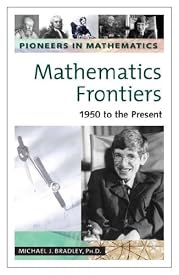
Mathematics Frontiers: 1950 to the Present


(Pioneers in Mathematics)
Michael J. Bradley

Facts on File | 2006 | 128 páginas |  pdf | 2 Mb

link direto
link
link1
scribd.com

Descrição: Tracing the development of mathematics from a biographical standpoint, "Mathematics Frontiers: 1950 to the Present" profiles innovators from the second half of the 20th century who made significant discoveries in both pure and applied mathematics. From John H. Conway, who helped complete the classification of all finite groups (and invented "The Game of Life" board game), to Stephen Hawking, who established the mathematical basis for black holes, to Fan Chung, who developed an encoding and decoding algorithm for cell phone calls, this lively survey of contemporary minds behind the math is ideal for middle and high school students seeking resources for research or general interest.

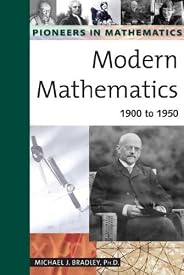
Modern Mathematics: 1900 to 1950


(Pioneers in Mathematics)
Michael J. Bradley

Facts on File | 2006 | 176 páginas | pdf | 2 Mb

link direto
link
link1

Descrição: During the first half of the 20th century, mathematics became an international discipline that led to major advances in science and technology. "Modern Mathematics: 1900 to 1950" provides an eye-opening introduction to those five historic decades by analyzing the advancement of the field through the accomplishments of 10 significant mathematicians. From David Hilbert and Emmy Noether, who introduced the infinite dimensional vector spaces and algebraic rings that bear their names, to Norbert Wiener, the founder of cybernetics, this in-depth volume is an excellent choice for libraries aiming to provide a range of resources covering the history of mathematics.

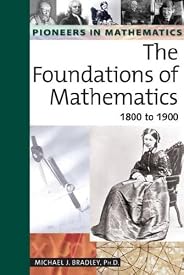
Foundations of Mathematics: 1800 to 1900


(Pioneers in Mathematics)
Michael J. Bradley

Facts on File | 2006 | 176 páginas |  pdf | 2 Mb

link direto
link
link1

Descrição:
During the 16th and 17th centuries, mathematicians developed a wealth of new ideas but had not carefully employed accurate definitions, proofs, or procedures to document and implement them. However, in the early 19th century, mathematicians began to recognize the need to precisely define their terms, to logically prove even obvious principles, and to use rigorous methods of manipulation. "The Foundations of Mathematics" presents the lives and accomplishments of 10 mathematicians who lived between CE 1800 and 1900 and contributed to one or more of the four major initiatives that characterized the rapid growth of mathematics during the 19th century: the introduction of rigor, the investigation of the structure of mathematical systems, the development of new branches of mathematics, and the spread of mathematical activity throughout Europe. This readable new volume communicates the importance and impact of the work of the pioneers who redefined this area of study.

The Age of Genius: 1300 to 1800


(Pioneers in Mathematics)
Michael J. Bradley

Facts on File | 2006 | 176 páginas |  pdf | 4 Mb

link direto
link
link1

Descrição: Although mathematical innovation stagnated in Europe after the fall of the Roman Empire, scholars in southern Asia and the Middle East continued to preserve the mathematical writings of the Greeks and contributed new ideas to arithmetic, algebra, geometry, and trigonometry, as well as astronomy and physics. The five centuries from CE 1300 to 1800 marked the end of a rich period of cultural, mathematical, and scientific advancements in China, India, and Arabic countries, while witnessing new intellectual life in Europe and the Western Hemisphere. The Age of Genius acquaints middle and high school students with the lives and contributions of 10 intriguing but perhaps lesser-known mathematical pioneers of this time. Included here, for example, is a portrait of 14th-century Iranian mathematician Ghiyāth al-Dīn Jamshīd Mas'ūd al-Kāshī, who developed and improved methods for approximating numerical values, and introduced geometrical methods for determining areas and volumes of architectural domes, arches, and vaults.