sexta-feira, 21 de agosto de 2009

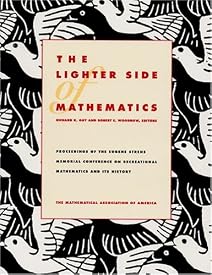
The Lighter Side of Mathematics - Proceedings of the Eugène Strens Memorial Conference on Recreational Mathematics and its History

(Spectrum)
Richard K. Guy, Robert E. Woodrow

The Mathematical Association of America | 1996 | 375 páginas | djvu | 15 Mb

link
link1
link2


Descrição: Recreational mathematics is thriving at the University of Calgar. Some would say that it is a hotbed for recreational mathematics, for it is the home of the Strens Collection of recreational mathematics materials. The Strens Collection is the most complete library of recreational mathematics in the world. In August of 1986, a special conference on recreational mathematics was held at the University of Calgary to celebrate the founding of the Strens Collection. Leading practitioners of recreational mathematics from around the world gathered in Calgary to share with each other the joy and spirit of play that is to be found in recreational mathematics. the papers in this volume, the proceedings of that conference, represent a veritable treasure trove of recreational mathematics by a star-studded cast: Leon Bankoff, Elwyn Berlekamp, H.S.M Coxeter, Ken Falconer, Branko Grunbaum, Richard Guy, Doris Schattssschneider, David Singmaster, Athelstan Spilhaus, Stan Wagon and many others. You will not soon find another collection of wonderful articles on recreational mathematics by a more distinguished group of authors. If you are interested in tessellations, Escher, tiling, Rubik's cube, pentominoes, games, puzzles, the arbelos, Henry Dudeney, or change ringing, then this book is a must for you. If you believe that recreational mathematics must be mathematics that is fun, then look no further, for The Lighter Side of Mathematics is full of fun.

domingo, 9 de agosto de 2009

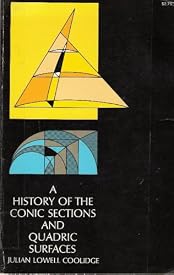
A History of the Conic Sections and Quadric Surfaces


Julian Lowell Coolidge

Dover | 1968 | 214 páginas | Djvu | 2,6 Mb

link
link1

Despite the wealth of the literature extant dealing with the conic sections, and the large amount of easily accessible material concerning the quadric surfaces, the extensive synopsis presented in this study by a distinguished geometer must be regarded as an altogether worth· while endeavor. The connected account which the author gives of these loci, from the discovery of the conics by Mcnaechmus (pupil of Plato and Eudoxus) to the differential properties of quadric surfaces, makes this a book which both amateur and professional mathematicians will consult with pleasure and profit. The copious quotations from early writers which the book contains are interlarded with sprightly observations. Though the animated style employed is perhaps unusual in a serious historical study, it undoubtedly stimul lates reader interest.
The first two chapters are devoted to the work of the Greeks. In the twelve hundred years from the time of Pappus to the beginning of the sixteenth century, there was apparently a complete loss of interest in the subject. The third chapter takes up the history with the re-awakening of interest evidenced by the work of Vlerner, Desargues, Pascal, and so on, and carries the account down to the great projective school, which is the subject of Chapter IV. Chapters V, VI, and VII deal with miscellaneous metrical theorems, systems of conics, and conics in space, respectively. They are followed by a chapter of six pages, concerning mechanical construction of conics, which completes the treatment of the conic sections.
The remaining fifty-five pages of the book are devoted to the quadric surfaces. The work is divided into four chapters, dealing with the synthetic, algebraic, higher algebraic, and differential methods.
The book is concluded with an excellent list of papers and books quoted in the text and an adequate subject index.
LEONARD M. BLUMENTHAL

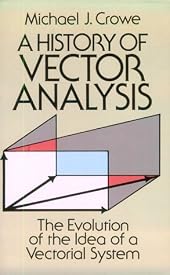
A History of Vector Analysis


Michael J. Crowe

Dover | 1985 | 270 páginas | pdf | 2 Mb

link
This prize-winning study traces the rise of the vector concept from the discovery of complex numbers through the systems of hypercomplex numbers created by Hamilton and Grassmann to the final acceptance around 1910 of the modern system of vector analysis. Concentrates on vector addition and subtraction, the forms of vector multiplication, and more.

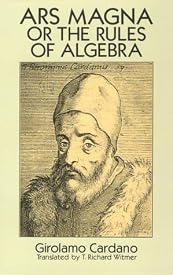
Ars Magna or the Rules of Algebra


T. Richard Witmer

Dover Publications | 1993 | 267 páginas | djvu | 2,32 Mb

link
link1

Descrição: First published in 1545, this is one of the cornerstone books in the history of mathematics. In it the author revealed for the first time the principles for solving cubic and biquadratic equations along with much other important mathematical information. Long unavailable, except in rare Latin editions, it is now widely available in this excellent affordable English translation by T. Richard Witmer.
The Ars Magna (Latin: "The Great Art") is an important book on Algebra written by Gerolamo Cardano. It was first published in 1545 under the title Artis Magnæ, Sive de Regulis Algebraicis Liber Unus (Book number one about The Great Art, or The Rules of Algebra). There was a second edition in Cardano's lifetime, published in 1570. It is considered one of the three greatest scientific treatises of the early Renaissance, together with Copernicus' De revolutionibus orbium coelestium and Vesalius' De humani corporis fabrica. It is interesting to note that the first editions of these three books were published within a two year span (1543–1545).

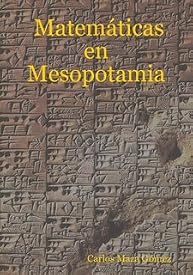
Matemáticas en Mesopotamia


Carlos Maza Gómez

Carlos Maza Gómez | 2007 | pdf | 6 Mb

uploading.com
scribd.com

Mesopotamia fue la primera civilización en dejar fuentes escritas de sus conocimientos y creencias. Entre los primeros las Matemáticas ocupan un lugar fundamental en su relación con la escritura cuneiforme y la resolución de problemas económicos y sociales de la naciente cultura.

Se presenta en este libro una revisión amplia de la investigación sobre lo que se sabe actualmente de los conocimientos de los escribas mesopotámicos en el terreno de las Matemáticas.

Contenido:
* Introducción
* Marcos geográfico e histórico
* Marco social
* Marco económico
* Contabilidad y numeración
* Comercio y aritmética
* Campos y figuras rectilíneas
* Las figuras circulares
* Reparto de herencias
* Ecuaciones de primer grado
* Ecuación cuadrática
* Plimpton 322
* Volúmenes
* Excavaciones
* Construcciones en ladrillo
* Bibliografía

sexta-feira, 7 de agosto de 2009

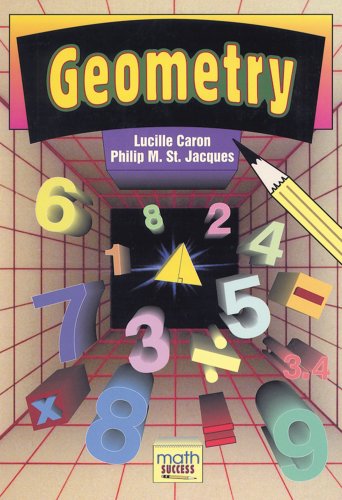
Geometry

(Math Success)
Lucille Caron, Philip M. St. Jacques

Enslow Publishers | 2001 | 64 páginas | pdf | 3,1 Mb

link
link1

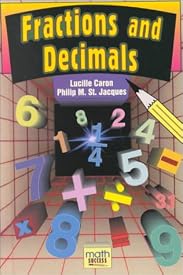
Fractions and Decimals


(Math Success)
Lucille Caron, Philip M. St. Jacques

Enslow Publishers | 2000 | 64 páginas | pdf | 5 Mb

link
link1

Grade 4-8-These books provide simple explanations with examples of the basic mathematical concepts identified in each title. Chapters are subdivided into sections with bold headings; a one-inch gray band with text devoted to a mathematical definition, explanation, or suggestion appears on the bottom of each page. Examples and problems set off in rectangular boxes resembling spiral notebooks provide visual interest. The authors do a good job of explaining each topic and of giving detailed, grade-appropriate examples. Excellent refresher courses for students who need additional practice.