sábado, 25 de julho de 2009

Handbook of Research on the Psychology of Mathematics Education Past, Present and Future


Angel Gutiérrez e Paolo Boero (editores)

Sense Publishers | 2006 | 536 páginas | PDF | 3,5 Mb

4shared.com
link

Alguns capítulos disponíveis

Capítulos
Foreword

Rina Hershkowitz e Chris Breen

Introduction

Angel Gutiérrez e Paolo Boero

Cognitive Aspects of Learning and Teaching Content Areas
Research on the Learning and Teaching of Algebra

Carolyn Kieran

Numerical Thinking
Lieven Verschaffel, Brian Greer, e Joke Torbeyns

The Complexity of Learning Geometry and Measurement
Kay Owens e Lynne Outhred

Cognitive Aspects of Learning and Teaching Transversal Areas
Research on Children’s Early Mathematical Development

Joanne Mulligan e Gerard Vergnaud
(pp. 117 - 146) - on-line: crimse.mq.edu.au

Advanced Mathematical Thinking
Guershon Harel, Annie Selden, e John Selden

Proof and Proving in Mathematics Education
Maria Alessandra Mariotti

Research on Visualization in Learning and Teaching Mathematics
Norma Presmeg
(pp. 205 - 234) - on-line: kaputcenter.umassd.edu (versão anterior do texto, mas praticamente igual)

Cognitive Aspects of Learning and Teaching with Technology

The Role and Uses of Technologies for the Teaching of Algebra and Calculus

Francesca Ferrara, Dave Pratt, e Ornella Robutti

Teaching and Learning Geometry with Technology
Colette Laborde, Chronis Kynigos, Karen Hollebrands, e Rudolf Strässer
(pp. 275 - 304)

Social Aspects of Learning and Teaching Mathematics

A Thirty-Year Reflection on Constructivism in Mathematics Education in PME
Jere Confrey e Sibel Kazak

Socio-Cultural Research in PME
Stephen Lerman

The Place of Equity and Social Justice in the History of PME
Peter Gates

Affect and Mathematics Education
Gilah C. Leder e Helen J. Forgasz

Professional Aspects of Teaching Mathematics

Mathematics (Student) Teachers and Teacher Educators as Learners
Salvador Llinares e Konrad Krainer

Mathematics Teachers’ Knowledge and Practices
João Pedro da Ponte e Olive Chapman


Authors Index
Terms Index

sexta-feira, 24 de julho de 2009

The Foundations of Arithmetic: A Logico-Mathematical Enquiry into the Concept of Number


2.ª Edição
Gottlob Frege (traduzido por J.L. Austin)

Harper & Brothers; Harper Torchbooks | 1960 | 119 páginas | pdf | 5,5 Mb

link
link1
naturalthinker.net (link direto)
scribd.com

This volume represents the first philosophically sound discussion of the concept of number in Western civilization. (Mathematics)

Perspectives on Mathematics Education


H. Christiansen, A. G. Howson, M. Otte (Editores)

Springer-Verlag New York | 1985 | 388 páginas | pdf | 21 Mb

link

Textos:

-->
Social norms and external evaluation (pp. 1-48)
A. G. Howson e S. Mellin-Oslen
Mathematics as a School Subject (pp. 49 -97)
W. Dörfler e R. R. McLone
Teachers Cognitive Activities (pp. 99 - 139)
R. Brommer e J. Brophy
Textual Analysis (pp. 141 - 172)
J. Van Dormolen
What Is a Text? (pp. 173 - 204)
M. Otte
Observing Students at Work (pp. 205 -241)
G. Brousseau, R. B. Davis e T. Werner
Task and Activity (pp. 243 - 307)
B. Christiansen e G. Walther
(tradução em português - on-line: educ.fc.ul.pt)
Classroom Organisation and Dynamics (pp. 309 - 366)
A. J. Bishop e F. Groffree
Index 367

Revue d’Histoire des Mathématiques 14

fascicule 1 (2008)
On-line: smf.emath.fr


Fermat’s method of quadrature
Jaume Paradís, Josep Pla, Pelegrí Viader
Résumé et texte intégral
La valeur de la connaissance approchée L’épistémologie de l’approximation d’Émile Bore
Anouk Barberousse l Résumé et texte intégral
Gödel et la thèse de Turing
Pierre Cassou-Noguès
Résumé et texte intégral
NOTES & DÉBATS : A note on Pérez de Moya’s Principios de Geometria (1584)
M. C
éu Silva, Antoni Malet
Résumé et texte integral
Revue d’Histoire des Mathématiques 14,
fascicule 2 (2008)
Quantifier et calculer : usages des nombres à Nippur
Christine Proust
Résumé et texte intégral
Étienne Bézout : Analyse algébrique au siècle des Lumières
Liliane Alfonsi
Résumé et texte intégral
Évariste Galois, un candidat à l'École préparatoire en 1829
Caroline Ehrhardt
Résumé et texte intégral
Outros números da mesma revista estão disponíveis em: smf.emath.fr

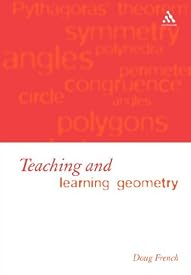
Teaching and Learning Geometry: Issues And Methods In Mathematical Education


Doug French

Continuum | 2005 | 169 páginas | rar - PDF | 8 Mb

link
password: matav

lib.freescienceengineering.org

Descrição: This fascinating title reviews the teaching and learning of school geometry from the perspective of both the new teacher and the more experienced teacher. It is designed to extend and deepen subject knowledge and to offer practical advice and ideas for the classroom in the context of current practice and research. Particular emphasis is given to the following elements: Understanding the key ideas of the geometry curriculum. Learning geometry effectively: lessons from research and current practice. Misconceptions and errors. Geometry reasoning: problem solving and proving. The role of technology in learning geometry.

Contents
Preface vi
1. The Role of Geometry 1
2. Learning Geometry 12
3. Beginnings: Experimental Geometry 30
4. Polygons: Symmetry and Angle Properties 40
5. Constructions and Congruence 55
6. Perimeter, Area and Volume 65
7. Enlargement and Similarity 77
8. The Theorem of Pythagoras 91
9. The Circle 104
10. Linking Geometry and Algebra 119
11. Polyhedra 136
12. Vector Geometry 149
Bibliography 162

Index

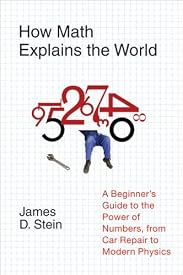
How Math Explains the World: A Guide to the Power of Numbers, from Car Repair to Modern Physics


James D. Stein

Collins | 2008 | 288 páginas | pdf | 1,13 Mb

link
link1
4shared.com

In How Math Explains the World, mathematician Stein reveals how seemingly arcane mathematical investigations and discoveries have led to bigger, more world-shaking insights into the nature of our world. In the four main sections of the book, Stein tells the stories of the mathematical thinkers who discerned some of the most fundamental aspects of our universe. From their successes and failures, delusions, and even duels, the trajectories of their innovations—and their impact on society—are traced in this fascinating narrative. Quantum mechanics, space-time, chaos theory and the workings of complex systems, and the impossibility of a "perfect" democracy are all here. Stein's book is both mind-bending and practical, as he explains the best way for a salesman to plan a trip, examines why any thought you could have is imbedded in the number π , and—perhaps most importantly—answers one of the modern world's toughest questions: why the garage can never get your car repaired on time. Friendly, entertaining, and fun, How Math Explains the World is the first book by one of California's most popular math teachers, a veteran of both "math for poets" and Princeton's Institute for Advanced Studies. And it's perfect for any reader wanting to know how math makes both science and the world tick.

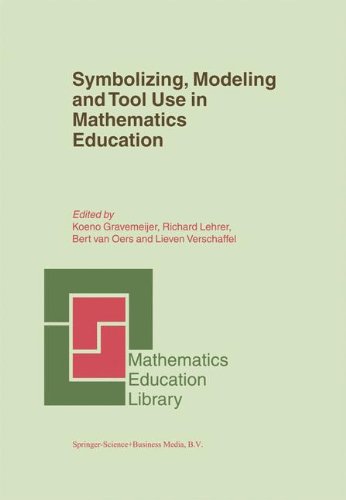
Symbolizing, Modeling and Tool Use in Mathematics Education


K. Gravemeijer, R. Lehrer, B. van Oers e L. Verschaffel (editores)

Springer | 2002 | 318 páginas | pdf | 22,6 Mb

link


Conteúdos

Table of contents
Preface
Koeno Gravemeijer, Richard Lehrer, Bert Van Oers e Lieven Verschaffel
Introduction and overview
Koeno Gravemeijer, Richard Lehrer, Bert Van Oers e Lieven Verschaffel
Preamble: from models to modeling
Koeno Gravemeijer

Section I: Emergent modeling
Introduction to section I: Informal representations and their improvements
Bert Van Oers
The mathematization of young children's language
Bert Van Oers
Symbolizing space into being
Richard Lehrer e Carrie Pritchard
Mathematical representations as systems of notations-in-use
Luciano Meira
Students' Criteria for Representational Adequacy
Andreia A. Disessa
Transitions in emergent Modeling
Norma Presmeg

Section II: The role of Models, Symbols and Tools in instructional design
Introduction to section II: The role of Models, Symbols and Tools in instructional design
Koeno Gravemeijer
Emergent models as an instructional design heuristic
Koeno Gravemeijer e Michelle Stephan
Modeling, Symbolizing, and Tool Use in Statistical Data Analysis
Paul Cobb
Didactic objects and didactic models in radical constructivism
Patrick W. Thompson
Taking into account different views: Three brief comments on papers by Gravemeijer & Stephan, Cobb and Thompson
Christoph Selter

Section III: Models, situated practices, and generalization
Introduction to section III: Models, situated practices, and generalization
Lieven Verschaffel
On Guessing the Essential Thing
Ricardo Nemirovsky
Everyday knowledge and mathematical modeling of school word problems
Lieven Verschaffel, Brian Greer e Erik de Corte
On the development of human representational competence from and evolutionary point of view: From Episodic To Virtual Culture
James Kaput e David Shaffer
Modeling Reasoning
David Carraher e Analucia Schliemann
Index