domingo, 31 de maio de 2009

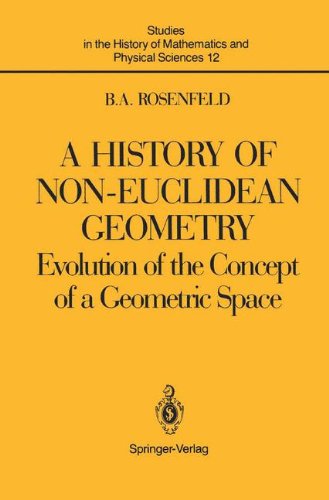
A History of Non-Euclidean Geometry

Boris A. Rosenfeld

Springer| 1988 | 488 páginas | djvu | 3,7 Mb

link direto
link
depositfiles.com


Descrição: This book is an investigation of the mathematical and philosophical factors underlying the discovery of the concept of noneuclidean geometries, and the subsequent extension of the concept of space. Chapters one through five are devoted to the evolution of the concept of space, leading up to chapter six which describes the discovery of noneuclidean geometry, and the corresponding broadening of the concept of space. The author goes on to discuss concepts such as multidimensional spaces and curvature, and transformation groups. The book ends with a chapter describing the applications of nonassociative algebras to geometry.

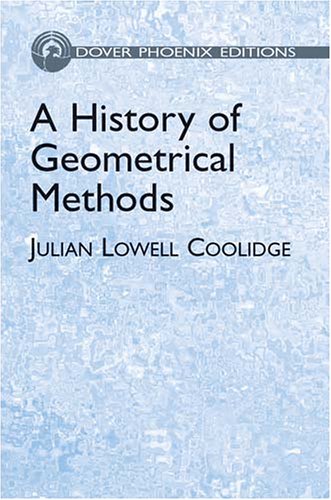
A History of Geometrical Methods

Julian Lowell Coolidge

Oxford University Press | 1940 | djvu | 8 Mb
link
link1
link2

Descrição: A History of Geometrical Methods is a full, authoritative history of the techniques for dealing with geometric equations covers development of projective geometry from ancient to modern times, explaining the original works, commenting on the correctness and directness of proofs, and showing the relationships between mathematics and other intellectual developments.

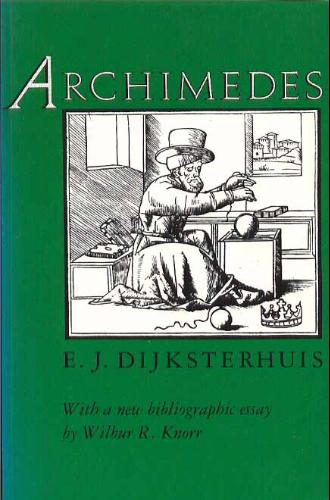
Archimedes


E. J. Dijksterhuis

Princeton University Press | 1987 | 457 páginas | Djvu | 4,28 Mb

link direto
link
link1

PDF

scribd.com

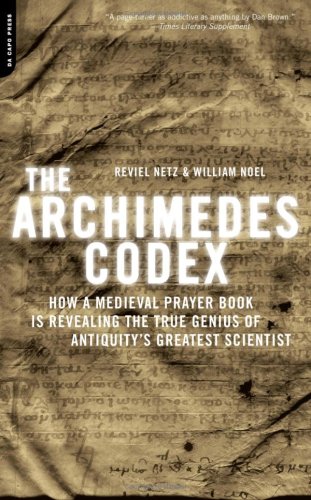
The Archimedes Codex: How a Medieval Prayer Book Is Revealing the True Genius of Antiquity's Greatest Scientist


Reviel Netz, William Noel

Da Capo Press | 2009 | 336 páginas |  pdf | 3,01 Mb

link
link1
4shared.com


Descrição:
Part archaeological detective story, part science, and part history, The Archimedes Codex tells the astonishing story of a lost manuscript, from its tenth-century creation in ancient Constantinople to the auction block at Christie’s in New York, and how a team of scholars used the latest imaging technology to reveal and decipher the original text. What they found was the earliest surviving manuscript by Archimedes (287 BC–212 BC), the greatest mathematician of antiquity—a manuscript that established, for the first time, the extent of his mathematical genius, which was two thousand years ahead of modern science.

quinta-feira, 28 de maio de 2009

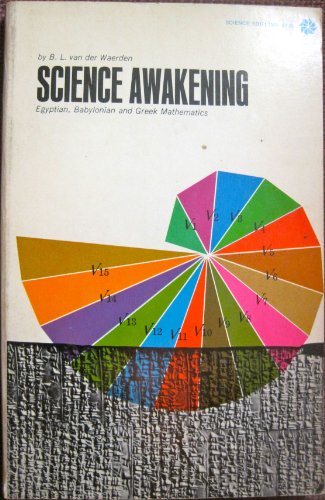
Science Awakening I: Egyptian, Babylonian and Greek Mathematics


English Translation By Arnold Dresden with Additions of the Author
B. L. Van Der Waerden

Oxford University Press | 1961 | 306 páginas | djvu | 18,2 Mb

link
link1


Why History of Mathematics?
Every one knows that we are living in a technological era. But it is not often realized that our technology is based entirely on mathematics and physics. When we ride home on the streetcar in the evening, when we turn on the electric light and the radio, everything depends on cleverly constructed physical mechanisms based on mathematical calculations. But more than that! We owe to physics not only these pleasant articles of luxury, but, to a large extent, even our daily bread. Apart from the fact that our grains come to us, chiefly by steamer from overseas, our own agriculture would be far less productive without artificial fertilizers. Such fertilizers are chemical products, and chemistry depends on physics.
But science has not brought us blessings only. The destructive armaments which mankind uses at the present time to knock its own civilization to pieces are also products to which the development of mathematics and physics have inevitably led.
Our spiritual life is also influenced by science and technology, in a measure but rarely fully understood. The unprecedented growth of natural science in the 17th century was followed ineluctably by the rationalism of the 18th, by the deification of reason and the decline of religion; an analogous development had taken place earlier, in Greek times. In a similar manner the triumphs of technology in the 19th century were followed in the 20th by the deification of technology.
Unfortunately, man seems to be overly inclined to deify whatever is powerful and successful.
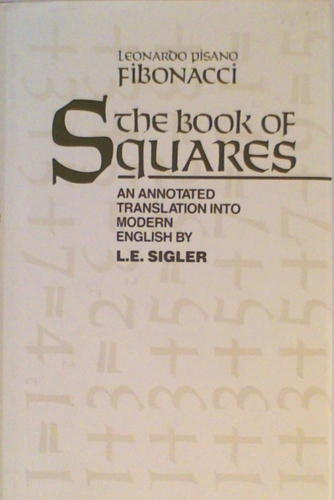
The Book of Squares


An annotated translation into modern English by L. E. Sigler
Leonardo Pisano Fibonacci

Academic Press | 1987 | 122 páginas | djvu | 1 Mb

link direto
link
link1


pdf - 8 Mb - link

Descrição: The Book of Squares by Fibonacci is a gem in the mathematical literature and one of the most important mathematical treatises written in the Middle Ages. It is a collection of theorems on indeterminate analysis and equations of second degree which yield, among other results, a solution to a problem proposed by Master John of Palermo to Leonardo at the Court of Frederick II. The book was dedicated and presented to the Emperor at Pisa in 1225. Dating back to the 13th century the book exhibits the early and continued fascination of men with our number system and the relationship among numbers with special properties such as prime numbers, squares, and odd numbers. The faithful translation into modern English and the commentary by the translator make this book accessible to professional mathematicians and amateurs who have always been intrigued by the lure of our number system.

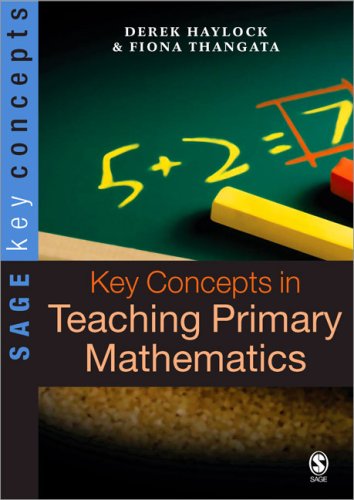
Key Concepts in Teaching Primary Mathematics


(SAGE Key Concepts series)
Derek W Haylock

Sage Publications Ltd | 2007 | 200 páginas | PDF | 1 Mb

link
4shared.com
depositfiles.com
depositfiles.com

Descrição: Covering the key principles and concepts in the teaching and learning of mathematics in elementary schools, this text provides trainee and practicing teachers with a quick and easy reference to what they need to know for their course, and in the classroom. The entries are arranged alphabetically, and each contains a brief definition, followed by an explanation and discussion, practical examples, and annotated suggestions for further reading.