segunda-feira, 4 de maio de 2009

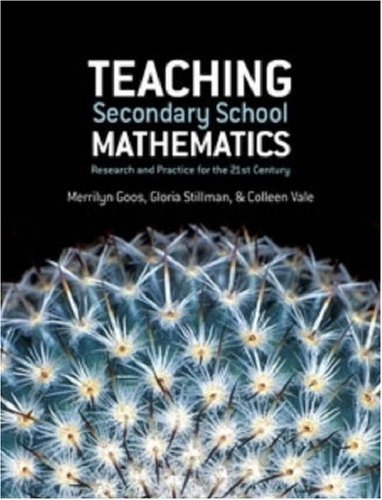
Teaching Secondary School Mathematics: Research and Practice for the 21st Century


Merrilyn Goos, Gloria Stillman, Colleen Vale

Allen & Unwin Academic | 2008 | 496 páginas |  PDF  | 6,8 Mb

link
link1

A research-based introduction to the professional knowledge, attributes, and practices needed to be an excellent instructor, this heavily illustrated resource reviews the cores of secondary mathematics. The research contained within discusses the challenges that many secondary mathematics teachers face today, and well-tested classroom examples show how teachers can build on their experiences to ensure students develop concepts and skills in mathematical thinking as well as a positive attitude toward the study. Both math and education professors and secondary school teachers will benefit from the curricula, methods of assessments, and pedagogical studies offered in this informative reference.


sábado, 2 de maio de 2009

Nuevos Acertijos de Sam Loyd

(em castelhano)
Martin Gardner

online: librosmaravillosos.com

pdf - link direto


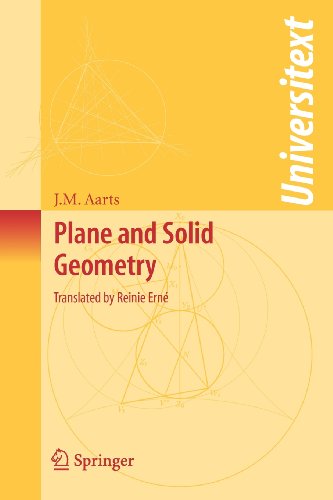
Plane and Solid Geometry


(Universitext)

 J.M. Aarts e Reinie Erne


Springer | 2008 | 349 páginas | pdf | 2 Mb

link
link1

This is a book on Euclidean geometry that covers the standard material in a completely new way, while also introducing a number of new topics that would be suitable as a junior-senior level undergraduate textbook. The author does not begin in the traditional manner with abstract geometric axioms. Instead, he assumes the real numbers, and begins his treatment by introducing such modern concepts as a metric space, vector space notation, and groups, and thus lays a rigorous basis for geometry while at the same time giving the student tools that will be useful in other courses.

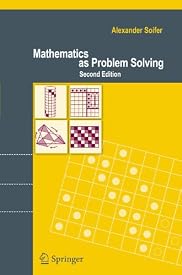
Mathematics as Problem Solving

Alexander Soifer

Springer (2.ª ed.) | 2009 | 124 páginas | pdf | 1,69 Mb

sma1pekalongan.sch.id (linkdireto)
link
link1
depositfiles.com
depositfiles.com

A brief narrative description of the journal article, document, or resource. 
This book contains about 200 problems. It is suggested that it be used by students, teachers or anyone interested in exploring mathematics. In addition to a general discussion on problem solving, there are problems concerned with number theory, algebra, geometry, and combinatorics.

Mathematics Education in the Middle Grades: Teaching to Meet the Needs of Middle Grades Learners and to Maintain High Expectations

National Research Council, National Convocation on Mathematics Education in the Middle Grades

National Academy Press | 2000 | 270 páginas | pdf | 1,7 Mb

on-line: nap.edu

link
link1


sexta-feira, 1 de maio de 2009

Handbook of international research in mathematics education


Lyn D. English (ed.)

Lawrence Erlbaum | 2002 | 848 páginas | pdf | 3,8 Mb

brolezzi.com.br (link direto)
link


CONTENTS
Preface ix
SECTION I: PRIORITIES IN INTERNATIONAL MATHEMATICS EDUCATION RESEARCH
Chapter 1 Priority Themes and Issues in International Research in Mathematics Education 3
Lyn English
Chapter 2 Democratic Access to Mathematics Through Democratic Education: An Introduction 17
Carol Malloy
Chapter 3 Research Design in Mathematics Education: Focusing on Design Experiments 27
Richard Lesh
Chapter 4 Developing New Notations for a Learnable Mathematics in the Computational Era 51
James Kaput, Richard Noss, and Celia Hoyles
SECTION II: LIFELONG DEMOCRATIC ACCESS TO POWERFUL MATHEMATICAL IDEAS
Part A: Learning and Teaching
Chapter 5 Young Children’s Access to Powerful Mathematical Ideas 81
Bob Perry and Sue Dockett
Chapter 6 Elementary Students’ Access to Powerful Mathematical Ideas 113
Graham Jones, Cynthia Langrall, Carol Thornton, and Steven Nisbet
Chapter 7 Mathematics Learning in the Junior Secondary School: Students’ Access to Significant Mathematical Ideas 143
Teresa Rojano
Chapter 8 Advanced Mathematical Thinking With a Special Reference to Reflection on Mathematical Structure 165
Joanna Mamona-Downs and Martin Downs
Chapter 9 Representation in Mathematical Learning and Problem Solving 197
Gerald Goldin
Chapter 10 Teacher Knowledge and Understanding of Students’ Mathematical Learning 219
Ruhama Even and Dina Tirosh
Chapter 11 Developing Mastery of Natural Language: Approaches to Theoretical Aspects of Mathematics 241
Paolo Boero, Nadia Douek, and Pier Luigi Ferrari
Part B: Learning Contexts and Policy Issues
Chapter 12 Access and Opportunity: The Political and Social Context of Mathematics Education 271
William Tate and Celia Rousseau
Chapter 13 Democratic Access to Powerful Mathematics in a Developing Country 301
Luis Moreno-Armella and David Block
Chapter 14 Mathematics Learning in Out-of-School Contexts: A Cultural Psychology Perspective 323
Guida de Abreu
Chapter 15 Research, Reform, and Times of Change 355
Miriam Amit and Michael Fried
Chapter 16 Democratic Access to Powerful Mathematical Ideas 383
Ole Skovsmose and Paola Valero
Chapter 17 Relationships Build Reform: Treating Classroom Research as Emergent Systems 409
James Middleton, Daiyo Sawada, Eugene Judson,
Irene Bloom, and Jeff Turley
SECTION III: ADVANCES IN RESEARCH METHODOLOGIES
Chapter 18 Research Methods in (Mathematics) Education 435
Alan Schoenfeld
Chapter 19 On The Purpose of Mathematics Education Research: Making Productive Contributions to Policy and Practice 489
Frank Lester, Jr. and Dylan Wiliam
Chapter 20 Funding Mathematics Education Research: Three Challenges, One Continuum, and a Metaphor 507
Eric Hamilton, Anthony Eamonn Kelly, and Finbarr Sloane
Chapter 21 Time(s) in the Didactics of Mathematics: A Methodological Challenge 525
Ferdinando Arzarello, Maria Bartolini Bussi, and Ornella Robutti
Chapter 22 The Problematic Relationship Between Theory and Practice 553
Nicolina Malara and Rosetta Zan
Chapter 23 Linking Researching With Teaching: Towards Synergy of Scholarly and Craft Knowledge 581
Kenneth Ruthven
Chapter 24 Linking Research and Curriculum Development 599
Douglas Clements
Chapter 25 Historical Conceptual Developments and The Teaching of Mathematics: From Philogenesis and Ontogenesis Theory to Classroom Practice 631
Fulvia Furinghetti and Luis Radford
SECTION IV: INFLUENCES OF ADVANCED TECHNOLOGIES
Chapter 26 Mathematics Curriculum Development for Computerized Environments: A Designer–Researcher–Teacher–Learner
Activity 657
Rina Hershkowitz, Tommy Dreyfus, Dani Ben-Zvi, Alex Friedlander, Nurit Hadas, Tsippora Resnick, Michal Tabach, and Baruch Schwarz
Chapter 27 The Influence of Technological Advances on Students’ Mathematics Learning 695
Maria Alessandra Mariotti
Chapter 28 Flux in School Algebra: Curricular Change, Graphing Technology, and Research on Student Learning and Teacher Knowledge 725
Michal Yerushalmy and Daniel Chazan
Chapter 29 Advanced Technology and Learning Environments: Their Relationships Within the Arithmetic Problem-Solving Domain 757
Rosa Bottino and Giampaolo Chiappini
Chapter 30 Future Issues and Directions in International Mathematics Education Research 787
Lyn English, Graham Jones, Richard Lesh, Dina Tirosh, and Maria Bartolini Bussi

quinta-feira, 30 de abril de 2009

How Students (Mis-)Understand Science and Mathematics: Intuitive Rules

(Ways of Knowing in Science, 13)
Ruth Stavy, Dina Tirosh

Teachers College Press | 2000 | 127 páginas | chm | 788 kb


link

Referência em MathEdu


In this volume, the authors identify three "intuitive rules" and demonstrate how these rules can be used to interpret important misconceptions many students have about science and maths. By showing how learners react in similar ways to scientifically unrelated situations, the authors make a strong case for a theoretical framework that can explain these inconsistencies and predict students' responses to scientific and mathematical tasks. Provided are useful teaching strategies, grounded in this framework, that may be used to strengthen students' abilities to understand scientific and mathematics content.
Table of contents
Introduction
1. How Children and Adults Use the Intuitive Rule “More A-More B” 1
Equality Situations 3
Inequality Situations 31
Some Questions About the Use of This Rule 37
2. Learning About the Intuitive Rule “Same A-Same B” 42
Directly Given Equality 42
Logically Deduced Equality 50
Some Questions About the Use of This Rule 59
3. The Nature of the Intuitive Rule “Everything Can Be Divided” 64
Repeated Halving 65
Decreasing Series 74
Some Questions About the Use of This Rule 78
4. Toward a Theory of Intuitive Rules 82
Theoretical Approaches to Students' Alternative Reasoning and Conceptions 83
Some Questions About the Intuitive Rules Theory 85
5. Using Knowledge About Intuitive Rules: Educational Implications 89
Overcoming the Effects of the Intuitive Rules: General and Specific Teaching Strategies 89
Overcoming the Effects of the Intuitive Rules: Using Related Knowledge in Instruction 97
References 109
Index 119
About the Authors 127