domingo, 26 de abril de 2009
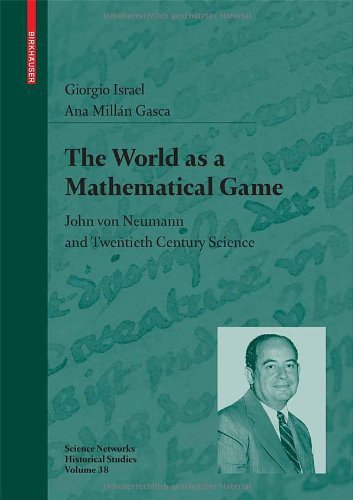
The World as a Mathematical Game: John von Neumann and Twentieth Century Science
(Science Networks. Historical Studies)
Giorgio Israel, Ana Millán Gasca
Birkhäuser Basel | 2009 | 207 páginas | pdf | 1,3 Mb
link direto
link
depositfiles.com (PDF - 1,7 Mb)
Galileo and Newton’s work towards the mathematisation of the physical world; Leibniz’s universal logical calculus; the Enlightenment’s mathematique sociale. John von Neumann inherited all these aims and philosophical intuitions, together with an idea that grew up around the Vienna Circle of an ethics in the form of an exact science capable of guiding individuals to make correct decisions. With the help of his boundless mathematical capacity, von Neumann developed a conception of the world as a mathematical game, a world globally governed by a universal logic in which individual consciousness moved following different strategies: his vision guided him from set theory to quantum mechanics, to economics and to his theory of automata (anticipating artificial intelligence and cognitive science). This book provides the first comprehensive scientific and intellectual biography of John von Neumann, a man who perhaps more than any other is representative of twentieth century science.
From the reviews:
“All the most important features of von Neumann’s impact on 20th-century economics – from the spread of the axiomatic method to the popularization of several analytical techniques to the idea itself of ‘modelization’ as the only proper way to investigate economic phenomena … it follows that this book is a real boon, as well as a must-read, for every historian or economist wishing to understand how, and by whom, modern neoclassical economics has been shaped in the first two or three decades after World War II.” (Nicola Giocoli, History of Economic Ideas, Vol. 18 (1), 2010)
“The World as a Mathematical Game says that the book ‘provides the first comprehensive scientific and intellectual biography of John von Neumann’. It covers the ground well and thoroughly in 175 pages of text, moving chronologically through his astonishing career. … The authors have written their book for a general audience. … In any event, it is good to have this outline of von Neumann’s work.” (Underwood Dudley, The Mathematical Association of America, October, 2009)
quinta-feira, 23 de abril de 2009
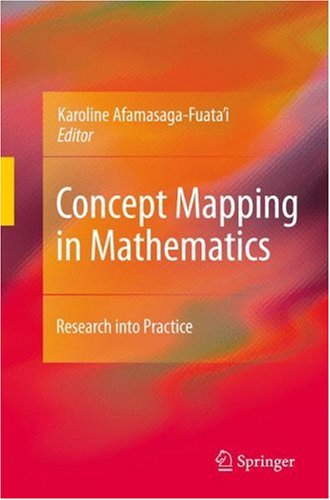
Concept Mapping in Mathematics: Research into Practice

Karoline Afamasaga-Fuata'i (Ed.)
Springer | 2009 | 225 páginas | PDF | 11 Mb
link
Concept Mapping in Mathematics: Research into Practice is the first comprehensive book on concept mapping in mathematics. It provides the reader with an understanding of how the meta-cognitive tool, namely, hierarchical concept maps, and the process of concept mapping can be used innovatively and strategically to improve planning, teaching, learning, and assessment at different educational levels. This collection of research articles examines the usefulness of concept maps in the educational setting, with applications and examples ranging from primary grade classrooms through secondary mathematics to pre-service teacher education, undergraduate mathematics and post-graduate mathematics education. A second meta-cognitive tool, called vee diagrams, is also critically examined by two authors, particularly its value in improving mathematical problem solving.
Thematically, the book flows from a historical development overview of concept mapping in the sciences toapplications of concept mapping in mathematics by teachers and pre-service teachers as a means of analyzing mathematics topics, planning for instruction and designing assessment tasks including applications by school and university students as learning and review tools. This book provides case studies and resources that have been field tested with school and university students alike. The findings presented have implications for enriching mathematics learning and making problem solving more accessible and meaningful for students.
The theoretical underpinnings of concept mapping and of the studies in the book include Ausubel’s cognitive theory of meaningful learning, constructivist and Vygotskian psychology to name a few. There is evidence particularly from international studies such as PISA and TIMSS and mathematics education research, which suggest that students’ mathematical literacy and problem solving skills can be enhanced through students collaborating and interacting as they work, discuss and communicate mathematically. This book proposes the meta-cognitive strategy of concept mapping as one viable means of promoting, communicating and explicating students’ mathematical thinking and reasoning publicly in a social setting (e.g., mathematics classrooms) as they engage in mathematical dialogues and discussions.
Concept Mapping in Mathematics: Research into Practice is of interest to researchers, graduate students, teacher educators and professionals in mathematics education.
Contents
Part I A Historical Overview of Concept Mapping
1 The Development and Evolution of the Concept Mapping Tool Leading to a New Model for Mathematics Education . . 3
Joseph D. Novak and Alberto J. Canas
Part II Primary Mathematics Teaching and Learning
2 Analysing the “Measurement” Strand Using Concept Maps and Vee Diagrams. . 19
Karoline Afamasaga-Fuata’i
3 Concept Mapping as a Means to Develop and Assess Conceptual Understanding in Primary Mathematics Teacher Education . . 47
Jean Schmittau and James J. Vagliardo
4 Using Concept Maps and Vee Diagrams to Analyse the “Fractions” Strand in Primary Mathematics . 59
Karoline Afamasaga-Fuata’i
5 Concept Maps as Innovative Learning and Assessment Tools in Primary Schools . . 87
Karoline Afamasaga-Fuata’i and Greg McPhan
Part III Secondary Mathematics Teaching and Learning
6 Evidence of Meaningful Learning in the Topic of ‘Proportionality’ in Second Grade Secondary Education . . . 117
Edurne Pozueta and Fermın M. Gonz´alez
7 Concept Mapping as a Means to Develop and Assess Conceptual Understanding in Secondary Mathematics Teacher Education . 137
Jean Schmittau
8 Concept Mapping a Teaching Sequence and Lesson Plan for “Derivatives” . . 149
Karoline Afamasaga-Fuata’i
9 Curricular Implications of Concept Mapping in Secondary Mathematics Education . . 171
James J. Vagliardo
10 Using Concept Maps and Gowin’s Vee to Understand Mathematical Models of Physical Phenomena . . 189
Maria S. Ram´ırez De Mantilla, Mario Asp´ee, Irma Sanabria,, and Neyra Tellez
11 Applying Concept Mapping to Algebra I . . . . 217
William Caldwell
Part IV University Mathematics Teaching and Learning
12 Enhancing Undergraduate Mathematics Learning Using Concept Maps and Vee Diagrams. . . . 237
Karoline Afamasaga-Fuata’i
13 Concept Mapping: An Important Guide for the Mathematics Teaching Process . . 259
Rafael Perez Flores
14 Concept Mapping and Vee Diagramming “Differential Equations” . . . 279
Karoline Afamasaga-Fuata’i
15 Using Concept Maps to Mediate Meaning in Undergraduate Mathematics . . 299
Karoline Afamasaga-Fuata’i
Part V Future Directions
16 Implications and Future Research Directions. . 329
Karoline Afamasaga-Fuata’i
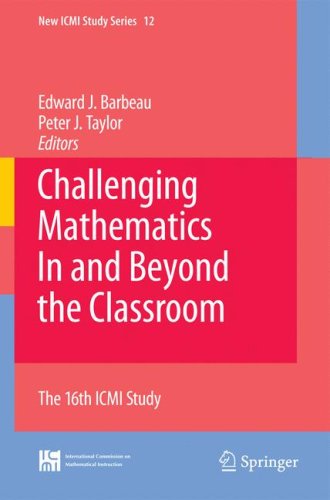
Challenging Mathematics In and Beyond the Classroom: The 16th ICMI Study

(New ICMI Study Series)
Edward J. Barbeau, Peter J. Taylor
Springer | 2008 | 325 páginas | pdf | 2,4 Mb
uploading.com
depositfiles.com
link
link1
The last two decades have seen significant innovation both in classroom teaching and in the public presentation of mathematics. Much of this has centered on the use of games, puzzles and investigations designed to capture interest, challenge the intellect and encourage a more robust understanding of mathematical ideas and processes. ICMI Study 16 was commissioned to review these developments and describe experiences around the globe in different contexts, systematize the area, examine the effectiveness of the use of challenges and set the stage for future study and development. A prestigious group of international researchers, with collective experience with national and international contests, classroom and general contests and in finding a place for mathematics in the public arena, contributed to this effort. The result, Challenging Mathematics In and Beyond the Classroom, deals with challenges for both gifted as regular students, and with building public interest in appreciation of mathematics.
quarta-feira, 22 de abril de 2009
Assessment of Authentic Performance in School Mathematics

Richard Lesh, Susan J. Lamon
Washington, DC: AAAS Press | 1992 | 445 páginas |rar-pdf|7,7 Mb
link
Password: matav
This book is the result of a conference sponsored by the Educational Testing Service and the University of Wisconsin's National Center for Research in Mathematical Sciences Education. The purpose of the conference was to facilitate the work of a group of scholars whose interests included the assessment of higher-order understandings and processes in foundation-level (pre-high school) mathematics. Discussions focused on such issues as the purposes of assessment, guidelines for producing and scoring "real-life" assessment activities, and the meanings of such terms as "deeper and higher-order understanding," "cognitive objectives," and "authentic mathematical activities."
Assessment was viewed as a critical component of complex, dynamic, and continually adapting educational systems. During the time that the chapters in this book were being written, sweeping changes in mathematics education were being initiated in response to powerful recent advances in technology, cognitive psychology, and mathematics, as well as to numerous public demands for educational reform. These changes have already resulted in significant reappraisals of what it means to understand mathematics, of the nature of mathematics teaching and learning, and of the real-life situations in which mathematics is useful. The challenge was to pursue assessment-related initiatives that are systematically valid, in the sense that they work to complement and enhance other improvements in the educational system rather than act as an impediment to badly needed curriculum reforms.
To address these issues, most chapters in this book focus on clarifying and articulating the goals of assessment and instruction, and they stress the content of assessment above its mode of delivery. Computer- or portfolio-based assessments are interpreted as means to ends, not as ends in themselves. Assessment is conceived as an ongoing documentation process, seamless with instruction, whose quality hinges upon its ability to provide complete and appropriate information as needed to inform priorities in instructional decision making. This book tackles some of the most complicated issues related to assessment, and it offers fresh perspectives from leaders in the field--with the hope that the ultimate consumer in the instruction/assessment enterprise, the individual student, will reclaim his or her potential for self-directed mathematics learning.
domingo, 19 de abril de 2009
Bringing Out the Algebraic Character of Arithmetic: From Children’s Ideas to Classroom Practic
Analucia Dias Schliemann, David William Carraher, Barbara M. Brizuela,
Lawrence Erlbaum | 2006 | 144 páginas | rar - pdf | 47,2 Mb
link (password: matav)
pdf | 1,37 Mb
on-line: earlyalgebra.terc.edu (Versão draft)
Referência em MathEdu
Bringing Out the Algebraic Character of Arithmetic contributes to a growing body of research relevant to efforts to make algebra an integral part of early mathematics instruction, an area of studies that has come to be known as Early Algebra. It provides both a rationale for promoting algebraic reasoning in the elementary school curriculum and empirical data to support it.
The authors regard Early Algebra not as accelerated instruction but as an approach to existing topics in the early mathematics curriculum that highlights their algebraic character. Each chapter shows young learners engaged in mathematics tasks where there has been a shift away from computations on specific amounts toward thinking about relations and functional dependencies. The authors show how young learners attempt to work with mathematical generalizations before they have learned formal algebraic notation.
The book, suitable as a text in undergraduate or graduate mathematics education courses, includes a CD-ROM with additional text and video footage on how students reason about addition and subtraction as functions; on how students understand multiplication when it is presented as a function; and on how children use notations in algebraic problems involving fractions. These three videopapers (written text with embedded video footage) present relevant discussions that help identify students' mathematical reasoning. The printed text in the book includes transcriptions of the video episodes in the CD-ROM.
Bringing Out the Algebraic Character of Arithmetic is aimed at researchers, practitioners, curriculum developers, policy makers and graduate students across the mathematics education community who wish to understand how young learners deal with algebra before they have learned about algebraic notation.
Contents:
Preface:
Rethinking Early Mathematics Education.
Interpreting Research About Learning Algebra.
Part I: Interview Studies.
Young Children's Understanding of Equivalences.
Can Young Students Solve Equations?
Part II: Classroom Studies.
Addition Operations as Functions.
From Quantities to Ratio, Functions, and Algebraic Notation.
On Children's Written Notation to Solve Problems.
Discussion.
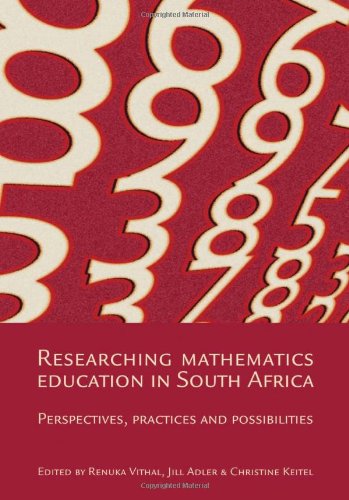
Researching Mathematics Education in South Africa: Perspectives, Practices and Possibilities
Renuka Vithal, Jill Adler, Christine Keitel
Human Sciences Research Council | 2005 | 368 páginas | pdf | 210 Mb
link
link1
Reflecting on the theoretical and ideological work that has contributed to the growth of mathematics education research in South Africa, this study provides a historical analysis of forces that have changed and shaped mathematics curricula over the years. The themes researched and explored include radical pedagogy, progressive classroom practices, ethnomathematics, and South African mathematics education research within both its local and international contexts.
quarta-feira, 15 de abril de 2009
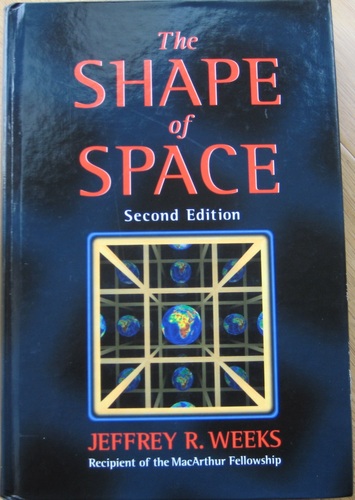
The Shape of Space
(Pure and Applied Mathematics)
Jeffrey R. Weeks
CRC | 2001 | 328 páginas | PDF | 11 Mb
link
link1
link2
djvu - 2,7 Mb
link
link1
Página sobre o autor: mathaware.org
Sugestões de jogos e programas de Geometria, por Jeffrey R. Weeks:
geometrygames.org
Maintaining the standard of excellence set by the previous edition, this textbook covers the basic geometry of two- and three-dimensional spaces Written by a master expositor, leading researcher in the field, and MacArthur Fellow, it includes experiments to determine the true shape of the universe and contains illustrated examples and engaging exercises that teach mind-expanding ideas in an intuitive and informal way. Bridging the gap from geometry to the latest work in observational cosmology, the book illustrates the connection between geometry and the behavior of the physical universe and explains how radiation remaining from the big bang may reveal the actual shape of the universe.
Subscrever:
Mensagens (Atom)