quarta-feira, 15 de abril de 2009

Perspectives on Mathematical Practices: Bringing Together Philosophy of Mathematics, Sociology of Mathematics, and Mathematics Education


(Logic, Epistemology, and the Unity of Science)

Bart Van Kerkhove, Jean Paul van Bendegem
Springer | 2006 | 241 páginas | pdf | 6 Mb

link

Philosophy of mathematics today has transformed into a very complex network of diverse ideas, viewpoints, and theories. Sometimes the emphasis is on the "classical" foundational work (often connected with the use of formal logical methods), sometimes on the sociological dimension of the mathematical research community and the "products" it produces, then again on the education of future mathematicians and the problem of how knowledge is or should be transmitted from one generation to the next.
The editors of this book felt the urge, first of all, to bring together the widest variety of authors from these different domains and, secondly, to show that this diversity does not exclude a sufficient number of common elements to be present. In the eyes of the editors, this book will be considered a success if it can convince its readers of the following: that it is warranted to dream of a realistic and full-fledged theory of mathematical practices, in the plural. If such a theory is possible, it would mean that a number of presently existing fierce oppositions between philosophers, sociologists, educators, and other parties involved, are in fact illusory.


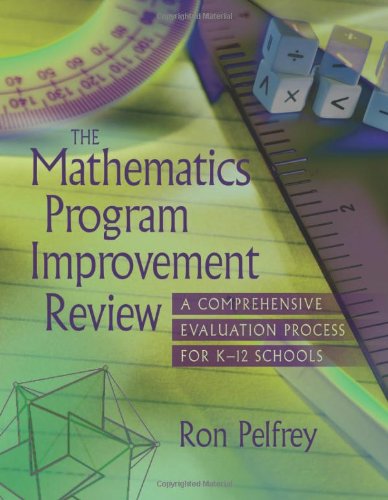
The Mathematics Program Improvement Review: A Comprehensive Evaluation Process for K-12 Schools

Ron Pelfrey 


ASCD | 2005 | 219 páginas | pdf | 1,58 Mb

link
link1

How good is your school's mathematics program? Test scores can provide some general trend information, but what you--and your students' parents--really need are specifics about the quality of the curriculum, the effectiveness of the instruction, and the school's overall capacity to support mathematics learning.
The Mathematics Program Improvement Review (MPIR) is a proven evaluation process focused on standards for high-quality mathematics programs in grades K-12. Based on research into effective program-evaluation methods, the MPIR approach uses multiple data sources to clarify exactly what is working within an individual school's math program and what is not.
Author and MPIR developer Ron Pelfrey has used this process to evaluate mathematics programs in more than 300 rural, urban, and suburban schools and has trained hundreds of educators to conduct reviews. Now this handbook makes the MPIR process and its benefits available to everyone. Inside, you'll find guidelines for training review team members and all the materials needed to conduct a review, including
* Lists of standards and indicators for the 10 essential components of an effective mathematics program.
* Templates for questionnaires, interviews, and classroom observations.
* Detailed evaluation rubrics.
* Forms for compiling ratings and generating a final report.
Whether used as a basis for informal faculty or departmental discussion, to promote best practices in a particular area (such as curriculum or instruction), or to guide a formal program evaluation, this book will help any school or district apply MPIR tools and procedures to bring about positive change in students' mathematics learning.

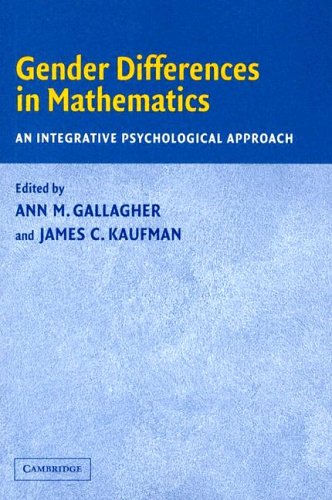
Gender Differences in Mathematics: An Integrative Psychological Approach

Ann M. Gallagher, James C. Kaufman

Cambridge University Press | 2004 | 368 páginas | PDF | 2,4 Mb

link
link1

This book explores gender differences in math performance--and why males outperform females on high stakes standardized tests but not in the classroom. These differences are important because scores on such tests are generally used in decisions that have important consequences for students such as college admissions and job placement. The contributions in this volume present a variety of theories and research that help to explain the differences, and highlight the consequences. Illustratively, if females receive lower scores on the tests, they are likely to be exposed to fewer opportunities thereafter.

Table of Contents
Preface
1. Research on the women and mathematics issue: a personal case history Susan Chipman
2. The perseverative search for sex differences in mathematic ability Paula Caplan and Jeremy Caplan
3. A psychobiosocial model: why females are sometimes > and sometimes < males in math achievement Diane Halpern, Jonathan Wai and Amanda Saw
4. Gender differences in math: cognitive processes in an expanded framework James Byrnes
5. Cognitive contributions to sex differences in math performance James M. Royer and Laura M. Garofoli
6. Spatial ability as a mediator of gender differences on mathematics tests: a biological-environmental framework M. Beth Casey, Ronald Nuttal and Elizabeth Pezaris
7. Examining gender-related differential item functioning using insights from psychometric and multicontext theory Rob Ibarra
8. The gender-gap artifact: women's underperformance in quantitative domains through the lens of stereotype threat Paul Davies and Steve Spencer
9. 'Math is hard!' (Barbie, 1994): responses of threat vs challenge mediated arousal of stereotypes alleging intellectual inferiority Talia Ben Zee, Cristina M. Carrasquillo, Alison M. L. Ching, Tattiya J. Kliengklom, Kristen L. McDonald, Daniel C. Newhall, Gillian E. Patton, Tiffany D. Stewart, Tonya Stoddard, Michael Inzlicht and Steve Fein
10. The role of ethnicity on the gender gap in mathematics Alyssa Walters and Lisa Brown
11. The gender gap in mathematics: merely a step function Sophia Catsambis
12. 'I can, but I don't want to': the impact of parents, interests, and activities on gender differences in math Janis E. Jacobs, Pamela Davis-Kean, Martha Bleeker, Jacquelynne S. Eccles and Oksana Malachuk
13. Gender effects on mathematics achievement: mediating role of state and trait self-regulation Eunsook Hong, Harold O'Neil and David Feldon
14. Gender differences in mathematics self efficacy beliefs Frank Pajares
15. Integrative conclusion Ann Gallagher and James Kaufman.

revisão MAA

Dyslexia and Mathematics


T. R. Miles

Routledge | 1991 | 144 páginas | pdf | 683 Kb

link

Descrição: As dyslexia is seen primarily as a limitation in the ability to learn the use of words and other symbols, special ways have been found to teach the notation of mathematics. Using case studies and analysis, the six contributors to Dyslexia and Mathematics show how the needs of dyslexic children, at various ages and levels, differ. They present alternative strategies and approaches in dealing with specific problems.
Throughout the book the need for practice as opposed to memorizing symbols is continually emphasized, and the skill of the dyslexic at pattern recognition is fully taken into account. All contributors have had experience in teaching dyslexic children at various levels.

sábado, 11 de abril de 2009

Geometry and Billiards


(Student Mathematical Library)
Serge Tabachnikov

American Mathematical Society | 2005 | 176 páginas | pdf | 1,1 Mb


math.psu.edu (link direto)
link
link1

Mathematical billiards describe the motion of a mass point in a domain with elastic reflections off the boundary or, equivalently, the behavior of rays of light in a domain with ideally reflecting boundary. From the point of view of differential geometry, the billiard flow is the geodesic flow on a manifold with boundary. This book is devoted to billiards in their relation with differential geometry, classical mechanics, and geometrical optics. Topics covered include variational principles of billiard motion, symplectic geometry of rays of light and integral geometry, existence and nonexistence of caustics, optical properties of conics and quadrics and completely integrable billiards, periodic billiard trajectories, polygonal billiards, mechanisms of chaos in billiard dynamics, and the lesser-known subject of dual (or outer) billiards. The book is based on an advanced undergraduate topics course. Minimum prerequisites are the standard material covered in the first two years of college mathematics (the entire calculus sequence, linear algebra). However, readers should show some mathematical maturity and rely on their mathematical common sense. A unique feature of the book is the coverage of many diverse topics related to billiards, for example, evolutes and involutes of plane curves, the four-vertex theorem, a mathematical theory of rainbows, distribution of first digits in various sequences, Morse theory, the Poincaré recurrence theorem, Hilbert's fourth problem, Poncelet porism, and many others. There are approximately 100 illustrations. The book is suitable for advanced undergraduates, graduate students, and researchers interested in ergodic theory and geometry. This volume has been copublished with the Mathematics Advanced Study Semesters program at Penn State. 

Sam Loyd's Cyclopedia of 5000 Puzzles


Sam Loyd

Corwin Books | 1976 | 384 páginas | zip | 39,95 Mb

on-line: mathpuzzle.com (imagens)
mathpuzzle.com (imagens em zip)


pdf - 41 Mb -
link direto
link

Sam Loyd (1841-1911) was the all time greatest inventor and developer of puzzles. He is described by Martin Gardner, the author of the "Mathematical Games" column in Scientific American, as "America's greatest puzzlist and an authentic American genius". His fame is world wide and books of his puzzles have been published in Russian and many other languages. This book, Sam Loyd's Cyclopedia of 5,000 Puzzles Tricks & Conundrums with Answers, was compiled by his son and published in 1914 after his death. Although many books have been written about some of Loyd's puzzles, this remains the most complete volume of all of his puzzles. This is considered to be the most fabulous and exciting collection of puzzles ever assembled in one volume. The puzzles come with wonderful illustrations.

Sam Loyd's puzzles: A book for children

Samuel Loyd

D. McKay | 1912 | 124 páginas | pdf | 14 Mb

on-line: samuelloyd.com (algumas imagens)

link
link1
scribd.com

Sam Loyd (1841-1911) was the all time greatest inventor and developer of puzzles. He is described by Martin Gardner, the author of the ?Mathematical Games? column in Scientific American, as ?America?s