terça-feira, 7 de abril de 2009

Pythagoras Revived: Mathematics and Philosophy in Late Antiquity


(Clarendon Paperbacks)

Dominic J. O'Meara

Oxford University Press, USA | 1991 | 264 páginas | pdf | 2 Mb

link
link1

Referência em MathEdu

The Pythagorean idea that number is the key to understanding reality inspired philosophers in the fourth and fifth centuries to develop theories in physics and metaphysics using mathematical models. These theories were to become influential in medieval and early modern philosophy, yet until now, they have not received the serious attention they deserve. This book marks a breakthrough in our understanding of the subject by examining two themes in conjunction for the first time: the figure of Pythagoras as interpreted by the Neoplatonist philosophers of the period, and the use of mathematical ideas in physics and metaphysics.

Understanding the Infinite


Shaughan Lavine

Harvard University Press | 1994 | 376 páginas | Djvu | 3,2 MB

link
link1

How can the infinite, a subject so remote from our finite experience, be an everyday tool for the working of a mathematician? Blending history, philosophy, mathematics, and logic, the author seeks to answers this question. Making use of the mathematical work of Jan Mycielski, he demonstrates that knowledge of the infinite is possible, even according to strict standards that require some intuitive basis for knowledge.

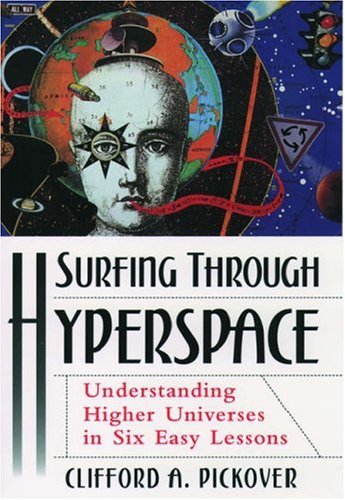
Surfing through Hyperspace


Clifford A. Pickover

Oxford University Press, USA | 1999 | 272 páginas | PDF | 17 Mb

link
link1

epub - 10 Mb - link

djvu - 5,1 Mb
link
link1
link2


Do a little armchair time-travel, rub elbows with a four-dimensional intelligent life form, or stretch your mind to the furthest corner of an uncharted universe. With this astonishing guidebook, Surfing Through Hyperspace, you need not be a mathematician or an astrophysicist to explore the all-but-unfathomable concepts of hyperspace and higher-dimensional geometry.
No subject in mathematics has intrigued both children and adults as much as the idea of a fourth dimension. Philosophers and parapsychologists have meditated on this mysterious space that no one can point to but may be all around us. Yet this extra dimension has a very real, practical value to mathematicians and physicists who use it every day in their calculations. In the tradtion of Flatland, and with an infectious enthusiasm, Clifford Pickover tackles the problems inherent in our 3-D brains trying to visualize a 4-D world, muses on the religious implications of the existence of higher-dimensional consciousness, and urges all curious readers to venture into "the unexplored territory lying beyond the prison of the obvious." Pickover alternates sections that explain the science of hyperspace with sections that dramatize mind-expanding concepts through a fictional dialogue between two futuristic FBI agents who dabble in the fourth dimension as a matter of national security. This highly accessible and entertaining approach turns an intimidating subject into a scientific game open to all dreamers.
Surfing Through Hyperspace concludes with a number of puzzles, computer experiments and formulas for further exploration, inviting readers to extend their minds across this inexhaustibly intriguing scientific terrain.

How Mathematicians Think: Using Ambiguity, Contradiction, and Paradox to Create Mathematics

William Byers

Princeton University Press | 2007 | 425 páginas | PDF | 1,3 Mb

link
link1

To many outsiders, mathematicians appear to think like computers, grimly grinding away with a strict formal logic and moving methodically--even algorithmically--from one black-and-white deduction to another. Yet mathematicians often describe their most important breakthroughs as creative, intuitive responses to ambiguity, contradiction, and paradox. A unique examination of this less-familiar aspect of mathematics, How Mathematicians Think reveals that mathematics is a profoundly creative activity and not just a body of formalized rules and results.
Nonlogical qualities, William Byers shows, play an essential role in mathematics. Ambiguities, contradictions, and paradoxes can arise when ideas developed in different contexts come into contact. Uncertainties and conflicts do not impede but rather spur the development of mathematics. Creativity often means bringing apparently incompatible perspectives together as complementary aspects of a new, more subtle theory. The secret of mathematics is not to be found only in its logical structure.
The creative dimensions of mathematical work have great implications for our notions of mathematical and scientific truth, and How Mathematicians Think provides a novel approach to many fundamental questions. Is mathematics objectively true? Is it discovered or invented? And is there such a thing as a "final" scientific theory?
Ultimately, How Mathematicians Think shows that the nature of mathematical thinking can teach us a great deal about the human condition itself.

The Calculus Gallery: Masterpieces from Newton to Lebesgue


William Dunham

Princeton University Press | 2008| 256 Páginas | djvu

capítulo 1 on-line: press.princeton.edu

link
link1 (edição de 2005)

Referência em: MathEduc

More than three centuries after its creation, calculus remains a dazzling intellectual achievement and the gateway into highermathematics. This book charts its growth and development by sampling from the work of some of its foremost practitioners, beginning with Isaac Newton and Gottfried Wilhelm Leibniz in the late seventeenth century and continuing to Henri Lebesgue at the dawn of the twentieth--mathematicians whose achievements are comparable to those of Bach in music or Shakespeare in literature. William Dunham lucidly presents the definitions, theorems, and proofs. "Students of literature read Shakespeare; students of music listen to Bach," he writes. But this tradition of studying the major works of the "masters" is, if not wholly absent, certainly uncommon in mathematics. This book seeks to redress that situation.

Calculus Gems: Brief Lives and Memorable Mathematics

George F. Simmons

McGraw-Hill Companies | 1992 | 355 Páginas | DjVu | 3,3 Mb

link
link1

Referência em: MathEduc

"Calculus Gems", a collection of essays written about mathematicians and mathematics, is a spin-off of two appendices ("Biographical Notes" and "Variety of Additional Topics") found in Simmons' 1985 calculus book. With many additions and some minor adjustments, the material will now be available in a separate softcover volume. The text is suitable as a supplement for a calculus course and/or a history of mathematics course, The overall aim is bound up in the question, "What is mathematics for?" and in Simmons' answer, "To delight the mind and help us understand the world". The essays are independent of one another, allowing the instructor to pick and choose among them. Part A, "Brief Lives", is a biographical history of mathematics from earliest times (Thales, 625-547 BC) through the late 19th century (Weierstrass, 1815-1897) that serves to connect mathematics to the broader intellectual and social history of Western civilization. Part B, "Memorable Mathematics", is a collection of interesting topics from number theory, geometry, and science arranged in an order roughly corresponding to the order of most calculus courses. Some of these sections have a few problems for the student to solve. Students can gain perspective on the mathematical experience and learn some mathematics not contained in the usual courses, and instructors can assign student papers and projects based on the essays. The book teaches by example that mathematics is more than computation. Original illustrations of influential mathematicians in history and their inventions accompany the brief biographies and mathematical discussions.

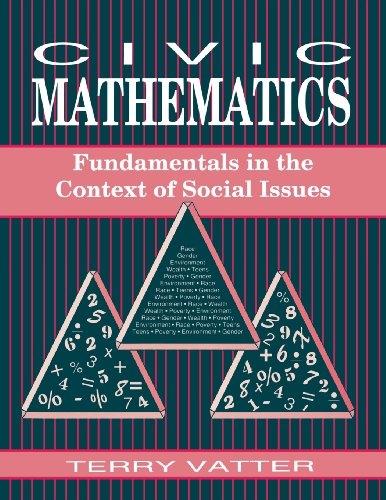
Civic Mathematics: Fundamentals in the Context of Social Issues

Terry Vatter

Teacher Ideas Press | 1996 | 169 páginas | pdf | 6 Mb

link
link1

What has math got to do with my life? If you've ever heard that protest from your students, this book can provide the answer. Presenting mathematics in the context of social issues makes it relevant and helps students learn how to apply math skills appropriately. Four sections-race and gender, poverty and wealth, the environment, and teen issues-have lessons based on themes such as estimating, probability, negative numbers, and multiplying decimals. Discussion questions, library research activities and guides, and reproducible homework assignments reinforce learning. With its concrete approach, this book allows students to see mathematics as a powerful tool for understanding the world. Working through the activities will motivate them and help them grow as mathematicians and as citizens.