segunda-feira, 6 de abril de 2009

Mathematics Education in Different Cultural Traditions - A Comparative Study of East Asia and the West


The 13th ICMI Study
Frederick K.S. Leung, Klaus-D. Graf, Francis J. Lopez-Real

Springer | 2006 | 597 páginas | PDF | 25,9 Mb

link

Referência em: MathEduc

The idea of the ICMI Study 13 is outlined as follows: Education in any social environment is influenced in many ways by the traditions of these environments. This study brings together leading experts to research and report on mathematics education in a global context. Mathematics education faces a split phenomenon of difference and correspondence. A study attempting a comparison between mathematics education in different traditions will be helpful to understanding this phenomenon.

Learning from TIMSS: Results of the Third International Mathematics and Science Study, Summary of a Symposium

 (Compass Series)
National Research Council

National Academy Press | 1997 | 56 páginas | 127 kb

on-line: nap.edu


Global Perspectives for Local Action: Using TIMSS to Improve U.S. Mathematics and Science Education


Committee on Science Education K-12 and Mathematical Sciences Education Board, National Research Council

National Academies Press | 1999 | 102 páginas | 645 kb

on-line: nap.edu

The Third International Mathematics and Science Study (TIMSS) raised the alarm about U.S. mathematics and science education. Most Americans are now aware that U.S. students lag behind their peers in other developed nations. In one state, the legislature reacted by lengthening the school year, assuming that more time on academic content would boost student performance. Some educators have fixed the blame on the mathematics and science curricula typically used in U.S. schools.

Does the problem lie in the curricula, instruction, or the system of support available to teachers? This book presents the first comprehensive analysis of TIMSS study--a half-million students from 15,000 schools around the world. It presents detailed reports on three major aspects of education, including curriculum issues, teaching practices, and school support.

Mathematics and Science Education Around the World

What Can We Learn From The Survey of Mathematics and Science Opportunities (SMSO) and the Third International ... and Science Study (TIMSS)?
(Compass Series)
Mathematical Sciences Education Board and Committee on Science Education K-12, National Research Council

National Academies Press | 1996 | 32 páginas

on-line: nap.edu

Contexts of Learning Mathematics and Science: Lessons Learned from Timss


Tjeerd Plomp

Routledge | 2006 | 413 páginas | PDF | 7,16 Mb

link
en.bookfi.org


Descrição: This book reports valuable research from across the world that addresses questions on what background and contextual factors are related to achievement in mathematics and sciences. All studies utilized data from the Third International Mathematics and Science Study (TIMSS) conducted under the auspices of the International Association for the Evaluation of Educational Achievement (IEA) in 1995, and repeated in 1998.
In many countries researchers have started secondary analysis of the data in search for relationships between contextual factors and achievement. In these analyses two different approaches can be distinguished, which can be characterized by the metaphors of 'fishing' and 'hunting'. In the 'fishing' approach, researchers in principle begin with an open mind, considering all possible context variables as possible explanatory variables. Applying analysis techniques like regression analysis, Lisrel, PLS, HLM, and MLn, they try to identify which factors within their countries or across a number of countries. In the 'hunting' approach, researchers have reasons to choose certain context variables upfront and research whether these variables account for part of the variance in the mathematics and/or science achievement. Truly international in scope the book includes contributions from over 15 countries around the world including the USA, South Africa, The Netherlands, Germany and Japan.


Lessons Learned: What International Assessments Tell Us About Math Achievement


Tom Loveless


Brookings Institution Press | 2007| 275 páginas | PDF

link

Standards for education achievement are under scrutiny throughout the industrial world. In this technological age, student performance in mathematics is seen as being particularly important. For more than four decades, international assessments conducted by the International Association for Evaluation of Educational Achievement (IEA) have measured how well students are learning mathematics in different countries. The latest round of mathematics testing of the Trends in Mathematics and Science Study (TIMSS) takes place in 2007. Beyond the horse race —the rankings that compare nations —what have we learned from the wealth of data collected in these assessments? How do US math curriculums compare to those used overseas? Is the effect of technology in the classroom uniform across nations? How do popular math reforms fare abroad? Those are some of the critical issues tackled in this important book. The authors use the database to address several pressing questions about school policy and educational research. For example, Ina Mullis and Michael Martin review the major lessons learned over the history of TIMSS testing. William Schmidt and Richard T. Houang examine whether curricular breadth affects student achievement. Jeremy Kilpatrick, Vilma Mesa, and Finbarr Sloane evaluate American performance in algebra relative to other nations and pinpoint strengths and weaknesses in American students' learning of algebra.

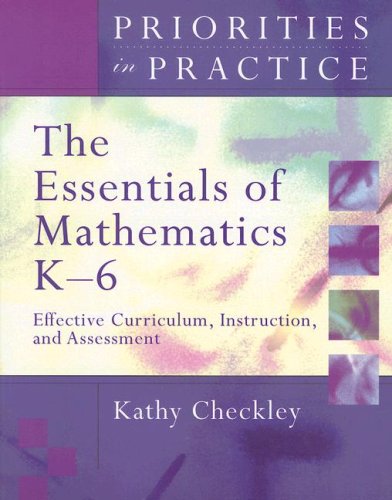
The Essentials of Mathematics K-6: Effective Curriculum, Instruction, and Assessment


(Priorities in Practice)

Kathy Checkley

Association for Supervision & Curriculum Development | 2006 | 176 páginas | PDF | 1,6 Mb

link
link1

Using national and state standards to guide your math program is just a start. You still have to decide how to apply the standards in your curriculum, determine when students should learn different content, and decide which programs and textbooks will help you make math come alive in the classroom. That’s where this new ASCD resource comes in. Priorities in Practice: The Essentials of Mathematics K-6 explores how educators--from classroom teachers to central office administrators--are tackling these major challenges in math education: 
* Emphasizing algebraic thinking, problem solving, and communication 
* Relying on research to guide the implementation of new teaching practices 
* Connecting math activities to larger purposes and everyday experiences 
* Differentiating instruction based on students’ learning styles, interests, and readiness levels 
* Helping teachers use classroom assessment to guide instruction 
* Improving math teaching practices through teacher professional development and analysis of student work. Whether you’re working with an established math curriculum or rethinking your whole approach, here’s an opportunity to see where your program stands in the context of current trends. 

This is the first volume in a new series from ASCD that explores tested methods of teaching and administrating curriculum in the major content areas.