segunda-feira, 6 de abril de 2009

The Essentials of Mathematics, Grades 7-12: Effective Curriculum, Instruction, and Assessment


(Priorities in Practice)
Kathy Checkley

Association for Supervision & Curriculum Development | 2006 | 129 páginas | PDF | 3,4 Mb

link
link1

Using national and state standards to guide your math program is just a start. You still have to decide how to apply the standards in your curriculum, determine when students should learn different content, and decide which programs and textbooks will help you make math come alive in the classroom. That’s where this new ASCD resource comes in. Priorities in Practice: The Essentials of Mathematics Grades 7-12 explores how educators--from classroom teachers to central office administrators--are tackling these major challenges in math education:
*Emphasizing algebraic thinking, problem solving, and communication
*Relying on research to guide the implementation of new teaching practices
*Connecting math activities to larger purposes and everyday experiences 
*Differentiating instruction based on students’ learning styles, interests, and readiness levels 
*Helping teachers use classroom assessment to guide instruction 
*Improving math teaching practices through teacher professional development and analysis of student work.
Whether you’re working with an established math curriculum or rethinking your whole approach, here’s an opportunity to see where your program stands in the context of current trends.

domingo, 5 de abril de 2009

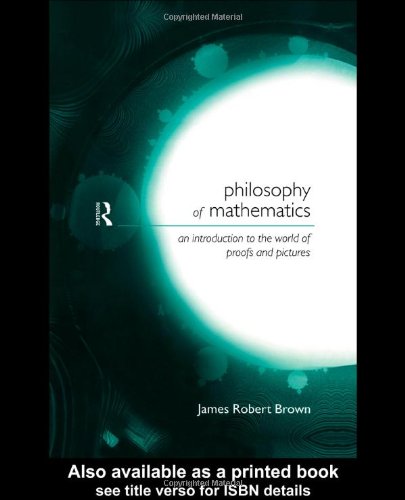
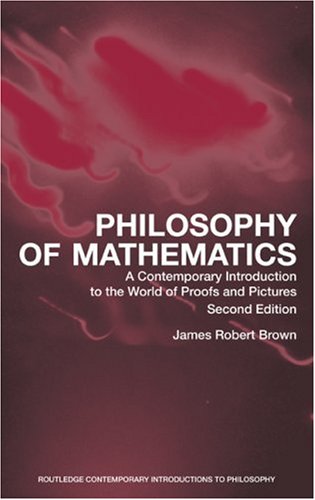
Philosophy of Mathematics: a contemporany Introduction to a World of Proofs and Pictures

2.ª edição
(Routledge Contemporary Introductions to Philosophy)
James Robert Brown

Routledge | 2008 | 245 páginas | PDF | 1 Mb

link
link1

In his long-awaited new edition of Philosophy of Mathematics, James Robert Brown tackles important new as well as enduring questions in the mathematical sciences. Can pictures go beyond being merely suggestive and actually prove anything? Are mathematical results certain? Are experiments of any real value?  
This clear and engaging book takes a unique approach, encompassing non-standard topics such as the role of visual reasoning, the importance of notation, and the place of computers in mathematics, as well as traditional topics such as formalism, Platonism, and constructivism. The combination of topics and clarity of presentation make it suitable for beginners and experts alike. The revised and updated second edition ofPhilosophy of Mathematics contains more examples, suggestions for further reading, and expanded material on several topics including a novel approach to the continuum hypothesis.


Philosophy of Mathematics: An Introduction to a World of Proofs and Pictures
(Philosophical Issues in Science)
James Robert Brown

Routledge | 1999 | 215 páginas | djvu | 1,6 Mb

link
This book offers an intriguing sample of both traditional and current ideas in the philosophy of mathematics. Its readable style is aimed at those with more background in philosophy than in mathematics, with detailed examples usually involving only secondary-level algebra and geometry. The author (philosophy, Univ. of Toronto) states that one of his goals is to argue for Platonism. This attempt is not entirely convincing, both because some of Browns positions need more substantiation and because alternative views are presented only insofar as they can be readily dismissed. As the subtitle suggests, a unique feature is the interesting argument in favor of the validity and usefulness of pictures (not limited to geometrical diagrams) as proofs in and of themselves. It is to be hoped that a few mathematically substantive typographical errors in the examples will be corrected in the finished edition. For academic mathematics and philosophy collections.Kristine Fowler, Mathematics Lib., Univ. of Minnesota, Minneapolis

Link para o vídeo da conferência:

Proofs and Pictures: The Role of Visualization in Mathematical and Scientific Reasoning

pirsa.org

History of Mathematics: A Supplement


Craig Smorynski

Springer | 2007 | 274 páginas | PDF | 2,7 Mb

f3.tiera.ru (link direto)
math-cs.aut.ac.ir (link direto)
link

General textbooks, attempting to cover three thousand or so years of mathematical history, must necessarily oversimplify just about everything, the practice of which can scarcely promote a critical approach to the subject. To counter this, History of Mathematics offers deeper coverage of key select topics, providing students with material that could encourage more critical thinking. It also includes the proofs of important results which are typically neglected in the modern history of mathematics curriculum.

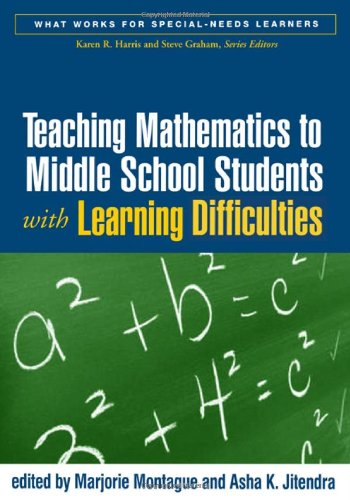
Teaching Mathematics to Middle School Students with Learning Difficulties


Marjorie Montague, Asha K. Jitendra

The Guilford Press | 2006 | 178 páginas | rar - pdf | 1,3 Mb

link
password: matav

A highly practical resource for special educators and classroom teachers, this book provides specific instructional guidance illustrated with vignettes, examples, and sample lesson plans. Every chapter is grounded in research and addresses the nuts and bolts of teaching math to students who are not adequately prepared for the challenging middle school curriculum. Presented are a range of methods for helping struggling learners build their understanding of foundational concepts, master basic skills, and develop self-directed problem-solving strategies. While focusing on classroom instruction, the book also includes guidelines for developing high-quality middle school mathematics programs and evaluating their effectiveness.

Quantitative Development in Infancy and Early Childhood


Kelly S. Mix, Susan Cohen Levine, Janellen Huttenlocher

Oxford University Press US | 2002 | 158 páginas | pdf |  688  kb

link
uploading.com

The aim of this book is to define and discuss the key issues raised by new findings in the study of quantitative development. One basic question addressed is how the abilities reported in infants and young children relate to later development. In some accounts, one is left with the impression that infants possess all the fundamental skills that make up mature quantitative reasoning. According to this view, subsequent development seems to consist of little more than the gradual expression of these skills in increasing complex and explicit tasks. This is a major departure from previously held views of quantitative development, such as that of Piaget. To evaluate these new claims, authors will first review the abilities attributed to infants and then define the parameters of early childhood competencies. Comparing the two developmental periods, the authors will evaluate the finding, discuss the transition between these age periods, and offer a framework for understanding later development of quantitative skills, such as counting and calculation. Underlying the argument throughout will be an examination of the nativist versus empiricist debate that has taken center stage in infancy research. 

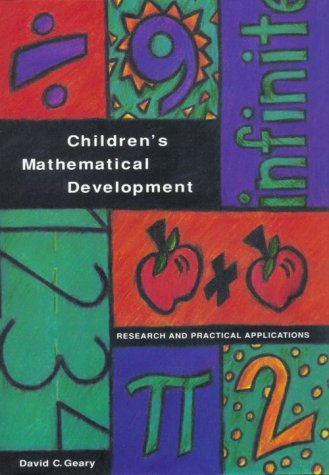
Children's Mathematical Development: Research and Practical Applications


David C. Geary

American Psychological Association (APA) | 1994 | 327 páginas | pdf | 19 MB

link
link1

This book should be required reading by every math educator...especially elementary teachers, whose math backgrounds are typically not as strong as secondary math teachers (though their teaching skills may be flawless). It should also be required reading by administrators and school board members who make the decisions concerning what(and especially how) math is taught in our schools. Concerned parents could also learn much that would enable them to help their children learn math easier and provide better basic skills.

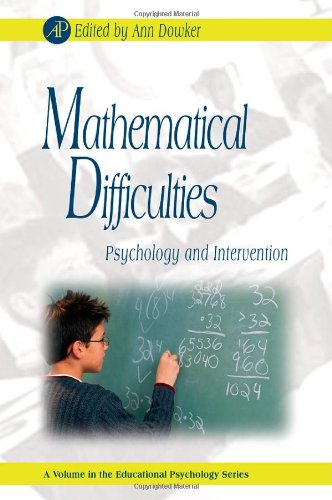
Mathematical Difficulties: Psychology and Intervention

(Educational Psychology)
Ann Dowker

Academic Press | 2008 | 272 páginas | rar - PDF | 1,4 MB

link
password: matav

This book examines the mathematical difficulties in typical and atypical populations. It discusses the behavioural, educational and neuropsychological characteristics of people with mathematical difficulties, and educational interventions to prevent, diagnose, treat or ameliorate such difficulties. The book brings together studies from different disciplines, including developmental psychology, neuroscience and education, and includes perspectives from practicing teachers.

The book is divided into three major sections. The first includes chapters about the nature and characteristics of mathematical difficulties in the population as a whole, in relation to both psychology and education. The second deals with mathematical difficulties in children with other problems such as specific language impairment and dyslexia. The third discusses methods of interventions aimed at preventing, treating or ameliorating mathematical difficulties, and will include discussions of assessment and diagnosis.