sexta-feira, 3 de abril de 2009

Dyslexia and Maths


Julie Kay e Dorian Yoo

David Fulton Publish | 2003 | 80 páginas | 761 kb

link

Referência em: MathEduc

This concise text helps the reader to understand why dyslexics find maths difficult and offers practical ideas for supporting them most effectively.
It explains which areas of maths dyslexics tend to have particular difficulty with, assesses current teaching philosophies and methods, describes a framework of general learning principles that allow dyslexics to make progress in maths, and outlines a number of specific and effective teaching recommendations.
The book helps teachers at primary and secondary levels to better understand the maths performance of dyslexics and gives them an overview of the ways in which dyslexics can best be supported in all aspects of maths learning.

Teaching Foundation Mathematics: A guide for teachers of older students with learning disabilities

(David Fulton / Nasen Publication)
Na Naggar-Smith

Routledge | 2008 | 186 páginas | pdf |1,4 Mb

link

This fully photocopiable resource will provide essential materials for anyone teaching pre-entry or foundation Maths in secondary schools and further education. Teaching Foundation Mathematics is developed to provide age appropriate material for adult learners with moderate to severe learning difficulties and/or disabilities and for children, over twelve, with special needs. It will also prove useful to teachers training to work with these learners.
Thirty ready-to-use lessons are at your fingertips in this book, complete with tutor’s notes, teaching objectives, detailed lesson plans and photocopiable worksheets, where appropriate. The lessons are divided into three areas – number, shape and measure.

quinta-feira, 2 de abril de 2009

History of Science, History of Text


Boston Studies in the Philosophy of Science , Vol. 238

Karine Chemla (Ed.)

Springer | 2005 | 254 páginas | PDF | 5,76 Mb

link
link1

To make this point, the book opts for a genuinely multicultural approach to the texts produced in the context of practices of knowledge. It is predicated on the conviction that, in order to approach any topic in the history of science from a theoretical point of view, it may be fruitful to consider it from a global perspective. 
The book hence does not only gather papers dealing with geometrical papyri of antiquity, sixteenth century French books in algebra, seventeenth century scientific manuscripts and paintings, eighteenth and nineteenth century memoirs published by European academies or scientific journals, and Western Opera Omnia. 
It also considers the problems of interpretation relating to reading Babylonian clay tablets, Sanskrit oral scriptures and Chinese books and illustrations. Thus it enables the reader to explore the diversity of forms which texts have taken in history and the wide range of uses they have inspired.

TABLE OF CONTENTS
History of Science, History of Text: An Introduction - Karine Chemla
PART I. WHAT IS A TEXT?
“Spatial Organization of Ancient Chinese Texts (Preliminary Remarks)” - Vera Dorofeeva-Lichtmann
PART II. THE CONSTITUTION OF SCIENTIF IC TEXTS: FROM DRAFT TO OPERA OMNIA
“Leibniz and the Use of Manuscripts: Text as Process” - Eberhard Knobloch
“Opera Omnia: The Production of Cultural Authority” - Michael Cahn
“Writing Works: A Reaction to Michael Cahn’s Paper” - Hans-Jorg Rheinberger
PART III. HOW SCIENTIF IC AND TECHNICAL TEXTS ADHERE TO LOCAL CULTURES
“Text, Representation and Technique in Early Modern China” - Craig Clunas
“The Algebraic Art of Discourse Algebraic Dispositio, Invention and Imitation in Sixteenth-Century France” - Giovanna C. Cifoletti
“Ancient Sanskrit Mathematics: An Oral Tradition and a Written Literature” - Pierre-Sylvain Filliozat
PART IV. READING TEXTS
“The Limits of Text in Greek Mathematics” - Reviel Netz
“Reading Strasbourg 368: A Thrice-Told Tale” - Jim Ritter
“What is the Content of this Book? A Plea for Developing History of Science and History of Text Conjointly” - Karine Chemla
EPILOGUE
“Knowledge and its Artifacts” - David R. Olson
Subject Index
Name Index


Outro livro de Karine Chemla , disponível no blog:


- K. Chemla (éd.) (2012). The History of Mathematical Proof in Ancient Traditions, Cambridge University Press.

Capítulos em livros de Karine Chemla , disponíveis no blog:
- Karine Chemla et Agathe Keller. (2002). The Sanskrit karanis, and the Chinese mian , Yvonne Dold-Samplonius, Joseph W. Dauben, Menso Folkerts, Benno van Dalen (éds.), From China to Paris: 2000 Years of Mathematical Transmission (Actes du Colloque de Bellagio, 5-2000) (pp. 87-132). Steiner Verlag, Stuttgart .
- K. Chemla (2005). The interplay between proof and algorithm in 3rd century China : The operation as prescription of computation and the operation as argument, in Paolo Mancosu, Klaus F. Jorgensen & Stig Andur Pedersen (éds.), Visualization, Explanation and Reasoning styles in mathematics,(pp. 123-145).  Synthese Library Series, volume 327, Springer, 
- K. Chemla (2009). Proof in the Wording : Two modalities from Ancient Chinese , in G. Hanna, H. N. Jahnke, H. Pulte (éds.), Explanation and Proof in Mathematics : Philosophical and Educational Perspectives, (pp. 253—285), Springer.
-  K. Chemla (2012). Using documents from ancient China to teach mathematical proof in G. Hanna and M. de Villiers (eds.), Proof and Proving in Mathematics Education (pp. 423 -). New ICMI Study Series 15

Capítulos em livros de Karine Chemla , disponíveis online (link externo ao blog):
- K. Chemla  (2010). A Chinese Canon in Mathematics and its two Layers of Commentaries : Reading a collection of texts as shaped by actors, in F. Bretelle-Establet (éd.), Looking at it from Asia : the processes that shaped the sources of history of science (pp 169—210), Springer, Boston Studies in the Philosophy of Science 265

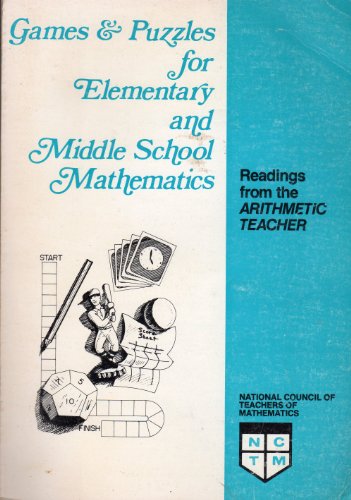
Games and puzzles for elementary and middle school mathematics : readings from the Arithmetic teacher

Seaton E. Smith, Carl A. Backman

National Council of Teachers of Mathematics | 1975 | 285 páginas | PDF | 5 MB

Nenhum link disponível

Referência em: MathEduc

This book contains 105 articles dealing with games for use in the elementary or middle school mathematics classroom. All the articles originally appeared in the "Arithmetic Teacher" between 1956 and 1974. In this volume the papers are arranged in nine categories: (1) using games and puzzles, (2) whole numbers, (3) numeration, (4) integers, (5) rational numbers, (6) number theory and patterns, (7) geometry and measurement, (8) reasoning and logic, and (9) multipurpose games and puzzles. While some of the games are aimed at review or practice on basic skills others were designed with multiple objectives in mind. There is a great variety in the forms of the games; board games, crossword-type puzzles, paper and pencil games, manipulative puzzles for individual solution, and many others are included. Some of the games were developed by students; many others were designed by teachers. (SD)

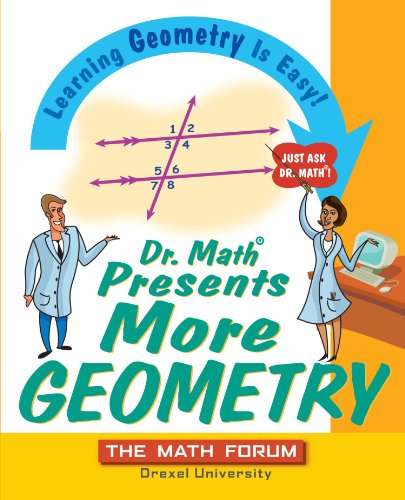
Dr. Math Presents More Geometry: Learning Geometry is Easy! Just Ask Dr. Math

The Math Forum Drexel University

Jossey-Bass | 2004 | 192 páginas| PDF | 2,1 Mb

link
link1
uploading.com

You, too, can understand geometry---- just ask Dr. Math ? !

Are things starting to get tougher in geometry class? Don't panic. Dr. Math--the popular online math resource--is here to help you figure out even the trickiest of your geometry problems.

Students just like you have been turning to Dr. Math for years asking questions about math problems, and the math doctors at The Math Forum have helped them find the answers with lots of clear explanations and helpful hints. Now, with Dr. Math Presents More Geometry, you'll learn just what it takes to succeed in this subject. You'll find the answers to dozens of real questions from students in a typical geometry class. You'll also find plenty of hints and shortcuts for using coordinate geometry, finding angle relationships, and working with circles. Pretty soon, everything from the Pythagorean theorem to logic and proofs will make more sense. Plus, you'll get plenty of tips for working with all kinds of real-life problems.

You won't find a better explanation of high school geometry anywhere!

Conteúdos

Points, Lines, Planes, Angles, and Their Relationships 

Angle Relationships and Perpendicular and Parallel Lines 
Proving Lines Parallel 
The Parallel Postulate
Coordinates and Distance 

Logic and Proof 

Introduction to Logic 
Direct Proof 
Indirect Proof 

Triangles: Properties, Congruence, and Similarity

The Triangle Inequality Property 
Centers of Triangles 
Isosceles and Equilateral Triangles 
Congruence in Triangles: SSS, SAS, and ASA 
Similarity in Triangles 

Congruence Proofs 

Ouadrilaterals and Other Polygons 

Properties of Polygons 
Properties of Ouadrilaterals 
Area and Perimeter of Ouadrilaterals 

Circles and Their Parts 

Tangents 
Arcs and Angles 
Chords


quarta-feira, 1 de abril de 2009

Teaching Mathematics to the New Standards: Relearning the Dance


(Practitioner Inquiry, 15)
Ruth M. Heaton

Teachers College Press | 2000 | 177 páginas | chm | 1,11 Mb

link
link1

Referência em: MathEduc

This book describes and traces efforts to change teaching practice in response to current national reforms in mathematics education. It explores changing practice from the vantages of both teacher and researcher. Chapters include: (1) "Do You See Any Patterns?"; (2) "Learning to Comprehend Mathematical Ideas in Topics, Texts, Tasks, and Talk"; (3) "The Teaching Has Been Missing"; (4) "Learning to Appreciate Teaching as an Improvisational Activity"; (5) "Bendable Rulers and Other Moments of Improvisation"; (6) "Learning to Share the Dance with Students"; (7 "What Should I Do Next?"; (8) "Learning to See Knowledge Differently"; and (9) "Learning to Teach While Inventing a Practice". 

Guide to Teaching Statistics: Innovations and Best Practices


(Teaching Psychological Science)
Michael R. Hulsizer, Linda M. Woolf

Wiley-Blackwell | 2008| 280 páginas | pdf | 1 Mb

link
link1
depositfiles.com

A Guide to Teaching Statistics: Innovations and Best Practices, by Michael R. Hulsizer and Linda M. Woolf, is an invaluable guide for both novice and seasoned teachers of statistics. Based on an extensive review of the research in fields such as education, health sciences, mathematics, statistics, psychology, and the social sciences, the book covers a range of statistics education and assessment topics. The book also includes novel classroom exercises, pedagogical tools, and computer applications designed to enhance active learning. Topics include descriptive, inferential, and multivariate statistics as well as the importance of using real data in the classroom, the role of ethics and diversity in statistics, and the effectiveness of online statistical education. The authors also provide extensive coverage of the research concerning statistical literacy, thinking, and reasoning.