domingo, 29 de março de 2009

Music and Mathematics: From Pythagoras to Fractals


John Fauvel, Raymond Flood, Robin Wilson

Oxford University Press, USA | 2006 | 200 páginas | pdf  |8  Mb

link
link1
link2

m.friendfeed-media.com (link direto)


From Ancient Greek times, music has been seen as a mathematical art, and the relationship between mathematics and music has fascinated generations. This collection of wide ranging, comprehensive and fully-illustrated papers, authorized by leading scholars, presents the link between these two subjects in a lucid manner that is suitable for students of both subjects, as well as the general reader with an interest in music. Physical, theoretical, physiological, acoustic, compositional and analytical relationships between mathematics and music are unfolded and explored with focus on tuning and temperament, the mathematics of sound, bell-ringing and modern compositional techniques.


Mobius and his Band: Mathematics and Astronomy in Nineteenth-Century Germany


John Fauvel, Robin Wilson, Raymond Flood

Oxford University Press, USA | 1993 | 184 páginas | Djvu | 8,6 MB

link
link1

August Mobius was one of the 19th century's most influential mathematicians and astronomers. Written by six distinguished contributors, this book explores the work of Mobius and his brilliant German contemporaries. The work emphasizes those achievements which in many ways can be seen to reflect the exciting advances taking place at the time throughout the entire scientific world. The background to Mobius's life and labors is provided by John Fauvel. Gert Schubring examines the mathematical community in 19th-century Germany, while Allan Chapman describes the revolution in astronomy that took place during the period. Jeremy Gray analyzes Mobius's contribution to geometrical mechanics and Norman Biggs traces his role in the development of topological ideas. Finally, Ian Stewart explores the legacy Mobius left to mathematics in our own century. This stimulating volume will appeal to all scientists in the fields that Mobius helped advance--physics, mathematics, and astronomy--as well as general readers interested in the history of science.

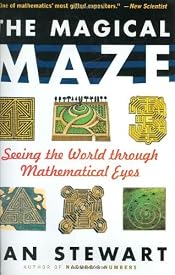
The Magical Maze: Seeing the World Through Mathematical Eyes

Ian Stewart

Wiley | 1999 | 268 páginas | 1,95 Mb

link

"Welcome to the maze.
A logical maze, a magical maze. A maze of the mind.
The maze is mathematics. The mind is yours. Let's see what happens when we put them together.
What is mathematics? What do mathematicians do?
What is a mathematician? Someone who does mathematics?
Not exactly. That's too easy an answer, and it creates too simple a maze--a circular loop of self-referential logic. No, a mathematician is more than just somebody who does mathematics. Think of it this way: what is a businessperson? Someone who does business? Yes, but not just that. A businessperson is someone who sees an opportunity for doing business where the rest of us see nothing; while we're complaining that there's no restaurant in the area, he or she is organizing a telephone pizza delivery service. Similarly, a mathematician is someone who sees opportunities for doing mathematics that the rest of us miss.
I want to open your mind to some of these opportunities."--from The Magical Maze
Praise for Ian Stewart's Previous Books
About Nature's Numbers: "Stewart achieves what other popular mathematics writers merely strive for: an accurate, informative portrayal of contemporary mathematics without a single equation in sight."--Nature
About The Problems of Mathematics:
"From one of mathematics' most gifted expositors . . . challenging and interesting. Those with no knowledge of the subject will be able to glimpse its beauty and appeal."--New Scientist
About The Collapse of Chaos:
"This ambitious book fearlessly asks some big questions, challenging us to look at science a new way."--San Francisco Chronicle
About Another Fine Math You've Got Me Into:
"Ian Stewart's quirky humor and imaginative storytelling entice readers into a fascinating world of mathematical curiosities."--Ivars Peterson author of The Jungles of Randomness
Enter the magical maze of mathematics and explore the surprising passageways of a fantastical world where logic and imagination converge. For mathematics is a maze--a maze in your head--a maze of ideas, a maze of logic. And that maze in your mind is a powerful tool for understanding an even bigger maze--the maze of cause and effect that we call "the universe." That is its special kind of magic. Real magic. Strange magic. Infinitely fascinating magic.
In this adventure of a book, acclaimed author Ian Stewart leads you swiftly and humorously through the junctions, byways, and secret passages of the magical maze to reveal its beauty, its surprise, and its power. Along the way, he reveals the infinite possibilities that arise from what he calls "the two-way trade between the natural world and the human mind."
On your travels you will encounter number magic--both the stage-act variety and the deeper magic of animals, plants, and the physical world. You will come to understand the amazing pattern-forming abilities of the humble slime mold, the numerology of flowers, and the feeding habits of pigs and panthers. You will discover how to solve puzzles the algorithmic way, the artistic way, and the army way. You will be amazed by the deep connections between the founding of Carthage, soap bubbles, and communications networks. You will discover how to use a toy train set as a computer, and find out why this implies that there are unavoidable limits to mathematics. You will join the controversy over cars and goats, find out the terrible truth about confessions, and win endless bets about birthdays. You will see how a new idea about ferns can lead to a multi-million-dollar computer graphics company, and how Jupiter and Mars can combine forces to hurl cosmic rocks at Earth. And you will never again be able to watch a kitten, a kangaroo, or a Chihuahua without noticing the delightfully rhythmic patterns with which they move their feet.
If you've always loved mathematics, you will find endless delights in the twists and turns of The Magical Maze. If you've always hated mathematics, a trip through this marvelous book will do much to change your mind.

From Here to Infinity


Ian Stewart

Oxford University Press, USA | 1996 | 336 páginas | pdf | 2,23 mb

link
rapidgator.net

In this retitled and revised edition of The Problems of Mathematics, renowned mathematician Ian Stewart gives math buffs and non-technical readers--as well as students of the subject--the perfect guide to today's mathematics. This challenging and fascinating book includes three new chapters that cover the most recent developments in the mathematics field, including one on Kepler's sphere-packing problem, to which a solution has been at last announced after a wait of 380 years.
Stewart, a particularly gifted mathematician and writer, shows us not only that math can be explained in everyday language, but that it can be downright fun as well. Puzzle solvers especially will delight in accounts of puzzles like Fermat's famous theorem, manifolds (a kind of mathematical origami in many dimensions), and the patterns in chaos. And what reader wouldn't want probability theory explained by demonstrating how to maximize one's lottery winnings?
According to From Here to Infinity, good mathematics has an air of economy and an element of surprise. One could easily make the same claim for this instructive, amusing, and sometimes mind-boggling book. 

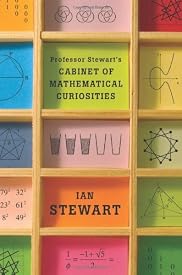
Professor Stewart's Cabinet of Mathematical Curiosities

Ian Stewart

Basic Books | 2009 | 320 páginas | 2,54 MB

link direto
link

Knowing that the most exciting math is not taught in school, Professor Ian Stewart has spent years filling his cabinet with intriguing mathematical games, puzzles, stories, and factoids intended for the adventurous mind. This book reveals the most exhilarating oddities from Professor Stewart’s legendary cabinet.
Inside, you will find hidden gems of logic, geometry, and probability—like how to extract a cherry from a cocktail glass (harder than you think), a pop-up dodecahedron, and the real reason why you can’t divide anything by zero. Scattered among these are keys to Fermat’s last theorem, the Poincaré conjecture, chaos theory, and the P=NP problem (you’ll win a million dollars if you solve it). You never know what enigmas you’ll find in the Stewart cabinet, but they’re sure to be clever, mind-expanding, and delightfully fun.

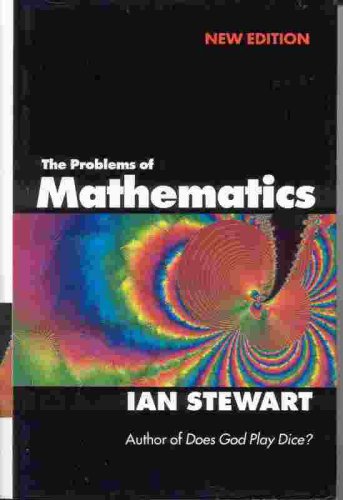
The Problems of Mathematics


2nd Edition
Ian Stewart

Oxford University Press, USA | 1992 | 368 páginas | DJVU | 4,65 MB

link

We are living in the Golden Age of mathematics, with more research being done than ever before. Yet many people view mathematics as a static, completed subject. This book for general readers aims to open the door to the rapid modern growth of mathematics and its power and beauty. It surveys many areas of current research in non-technical terms, describing what the problems are, where they come from, how they get solved, what mathematicians are like, what you can do with the answers when you get them, and how solving them or failing to solve them changes peoples' views of mathematics and the way it is advancing. Topics include Fermat's Last Theorem, the Riemann hypothesis, the Poincare Conjecture, prime numbers, non-Euclidean geometry, infinity, the four-color problem, probability, catastrophe theory, chaos, fractals, algorithms, and undecidable propositions. A final chapter discusses the relations between mathematics and its applications. Each topic is developed within a historical framework, and a number of recent breakthroughs are presented for the first time in layman's terms.

Use of Open-Ended Problems in Mathematics Classroom


Erkki Pehkonen (Ed.)

Research Report 176, Department of Teacher Education: University of Helsinki The University of Helsinki | 1997 | 134 páginas | pdf | 3,45 mb

on-line: eric

Referência em: MathEduc

During the years 1993-96, there has existed an active discussion group entitled "Using Open-Ended Problems in Mathematics" as a part of the scientific program of the Psychology of Mathematics Education (PME) conference. This report contains revised versions of presentations given in the discussion group. Since the PME is an international organization and the presenters were selected from different parts of the world, this book gives a worldwide view of the use of open-ended problems in the mathematics classroom. Most contributors hail from Australia, Japan, and the United Kingdom since in these countries, there is a long tradition of using open-ended problems. There were also presentations from other countries including Finland and Taiwan. Most of the papers concentrate on the realization of mathematics teaching with open-ended problems and give a variety of examples. There are also two critical papers that bring forth some uncomfortable and unasked questions regarding the use of open-ended problems. Papers include: (1) "Introduction To the Concept 'Open-Ended Problem'" (Erkki Pehkonen); (2) "Implementing Open Problem-Solving, Some Pitfalls of Curriculum Development through Assessment in the UK" (Paul Blanc); (3) "On the Open-Ended Nature in Mathematical Problem Posing" (Shuk-kwan S. Leung); (4) "Testing Problem Solving in a High-Stakes Environment" (Barry McCrae and Kaye Stacey); (5) "The Institutionalisation of Open-Ended Investigation: Some Lessons from the U.K. Experience" (Candia Morgan); (6) "Communication and Negotiation through Open-Approach Method" (Nobuhiko Nohda and Hideyo Emori); (7) "Use of Problem Fields as a Method for Educational Change" (Erkki Pehkonen); (8) "On the Use of What-If-Not Strategy for Posing Problem" (Hye Sook Seo); (9) "Learning Mathematics through Exploration of Open-Ended Tasks: Describing the Activity of Classroom Participants" (Peter Sullivan, Dianne Bourke, and Anne Scott); (10) "Teaching Children To Think Mathematically" (Howard Tanner and Sonia Jones); and (11) "Literature on Open-Ended Problems" (Erkki Pehkonen).